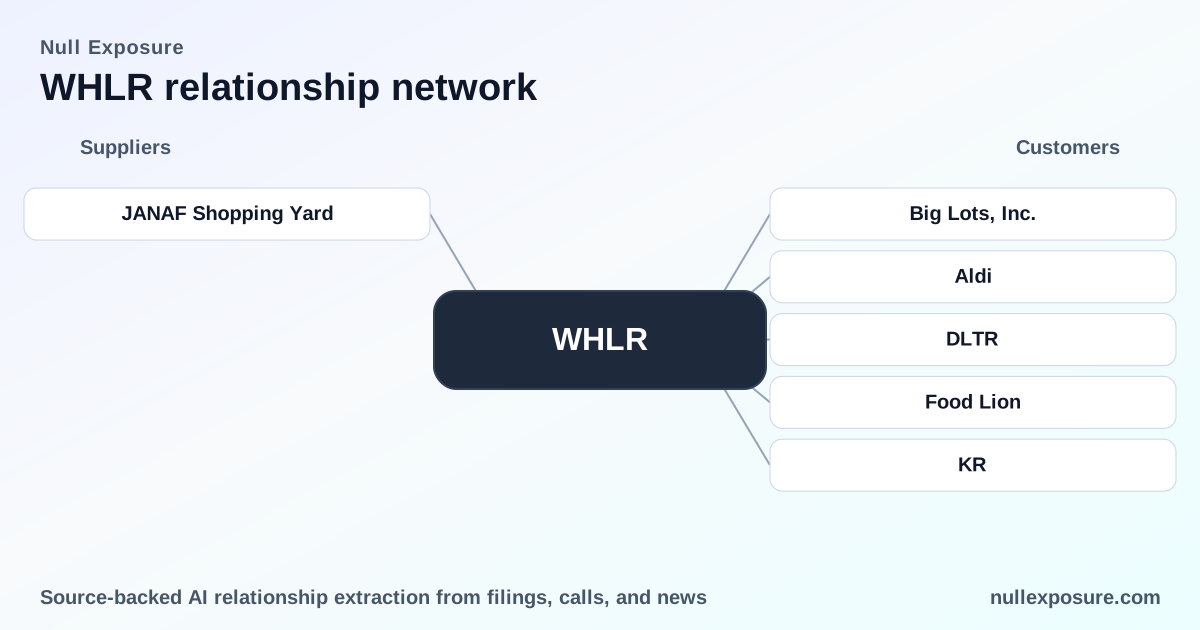
Wheeler REIT (WHLR) — supplier relationships, asset purchases, and what they mean for investors
Wheeler Real Estate Investment Trust (WHLR) acquires, manages and repositions retail and mixed-use properties and monetizes by collecting rental income, driving occupancy and executing selective asset sales that unlock capital appreciation. The company funds that strategy with a mix of equity and structured debt and extracts recurring cash flow from leases tied to neighborhood retail; its supplier footprint reflects operating needs (auditing, legal, property services) and capital-transaction activities (acquisitions and financings). For investors, the driver to watch is how asset-level income and recurring vendor spend intersect with WHLR’s longer-dated financing profile and capital allocation choices.
Explore more supplier intelligence at https://nullexposure.com/ to see how these relationships map to risk and opportunity.
How WHLR’s operating model shapes supplier relationships
Wheeler runs a value-oriented, asset-management REIT model: identify well-located retail assets, stabilize operations through leasing and property management, and realize gains through disciplined sales. That model produces two predictable supplier patterns:
- Recurring professional services (audit, legal, property management) that are critical to compliance and operations but clustered in mid-range spend bands rather than enterprise-scale retainer agreements.
- Long-dated capital obligations that push the company into stable debt servicing relationships with lenders and noteholders rather than short-term trade credit.
From the company-level constraints extracted, WHLR’s supplier posture is characterized by long-term financing commitments and moderate vendor spend concentration. The filings show a long-term convertible note structure carrying interest-only payments through December 2031, indicating multi-year debt commitments that are material to liquidity planning. Separately, audit fees reported to the company’s independent auditor sit inside a $100k–$1M annual spend band, signalling professional services are important but not outsized relative to total operating costs.
Known supplier and asset relationships you should factor in
JANAF Shopping Yard — an acquisitive asset that expands the portfolio
WHLR purchased the JANAF Shopping Yard in Norfolk for just over $85 million, a transaction that adds a cash-flowing retail asset to the portfolio and underscores the company’s strategy of buying well-located shopping centers. According to a local report, Virginia Beach–based Wheeler Real Estate Trust completed the acquisition in FY2018; the article noted the purchase price and the asset transfer into WHLR’s holdings (13NewsNow, FY2018: https://www.13newsnow.com/article/news/local/mycity/norfolk/local-company-buys-janaf-shopping-yard-for-856m/291-510777420).
Cherry Bekaert LLP — the external auditor and a recurring service provider
WHLR’s filings for the years ended December 31, 2024 and 2023 list fees paid to independent registered public accounting firm Cherry Bekaert LLP under audit fees, placing the auditor relationship inside a moderate annual spend band consistent with the company’s disclosed professional-services costs. The fee table in the 2024/2023 filings documents this engagement and provides a direct view into recurring compliance spend and vendor selection (WHLR filings, years ended Dec. 31, 2024 & 2023).
What the relationship set tells investors about risk and concentration
WHLR’s supplier footprint and the constraints in its public filings produce several actionable signals:
-
Contracting posture — medium-term, predictable: The presence of long-dated convertible notes (interest-only, 7.00%, maturing December 2031) shows the company is operating with a multi-year capital structure that locks in financing terms and shapes liquidity needs. This creates predictable interest-service obligations but also concentrates refinancing risk toward the early 2030s if market conditions deteriorate.
-
Spend concentration — professional services oriented and mid-sized: Audit fees and related vendor payments fall into the $100k–$1M band, indicating WHLR relies on repeatable, contract-style engagements rather than a fragmented, high-volume supplier base. That reduces operational procurement complexity but concentrates operational risk in fewer, higher-impact relationships.
-
Criticality and maturity — auditors and lenders are mission-critical: Audit and capitalization partners (auditors, noteholders, lenders) are critical to WHLR’s compliance and access to capital; these relationships have medium to high maturity, with formal engagements governed by regulatory and contractual frameworks rather than transactional invoices.
These signals combine into a simple profile: WHLR runs a capital-intensive REIT with stable operating supplier needs and concentrated financing relationships that dominate strategic risk.
Take a closer look at how supplier relationships affect asset-level returns at https://nullexposure.com/.
Operational and market risks that flow from supplier choices
-
Refinancing and interest-rate sensitivity. The long-term convertible notes schedule large interest obligations through 2031 and therefore place refinancing timing and market-rate exposure squarely on the investor risk checklist. If interest rates re-price or capital markets constrict, costs of capital will rise and could pressure distributions and asset-sale timing.
-
Service reliance with modest spend. Auditor fees and similar service-provider payments are not enormous on a per-vendor basis, yet those relationships are non-discretionary; a change in auditor or professional services terms would affect compliance costs and could temporarily constrain transaction cadence.
-
Asset concentration after acquisitions. Large, discrete acquisitions such as the JANAF Shopping Yard can materially change localized cash flow and tenant mix; underperformance at a single acquired center could have outsized impact relative to WHLR’s overall market cap.
How operators and investors should act on this profile
-
For operators: prioritize liquidity management and vendor continuity — maintaining stable audit and legal relationships while mapping out refinancing pathways for the convertible notes will reduce execution risk and preserve optionality on asset dispositions.
-
For investors: focus on capital structure and asset-level cash flow rather than marginal changes in professional-service fees. The convertible note schedule and the portfolio’s lease roll profile are the chief drivers of near-term valuation sensitivity.
If you want a structured view of WHLR’s supplier exposures against comparable REITs, start with a vendor-level analysis tool at https://nullexposure.com/ to benchmark cost and concentration metrics.
Bottom line
Wheeler REIT’s supplier network is small but strategically important: auditors and other professional-services providers underpin compliance and transactions, while long-term secured financing defines the firm’s liquidity runway. The JANAF Shopping Yard acquisition exemplifies WHLR’s asset-acquisition playbook and underscores how single-asset deals can meaningfully reshape cash flow. For investors, the most consequential inputs are capital structure timing and asset-level rent stability, not incremental vendor spend changes.
To map these supplier signals directly to portfolio risk and to monitor material relationship changes in real time, visit https://nullexposure.com/ for analyst-ready exposure profiles.