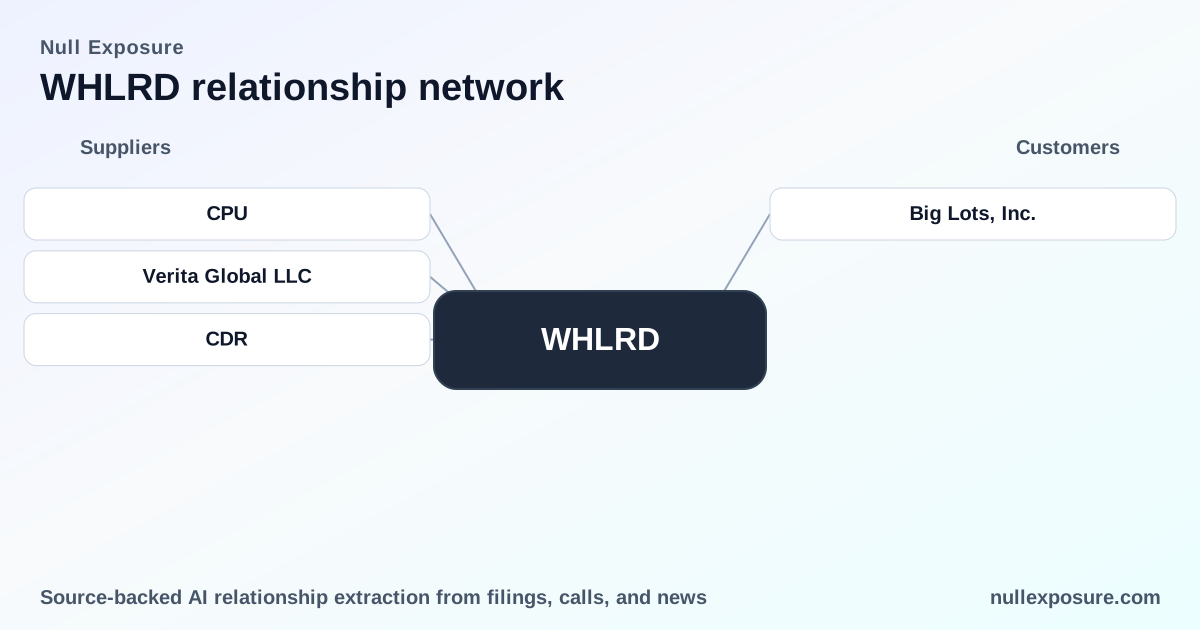
Wheeler REIT (WHLRD): supplier relationships that matter for investors and operators
Wheeler Real Estate Investment Trust Inc (ticker WHLRD) operates as a specialized REIT that acquires and manages income-producing retail and mixed-use properties across the United States and monetizes through rental income, active asset management and selective property transactions. As a publicly traded preferred stock, its cash flow profile is driven by leased rents and portfolio disposition activity; liquidity events, transfer-agent processing and claims administration are therefore operationally relevant to any investor assessing counterparty exposure. This review focuses on three supplier relationships surfaced in recent reporting and what they reveal about Wheeler’s operating posture, concentration risks and near-term remediation exposures.
Explore the full supplier map and analytical context at https://nullexposure.com/ to see where these counterparties sit in Wheeler’s broader ecosystem.
Why supplier relationships matter for a REIT like Wheeler
For retail-focused REITs, third-party service providers—transfer agents, claims administrators, and previous transaction counterparties—are operational levers that influence cash collection, shareholder mechanics and legal settlement execution. The suppliers listed in recent reporting are not large vendor rosters; they represent discrete operational nodes that intersect with corporate actions (reverse splits), investor payouts (settlement administration), and historical portfolio transactions (acquisitions and sellers). The makeup of these suppliers signals a low-volume but high-impact vendor structure: a small number of specialized providers that handle critical services.
- Contracting posture: Wheeler relies on standard industry third parties rather than bespoke internal platforms, indicating a preference for off-the-shelf operational partners.
- Concentration & criticality: The supplier footprint is concentrated; a failure or delay at one node (for example, the transfer agent) would have outsized investor impact.
- Maturity: Relationships are typical incumbent services—transfer agents and claims administrators—reflecting mature, outsourcer-driven operations rather than nascent vendor experimentation.
If you want an interactive supplier breakdown for investment due diligence, visit https://nullexposure.com/ and request detailed counterparty profiles.
The supplier list — plain-English summaries and sources
Computershare Trust Company (transfer agent)
Wheeler used Computershare as transfer agent to aggregate fractional shares generated by a reverse stock split and then sold those fractional shares into the market, a standard industry mechanism to resolve fractional entitlements after corporate reorganizations. According to an ADVFN notice on Wheeler’s reverse split, Computershare aggregated and sold the fractional shares (reported March 2026; fiscal period FY2025). Source: ADVFN report on Wheeler’s reverse split — https://br.advfn.com/bolsa-de-valores/nasdaq/WHLR/share-news/74237390/wheeler-real-estate-investment-trust-inc-announces-effectiveness-of-reverse-st
Verita Global LLC (claims/settlement agent)
Verita Global LLC is listed as the mailing address and handling agent for a $7.125 million Wheeler REIT settlement, indicating that Verita is administering investor payouts and claims processing for the settlement. A news report covering the settlement referenced Verita Global LLC as the contact point for distributions and claimant communications (reported March 2026; fiscal period FY2026). Source: USA Herald coverage of the Wheeler REIT settlement — https://usaherald.com/wheeler-reit-7-125m-settlement-clears-path-for-investor-payouts/
Cedar Realty Trust (historical transaction counterparty)
Wheeler completed a material acquisition from Cedar Realty Trust—an earlier transaction involved a $130 million cash purchase of 19 properties in 2022—illustrating Wheeler’s use of single-counterparty bulk acquisitions to scale its portfolio. Barchart’s reporting on Wheeler’s portfolio history references the 2022 Cedar Realty Trust sale and the $130 million purchase price (reported March 2026; fiscal period FY2025). Source: Barchart feature on Wheeler’s portfolio and transaction history — https://www.barchart.com/story/news/34254146/bottom-100-stocks-wheeler-real-estate-leads-the-list-yet-the-reit-stands-out-as-an-interesting-play
What these relationships tell investors about operational risk
These three suppliers reveal a compact, high-impact vendor profile:
- Critical operational nodes are outsourced. Transfer-agent functions and settlement administration are handled by established third parties rather than in-house processes; this reduces operational overhead but raises vendor-dependency risk.
- Concentration risk is tangible. A small set of providers perform critical tasks—if Computershare or Verita experiences delays or processing errors, investor payouts and shareholder recordkeeping are directly affected.
- Legal and remediation exposure is active. The presence of a regulated settlement and a named claims administrator indicates Wheeler has recently executed a remediation pathway that required third-party administration, which is relevant for cash-flow timing and legal accruals.
These are not hypothetical concerns: the reverse split processing (Computershare) and the claims administration (Verita) are real, recent touchpoints that impact shareholder mechanics and cash distribution timing.
Practical implications for portfolio managers and operators
For investors underwriting WHLRD or counterparty concentration for operational risk models:
- Monitor cash flow timing around the Verita-administered settlement and any subsequent claims deadlines, as distributions will directly affect short-term liquidity and investor returns.
- Confirm transfer-agent reconciliation and timing for reverse-split proceeds to avoid unexpected float or market microstructure impacts that could affect short-term price behavior.
- Consider the historical acquisition from Cedar Realty Trust when stress-testing portfolio composition and valuation—bulk acquisitions can amplify asset concentration and integration risk.
If you need granular supplier exposure and contract-level signals for WHLRD, start an inquiry at https://nullexposure.com/ and get the counterparty detail that matters for risk-adjusted valuation.
Closing assessment — buy-side takeaways
Wheeler’s supplier footprint is compact and operationally critical: transfer-agent activity and settlement administration are near-term drivers of shareholder outcomes, while past portfolio transactions with counterparties like Cedar Realty Trust shaped the current asset base. There are no additional supplier constraints listed in the available supplier records, which is itself a company-level signal: no flagged contractual constraints surfaced in this supplier extraction, implying either standard commercial vendor terms or limits in public reporting of vendor contracts.
For investors and operators, the immediate priorities are monitoring settlement execution and transfer-agent reconciliations, and accounting for the concentration risk inherent to a lean supplier model. For a deeper counterparty assessment and to map these relationships into a broader exposure framework, visit https://nullexposure.com/ to request the detailed supplier dossier and scenario-based impact analysis.