WHLRP (Wheeler REIT Pref): Supplier relationships and operational posture investors should price
Wheeler Real Estate Investment Trust’s preferred security (WHLRP) is an income-oriented claim on a small, retail-focused REIT that monetizes through leased retail and community shopping centers, landlord services, and tenant reimbursements. Revenue is driven by rental cash flow and ancillary property-level recoveries; operating expenditures are reduced through subcontracting of on-site maintenance and services, with those costs often passed to tenants. Preferred holders currently have no declared dividend, underscoring that WHLRP value is tied to corporate cash allocation and balance-sheet health rather than a steady payout. For a contextual view of counterparties and supplier posture, review the supplier intelligence at https://nullexposure.com/.
One-line investor thesis: what to price into WHLRP
Wheeler REIT runs a conventional retail-REIT operating model: acquire and manage shopping centers, extract rent and tenant reimbursements, and limit in-house operating staff by outsourcing routine property services. The credit profile for holders of WHLRP depends on the REIT’s ability to sustain property cash flow, control outsourced service costs, and manage legal and administrative contingencies.
Visit https://nullexposure.com/ for a deeper supplier relationship breakdown and monitoring tools.
What supplier relationships are visible on public records
The dataset returned a single supplier-related relationship of consequence:
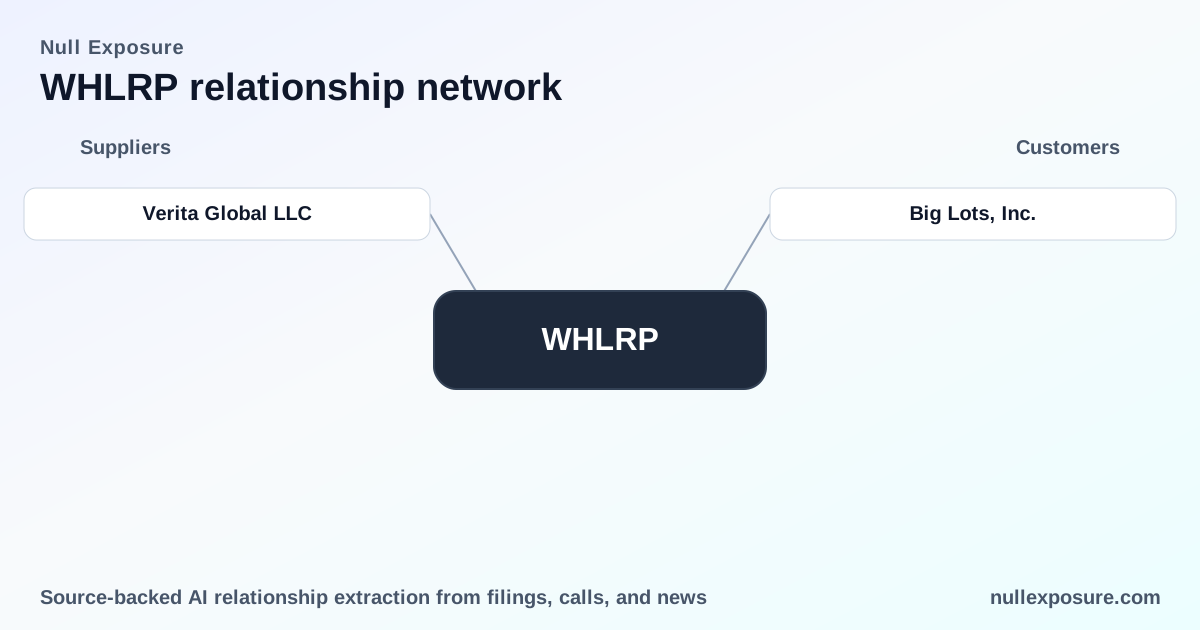
- Verita Global LLC — Named as the settlement administrator for a Wheeler REIT settlement; contact and mailing information are listed on the public claims portal. According to the claims administrator page for the Wheeler REIT settlement (posted March 10, 2026), Verita Global is handling notice and claims administration for the matter: https://www.claimdepot.com/settlements/wheeler-reit-settlement.
How to read this relationship
The Verita Global entry is a third-party administrative engagement tied to a legal/settlement process rather than an ongoing facilities or property-services vendor relationship. As a settlement administrator, Verita Global provides discrete services (notice, claim intake, distribution) that are transactional and non-operational in the sense of day-to-day property management; the cost and duration are finite and typically immaterial to recurring property cash flow. Source: ClaimDepot settlement page (first seen 2026-03-10).
Operational constraints and what they reveal about vendor posture
Company-level disclosures note that on-site functions — maintenance, landscaping, sweeping, plumbing and electrical — are subcontracted at each location, and, where leases permit, the costs of these functions are passed on to tenants. That statement is a direct indicator of Wheeler REIT’s operating model and vendor posture:
- Contracting posture: outsourced and decentralized. The REIT relies on local subcontractors for routine services rather than centralized, captive operations.
- Concentration: subcontracting implies diffuse vendor exposure across properties rather than single-vendor concentration, which reduces single-counterparty risk but increases oversight and procurement complexity.
- Criticality: these services are operationally critical to property performance and tenant retention, yet each contract is functionally replaceable at the property level, lowering systemic counterparty risk.
- Maturity: the arrangement is consistent with mature retail-REIT practices—standardized outsourcing with cost pass-through to tenants where contracts allow.
These constraints are company-level signals tied to the REIT’s standard operating model rather than to any specific supplier named in a relationship excerpt.
Financial context that shapes supplier risk
Latest reported quarter (2025-12-31) shows revenue ~$99.4M and EBITDA ~$52.2M, indicating the REIT produces operating cash that supports property services and occasional one-off legal costs. Market capitalization for WHLRP is small (reported at approximately $6.97M), and preferred dividend metrics show no current declared dividend, with the last recorded dividend activity in 2018. These facts matter: a small market cap and nil current dividend emphasize sensitivity to capital allocation and the potential for supplier payments or settlement costs to be absorbed from operating cash or financing actions. Source: company filings / public profile and latest quarter data (2025-12-31).
Practical implications for investors and operators
Understand three investment and operational vectors when assessing WHLRP exposure:
- Cash-flow prioritization: outsourced operating costs are routinely passed to tenants—this reduces landlord-funded operating outlays but creates exposure to lease enforceability and tenant solvency.
- Event-driven legal costs: the presence of a settlement administrator (Verita Global) signals legal or regulatory events that are administratively managed; these engagements are typically limited in duration and budget, but require monitoring for materiality.
- Vendor oversight and operational risk: decentralized subcontracting reduces concentration risk but requires active vendor management to maintain service levels and control cost drift.
Key takeaways:
- Verita Global relationship is narrowly scoped to settlement administration and not an ongoing operational dependency (ClaimDepot, March 10, 2026).
- On-site functions are subcontracted and cost-shifted to tenants per company disclosures, which reduces recurring landlord cash outlays but increases exposure to lease structure and tenant credit.
- WHLRP lacks a current declared dividend, which repositions the preferred class as more dependent on corporate cash allocation than on scheduled payouts.
For a more complete supplier-impact assessment and follow-up on counterparty status, consult the supplier intelligence hub at https://nullexposure.com/.
Actions for investors evaluating WHLRP
- Verify the materiality of the Wheeler REIT settlement costs and whether those amounts are one-off or indicate broader litigation exposure; the administrator listing on ClaimDepot is the starting point.
- Review lease schedules to confirm pass-through mechanics for maintenance and service costs at the property level; this determines how much operating expense risk the landlord actually carries.
- Monitor liquidity and capital-allocation updates from Wheeler (operating cash, asset sales, or recapitalization) because preferred claims are subordinated to senior obligations for liquidity decisions.
Closing thought and final resource Supplier relationships for Wheeler REIT are not concentrated around a single operational vendor; instead, the REIT’s model is to outsource routine service lines and use specialized third parties for event-driven administration. That structure reduces single-vendor risk but raises governance and lease-enforceability questions investors must price. For ongoing tracking of counterparties and supplier-level materiality across REITs, visit https://nullexposure.com/ for detailed supplier relationship monitoring and alerts.