Whitehawk Therapeutics (WHWK): Supplier map and what it means for investors
Whitehawk Therapeutics develops next‑generation antibody‑drug conjugates (ADCs) and monetizes through in‑licensing clinical assets, advancing them into clinical proof‑points, and retaining commercialization rights where possible. The company runs a deliberately outsourced operating model—licensed IP plus third‑party manufacturing and clinical support—and captures value by progressing assets toward clinic‑enabling milestones that increase asset value for equity investors or commercial partners.
Explore a consolidated supplier view and risk checklist at https://nullexposure.com/ — the supplier relationships outlined here are the operational levers that will drive Whitehawk’s value realization.
The core operating model — focused, outsourced, milestone‑driven
Whitehawk is an early commercial‑stage biotech whose economic model is development‑value capture rather than recurring product sales today. Financials show modest revenue (TTM revenue roughly $7.1M) alongside negative operating and net margins, which is consistent with a company funding development through capital markets and partnerships rather than product cash flow. The company’s playbook is:
- Acquire or license promising ADC assets (costs include upfront payments and milestone obligations).
- Outsource R&D, manufacturing and clinical operations to specialists to preserve capital and accelerate timelines.
- Use data and analytics partnerships to refine trial design and target selection, reducing clinical execution risk.
This posture produces high leverage to clinical readouts: success drives substantial upside, while program delays or supplier disruptions translate quickly to cash burn and valuation pressure.
Visit the Whitehawk supplier hub for structured diligence resources: https://nullexposure.com/.
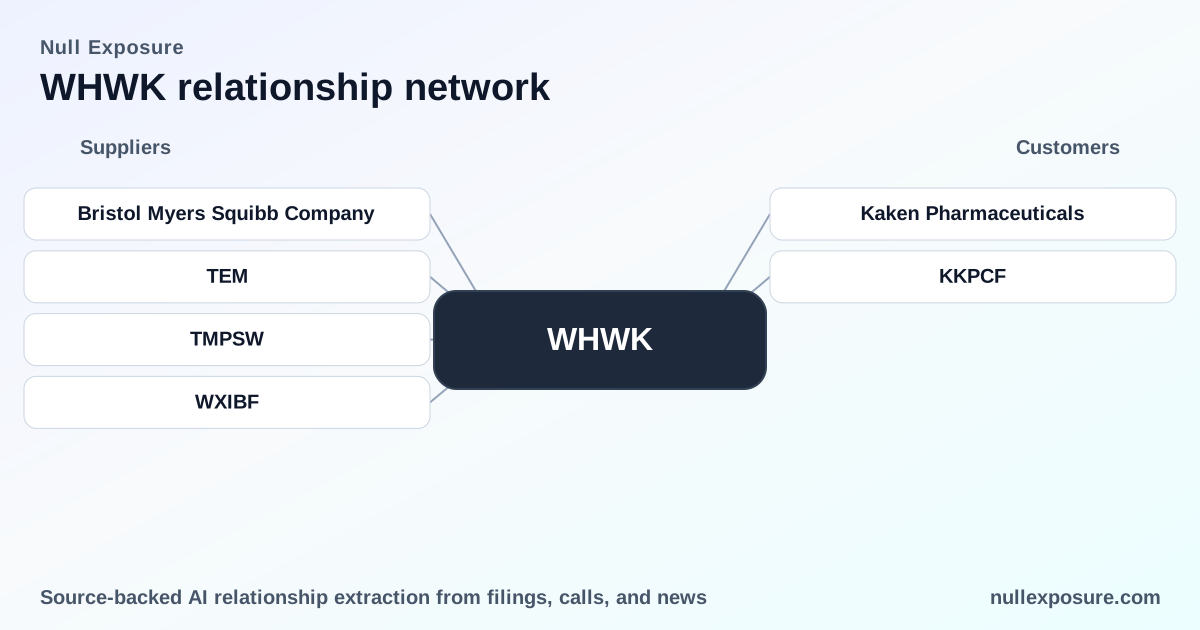
Counterparty snapshot: the three supplier relationships you must monitor
Bristol Myers Squibb — longstanding IP/licensing relationship
Whitehawk holds rights under a license with Bristol Myers Squibb that provides exclusive patent rights and licensed product supply for FYARRO‑related technology, with BMS committed to supplying licensed FYARRO product for clinical development. This relationship is documented in Whitehawk’s FY2024 10‑K license disclosures (BMS License Agreement, April 9, 2014). (Source: FY2024 10‑K filing.)
Tempus AI — clinical data and analytics collaboration to improve trial design
Whitehawk signed a multi‑year collaboration with Tempus to apply de‑identified, multimodal clinical data and AI analytics to inform trial design and characterize target expression (PTK7), intended to sharpen patient selection and accelerate ADC development. Market coverage of the partnership appeared in multiple reports in March 2026, noting the collaboration’s role in supporting Whitehawk’s clinical programs. (Source: press and market reports, March 2026 — e.g., AsianetNews/Benzinga/FinancialContent.)
WuXi Biologics — in‑licensor, development partner and outsourced manufacturer
Whitehawk in‑licensed three ADC assets from WuXi Biologics under an exclusive development and global commercialization agreement, including a non‑refundable partial upfront payment and a scheduled $38 million payment expected in April 2025 for ADC in‑licensing; Whitehawk also relies on WuXi (and named contract parties in China) for antibody design and manufacturing input. WuXi’s role is both IP licensor and critical manufacturer/service provider, cited repeatedly in company releases and the FY2024 10‑K. (Sources: FY2024 10‑K; multiple Whitehawk press releases and investor materials, 2025–2026.)
What the supplier relationships reveal about operating constraints and risk
Whitehawk’s public filings and disclosures make several structural features explicit:
- Outsourced, cancellable contracting posture. Management states a deliberate outsourced model for R&D and manufacturing, and many vendor agreements for clinical trials and contract manufacturing are cancellable with notice, which reduces fixed cost but increases operational fragility if partners reallocate capacity. This is a company‑level characteristic drawn from the FY2024 filing.
- Concentration in APAC manufacturing. Whitehawk discloses material reliance on WuXi Biologics and Hangzhou DAC—both located in China—creating geographic concentration risk tied to regional political, regulatory, and supply‑chain conditions. The FY2024 10‑K explicitly ties these providers to potential country‑level exposures.
- Mixed‑role counterparties increase single‑point criticality. WuXi is both an in‑licensor and a manufacturer/designer for key ADC components; that dual role concentrates legal, technical and delivery risk in a single external organization, boosting systemic exposure if the partner underperforms.
- Licensing is a core value lever but generates fixed cash obligations. The company has paid upfront license fees (e.g., $6.0M to WuXi on December 20, 2024) and expects scheduled payments (the $38M noted in filings), which creates near‑term cash commitments tied to supplier agreements rather than optional vendor services.
Together these constraints paint a company that is capital‑efficient on paper but operationally dependent: outsourced partners reduce fixed overhead but concentrate execution risk around a small set of external suppliers.
Learn how this supplier posture compares across peers at https://nullexposure.com/.
How investors should treat these suppliers in the model
- Value catalysts are clinical and data milestones. The Tempus collaboration is a de‑risking move that improves trial design and target validation, shortening timelines to pivotal readouts that materially revalue the stock.
- Liquidity and covenant planning are essential. With non‑recurring revenues and material license payments, investors need line‑item clarity on cash runway and contingent payments tied to supplier contracts.
- Geopolitical and manufacturing continuity risks are not theoretical. Given the APAC concentration and dual‑role counterparties, include scenario analysis for supply interruption and alternative contract remedies when modeling downside.
Bottom line and recommended next steps
Whitehawk’s model is clear and investable for risk‑tolerant, catalyst‑driven investors: it leverages licensed IP and external capabilities to concentrate returns around clinical progress. However, the company’s operational reliance on a small set of suppliers, material license payment obligations, and regional manufacturing exposure are real constraints that require active monitoring.
Actionable next steps:
- Review the FY2024 10‑K schedule of license payments and vendor contract terms to quantify near‑term cash exposure.
- Track progress and deliverables tied to the Tempus collaboration for evidence of improved patient selection signals.
- Monitor WuXi delivery milestones and any regulatory developments affecting APAC manufacturing.
For a structured supplier diligence checklist and comparison to peers, visit https://nullexposure.com/.
Final takeaway: Whitehawk’s upside sits squarely on clinical execution and supplier reliability; those two vectors—data partnerships and mandated license/manufacturing payments—will determine whether the company is a high‑reward development story or a cash‑constrained biotech with concentrated counterparty risk.