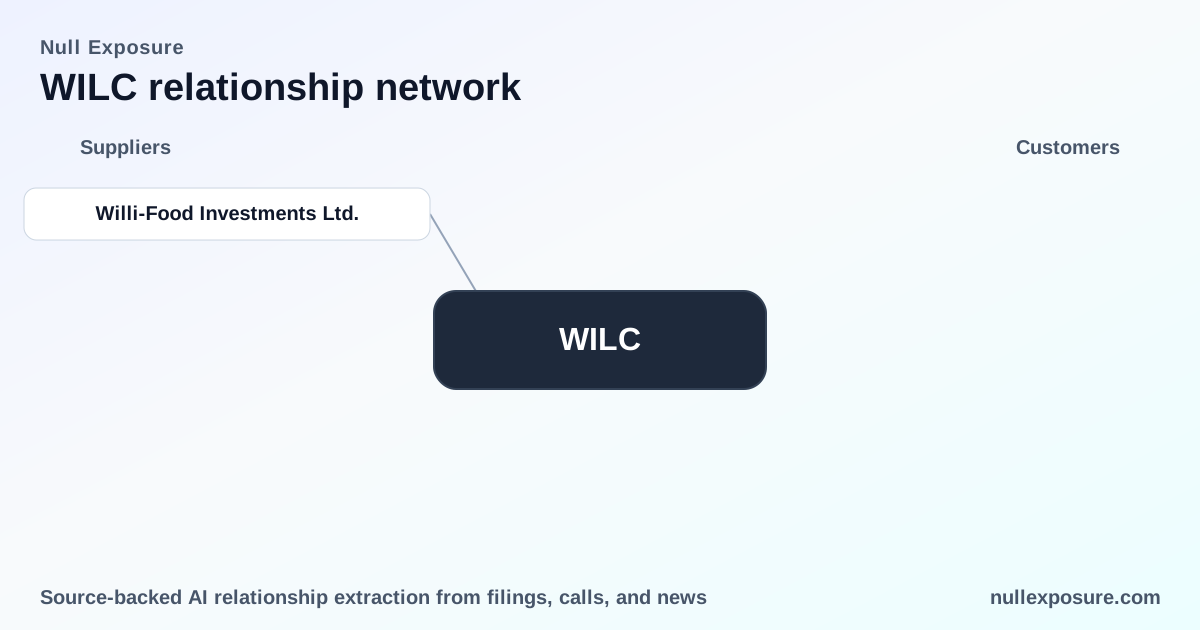
G. Willi‑Food (WILC): related‑party services extension sharpens governance and operational visibility
G. Willi‑Food International Ltd. operates as a global food distributor and marketer, monetizing through wholesale distribution margins, branded product sales and service arrangements that support its import/export operations. Revenue is driven by scale in distribution and a concentrated ownership structure that funnels certain operational services through a controlling shareholder, making contract renewals with that shareholder a material governance and execution event for investors. For an immediate operational intelligence briefing, see https://nullexposure.com/.
Why the March 2026 notices matter for investors
Three independent press reports recorded the same corporate action: a three‑year extension of a services agreement with controlling shareholder Willi‑Food Investments Ltd., effective January 1, 2026. That renewal is not a routine administrative note — it is a discrete governance decision that affects procurement of services, director composition and related‑party oversight. Given the company’s reported 61.3% insider ownership and $598m in trailing twelve‑month revenue, the contracting posture and concentration of control amplify the significance of any multi‑year services pact.
- Contracting posture: related‑party services are formally renewed for three years, implying continuity of operating arrangements and a predictable cost base tied to the shareholder entity.
- Concentration: controlling shareholder influence is high (insider ownership 61.325%), which raises questions about negotiation leverage and minority protections.
- Criticality: service arrangements with an owner are operationally material, given the company’s distribution model and scope of global logistics.
- Maturity: the agreement’s three‑year horizon provides medium‑term visibility but also locks in governance terms that investors should monitor at renewal.
Explore additional supplier and governance signals at https://nullexposure.com/ for deeper context.
The complete relationship set reported (every item)
Willi‑Food Investments Ltd. — a three‑year extension of the services agreement from January 1, 2026, was announced in a company filing; the move was put to shareholders via a special meeting scheduled for March 24, 2026. According to a Globe and Mail press release published March 10, 2026, the extension and executive‑role/service pact were subject to shareholder vote (source: https://www.theglobeandmail.com/investing/markets/stocks/WILC-Q/pressreleases/313458/g-willi-food-sets-march-24-2026-special-meeting-to-vote-on-executive-role-services-pact-and-new-external-director/).
Willi‑Food Investments Ltd. — the same three‑year extension of the services agreement is described in a separate Globe and Mail distribution of the company notice, reiterating the effective date of January 1, 2026 and the governance mechanics around the special meeting on March 24, 2026 (source: https://www.theglobeandmail.com/investing/markets/stocks/WILC-Q/pressreleases/283528/g-willi-food-sets-march-24-2026-special-meeting-on-governance-and-service-pact-changes/).
Willi‑Food Investments Ltd. — coverage syndicated through TipRanks also reported the three‑year services agreement extension and the planned shareholder vote in March 2026, underscoring market distribution of the same corporate disclosure (source: https://www.theglobeandmail.com/investing/markets/markets-news/Tipranks/313458/g-willi-food-sets-march-24-2026-special-meeting-to-vote-on-executive-role-services-pact-and-new-external-director/).
Each of the three records references the identical contractual extension and the governance process; together they constitute the complete set of supplier‑relationship signals surfaced in the reporting window.
How this fits the company’s operating and business model
G. Willi‑Food’s core economics are distribution scale and recurring margin capture on branded and sourced goods (RevenueTTM $598m; GrossProfitTTM $170.5m). The company’s ownership concentration and repeated use of services provided by a controlling shareholder align incentives for operational continuity but introduce governance and minority‑interest considerations that investors must price.
- Operationally, the company relies on external services that are now confirmed for three years, creating medium‑term predictability in service delivery and expense recognition.
- Strategically, the extension reduces short‑term renegotiation risk but increases the importance of monitoring related‑party disclosures and the special‑meeting vote outcomes.
- Governance maturity: the public call for a special meeting to ratify the pact and appoint an external director is a governance signal — it indicates the firm is pursuing some formal oversight steps while maintaining control through the shareholder services relationship.
There are no explicit constraint excerpts in the provided relationship data; the above observations are company‑level signals drawn from ownership, revenue scale and the nature of the disclosed agreement.
Risk and strategic implications investors should price
Related‑party contracting raises governance and minority‑shareholder risk even as it provides operational continuity. For investors, the implications are twofold:
- Upside from stability: the three‑year term supports predictable operating costs and execution continuity for distribution networks, supporting the company’s positive profit margins (15.8%) and EBITDA generation.
- Downside from concentration: the controlling shareholder structure and insider ownership (61.3%) concentrate negotiating power; investors should require transparent fee schedules, arm’s‑length pricing disclosure, and independent director oversight to mitigate extraction risk.
Operational metrics — forward PE of 7.72, EV/EBITDA of 9.71, and a market cap around $364m — suggest the market prices both profitability and the governance premium/discount that will accompany any perceived related‑party advantage. Track the March 24, 2026 shareholder actions for immediate market signals.
For more supplier and governance intelligence on WILC and peer suppliers, refer to https://nullexposure.com/.
What to watch next and investor action points
- Monitor the March 24, 2026 special meeting results for ratification of the services pact and any external director appointment; voting outcomes will clarify minority protections and oversight changes.
- Seek the full text of the extended services agreement in SEC or local filings to confirm pricing, scope, termination clauses and performance KPIs.
- Watch for subsequent quarterly disclosures quantifying amounts paid to Willi‑Food Investments Ltd. and whether any new indemnities or fee escalators are introduced.
If governance transparency is a priority, require explicit contractual disclosure before increasing exposure. For a tailored supplier‑risk briefing and historical relationship tracking for WILC, visit https://nullexposure.com/ — we consolidate press, filings and governance actions into investor‑grade intelligence.
Closing thought: the three‑year services renewal is a measured operational outcome that enhances predictability but simultaneously concentrates governance importance in the hands of the controlling shareholder; investors should treat the contract extension as both a stability signal and a governance field test.