Winmark (WINA): Credit Relationships Signal Conservative Leverage and Operational Optionality
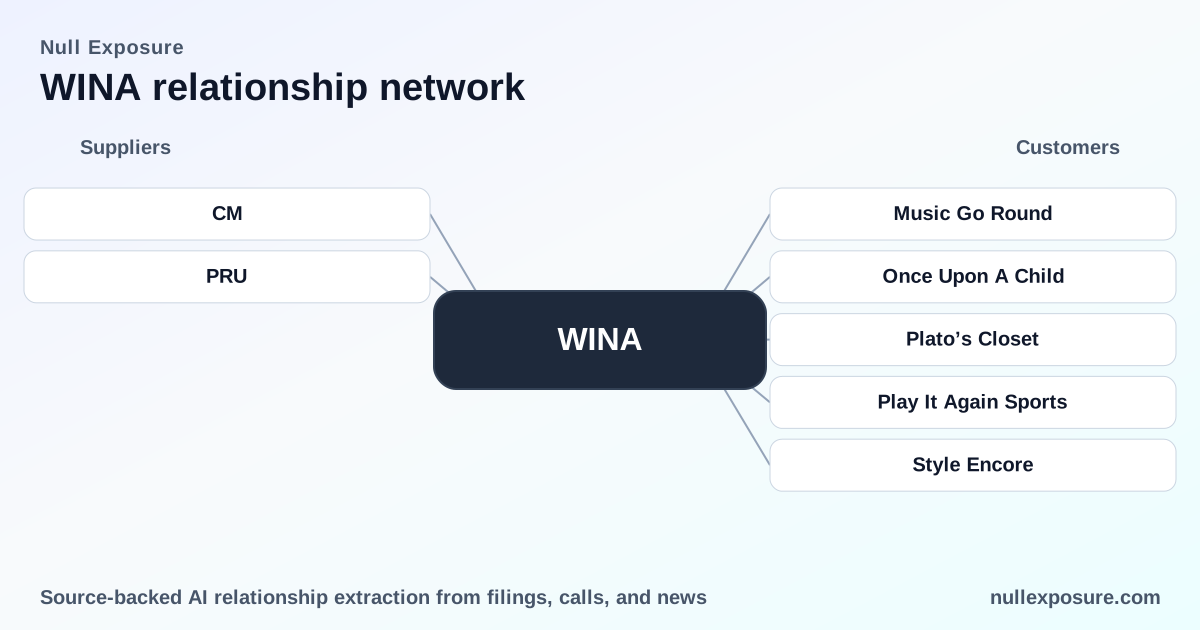
Winmark Corporation operates as a franchisor of five specialty retail concepts that buy, sell, trade and consign used merchandise across the U.S. and Canada. The company monetizes through franchise fees, royalties and support services to franchisees, while corporate liquidity is supplemented by secured lending arrangements; these credit relationships fund working capital and occasional corporate initiatives without ceding operating control to strategic partners. Investors should view Winmark’s lender relationships as financing instruments rather than strategic supplier ties—supporting growth and payout capacity while preserving franchise economics. For an integrated view of supplier and counterparty exposure, visit https://nullexposure.com/.
Why the financing relationships matter to investors
Winmark’s business model is capital-light at the store level because franchisees underwrite most store CAPEX and operating cost. That structure concentrates corporate risk into three places: franchise system health, corporate liquidity, and the firm’s ability to support franchisees through inflection periods. The two disclosed credit relationships provide direct color on liquidity and funding cost: one revolving/delayed-draw facility and one fixed-rate note. Together they illuminate the firm’s contracting posture (straightforward bilateral financing), concentration (few formal credit counterparties), and maturity profile (short- to medium-term corporate debt rather than long-term strategic joint ventures).
Key company context: Winmark reported TTM revenue of roughly $86 million and a market capitalization of about $1.59 billion, with a high reported profit margin (48.4%) and an established dividend policy, underlining why management conservatively uses credit to bridge timing or strategic needs rather than fund growth capex.
The disclosed relationships — what the filings say
Below are every relationship found in the supplied results, each summarized in plain English with source context.
-
CIBC Bank USA: Winmark maintains a Line of Credit providing up to $20 million in revolving loans and $30 million in delayed-draw term loans, with $30 million currently drawn as of FY2026. This facility supplies short-term liquidity and optional delayed funding capacity that management can tap without issuing equity. (TradingView summary of the company’s SEC 10‑K, March 2026: https://www.tradingview.com/news/tradingview:c601b6742e032:0-winmark-corp-sec-10-k-report/)
-
PGIM, Inc.: Winmark has a $30 million Note Agreement with PGIM that carries a fixed interest rate of 3.18% per annum, providing a medium-term fixed-cost financing option that complements revolver liquidity. This note locks in low-cost debt and reduces interest-rate variability on a material portion of corporate borrowings. (TradingView summary of the company’s SEC 10‑K, March 2026: https://www.tradingview.com/news/tradingview:c601b6742e032:0-winmark-corp-sec-10-k-report/)
How these relationships translate into portfolio signals
- Concentration: Winmark works with a small number of lenders for its corporate debt needs; that concentration is normal for mid-cap franchisors and simplifies covenant negotiation and administrative overhead.
- Contracting posture: The arrangements are classic corporate credit facilities—revolver + delayed-draw term loans and a separately negotiated note—indicating a transactional, arm’s-length contracting posture rather than strategic partnership structures.
- Criticality: These are finance contracts underpinning corporate liquidity; they are critical to funding corporate working capital and smoothing cash flow, but they do not appear to change franchise economics or operational control.
- Maturity and cost profile: The PGIM note at 3.18% represents a relatively low fixed cost in the current rate environment, while the CIBC facility provides flexible, short-term liquidity that can be drawn or repaid as needed.
If you want a consolidated risk matrix for counterparties and suppliers tied to this profile, see how we map relationship criticality and concentration at https://nullexposure.com/.
Financial and strategic implications for investors
- Liquidity buffer: With $30 million drawn on the CIBC facility plus the $30 million PGIM note, disclosed corporate borrowings total approximately $60 million based on FY2026 filings—an amount management uses to offset timing and corporate-level cash needs rather than fund franchise rollouts.
- Interest-rate management: Locking a material note at 3.18% reduces earnings volatility from short-term rate swings and supports stable free cash flow for dividends.
- Low operational dilution: The financing structure preserves Winmark’s capital-light franchise model and avoids equity dilution or strategic capital partnerships that could compress long-term returns.
Risk factors tied to these counterparties
- Single-counterparty concentration risk: A small set of lenders concentrates counterparty risk; a material shift in lender posture could increase funding costs or restrict access to revolving liquidity.
- Leverage timing: Although current leverage is moderate relative to revenue, any unexpected franchise performance deterioration would put pressure on covenant compliance or require additional financing options.
- Refinancing risk: The maturities and renewal terms for these facilities will determine refinancing exposure; the PGIM note’s fixed rate is a strength, but the revolver’s renewal timetable is an operational hinge point.
Quick takeaways for portfolio managers
- Winmark uses credit conservatively—debt facilities support liquidity and payout rather than aggressive expansion.
- Funding is concentrated but conventional, with a low-cost fixed-rate tranche mitigating rate risk.
- Operational control remains with Winmark and its franchisees, so these are financing relationships, not strategic supply dependencies.
For a deeper counterparty map and to monitor changes in Winmark’s supplier and lender relationships, visit https://nullexposure.com/.
Conclusion and investor action
Winmark’s disclosed lender relationships show disciplined use of credit: flexible short-term capacity through CIBC and a low-cost fixed note with PGIM that reduces interest-rate exposure. These arrangements support the firm’s capital returns and franchise-centric business model without introducing strategic vendor entanglements. Investors focused on dividend stability and low operational leverage should treat these credit links as positive liquidity management rather than sources of strategic risk.
For ongoing tracking of Winmark and comparable franchisors, sign up and explore our relationship intelligence at https://nullexposure.com/.