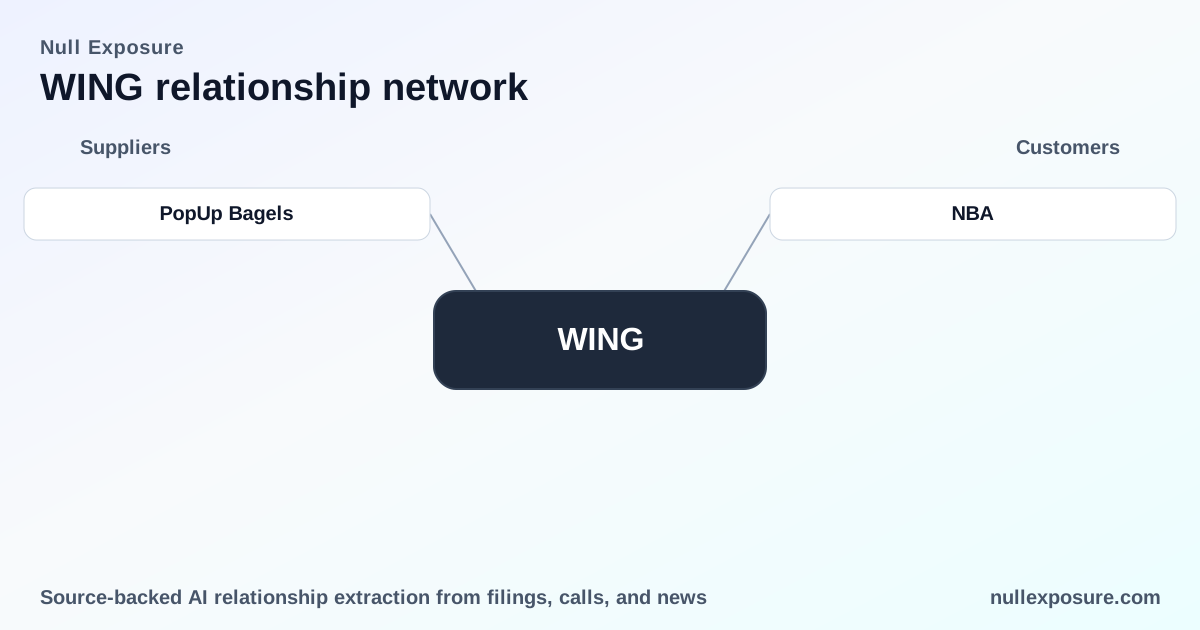
Wingstop (WING): Supplier structure, concentration risks, and where value flows
Wingstop is a franchisor and operator of fast-casual chicken restaurants that monetizes through a mix of franchise royalties and fees, company-owned restaurant sales, and vendor rebate programs tied to purchase volume. The business combines high unit-level margins with a capital-light growth vector via franchising; however, the supplier side of the model introduces concentrated operational dependencies that directly affect cost of goods sold and margin durability. For a focused supplier-risk read on Wingstop—its contracting posture, distributor concentration, and recent co‑brand activity—review the analysis below. If you want a consolidated supplier-risk scorecard and live references, visit https://nullexposure.com/.
How Wingstop gets paid and why supplier relationships move the P&L
Wingstop’s core revenue streams are franchise royalties and cash sales from company stores, with systemwide sales driving both top-line growth and the vendor rebate mechanics disclosed in filings. Public metrics show Wingstop generates roughly $697 million in trailing revenue with a 25% reported profit margin and operating margin near 27%, underscoring that low-cost goods and supply reliability materially influence profitability. Analysts price in growth — consensus target around $325 per share — which assumes continued system expansion and stable input costs.
From an investor lens, supplier arrangements are not peripheral: they affect unit economics at franchised locations, the attractiveness of new unit economics to franchisees, and timing/permanence of promotional products that drive incremental traffic.
The company-level supplier posture you need to know
Wingstop’s public disclosures establish a clear contracting and distribution posture that shapes operational risk:
- Buyer posture with structured vendor programs. Wingstop reports vendor rebate programs based on dollar volume for both company-owned and franchised restaurants, creating a direct link between purchasing volumes and margin enhancements.
- High distribution concentration in the U.S. market. The company states that “All food items and packaging goods for Wingstop restaurants in the U.S. are currently supplied through one distributor.” This single-distributor setup reduces logistical complexity but increases single-counterparty risk.
- Direct manufacturer contracting feeding the distributor. Wingstop contracts directly with manufacturers who sell to the distributor, which in turn earns a delivery fee—an arrangement that centralizes procurement but bifurcates price negotiation (manufacturer ↔ Wingstop and distributor ↔ restaurants).
- Active, operational supplier relationships. Filings classify these arrangements as operationally active rather than exploratory.
These are company-level signals drawn from the firm’s reporting and should be treated as structural features of Wingstop’s operating model rather than one-off vendor anecdotes. The combination of rebate dependence and single-distributor reliance is a strategic simplification that creates concentrated counterparty exposure; it also provides scale leverage on pricing for high-volume SKUs.
For a tactical supplier-impact analysis tied to investment decisions, see more on the platform: https://nullexposure.com/.
A recent partnership to watch: PopUp Bagels
Wingstop executed a consumer-facing collaboration with PopUp Bagels on a limited product called a “Lemon Pepper Schmear,” extending Wingstop’s flavor branding into co‑branded grocery or adjacent food products to broaden reach and trial. A StocksToTrade news post (Feb 17, 2026) reported that this initiative expands Wingstop’s flavor influence beyond its restaurants and supports cross-channel marketing. (Source: StocksToTrade news, 2026-02-17 — https://stockstotrade.com/news/wingstop-inc-wing-news-2026_02_17/)
This relationship is an example of Wingstop leveraging branded flavor IP to generate incremental engagement; the collaboration is promotional and brand-extension oriented rather than a core supply contract.
What the supplier structure implies for investors and operators
- Concentration risk is real and measurable. One U.S. distributor supplying all food and packaging creates outsized operational dependency; any disruption at that counterparty would transmit quickly to store operations and franchise economics.
- Pricing leverage exists, but rebates are a double-edged sword. Vendor rebates improve margins as volumes grow, aligning incentives across the system, but they also mean realized COGS are partly a function of future volume — a leverage point that benefits growth but complicates short‑term margin forecasting.
- Manufacturer relationships are upstream controls. By contracting directly with manufacturers, Wingstop centralizes specification and quality control while outsourcing distribution execution; this supports consistency but leaves delivery risk concentrated.
- Promotional co‑brands are marketing, not substitution. The PopUp Bagels collaboration demonstrates brand extension strategies that drive trial and marketing lift without materially changing procurement concentration.
Key valuation context: Wingstop trades at a trailing P/E of about 32x with forward P/E above 42x, indicating investor expectation for continued margin expansion or growth. The firm's beta near 1.86 signals elevated sensitivity to market cycles, which amplifies supplier-driven margin volatility for investors.
Practical next steps for investors and operators
- For investors: stress-test unit economics under scenarios where the single U.S. distributor faces a service interruption or pricing pressure; quantify the impact of lost vendor rebates if volumes decelerate. Use the company’s fiscal disclosures to model rebate sensitivity and COGS elasticity.
- For franchise operators: confirm contingency plans and SLAs with the distributor and negotiate clarity on rebate pass-through for locally negotiated supply items.
- For procurement teams: push for multi-sourcing pilots on non-critical SKUs to reduce single-counterparty exposure while maintaining the benefits of centralized manufacturer contracts.
If you want a supplier-risk dossier or to monitor ongoing relationship changes at Wingstop in a format optimized for investment committees, start here: https://nullexposure.com/.
Final read: trade-offs and recommendation
Wingstop’s supplier model delivers scale-driven cost advantages and operational simplicity but concentrates risk materially in distribution execution and vendor rebate mechanics. The central risk for investors is counterparty concentration rather than an inability to source product; that risk is manageable through contingency planning, contractual SLAs, and selective multi-sourcing of critical SKUs. Monitor distributor performance metrics and rebate disclosures closely in upcoming quarterly filings, and treat promotional co‑brands like PopUp Bagels as incremental marketing upside rather than a change to the underlying supplier architecture.
For a concise supplier-risk assessment and ongoing alerts tied to Wingstop’s vendor disclosures, visit https://nullexposure.com/ and subscribe to supplier-monitor updates.