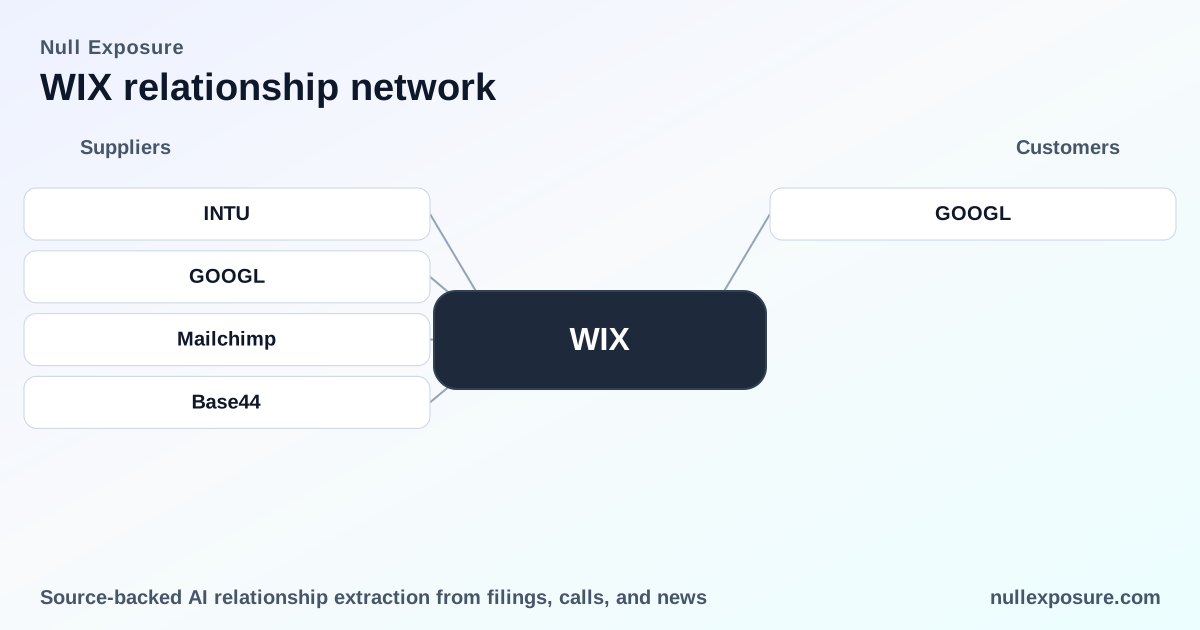
Wix.com Ltd (WIX) — supplier relationships and strategic implications
Wix operates a cloud-native platform that lets small and mid-sized businesses create, host, and manage web presences, monetizing primarily through subscription plans, paid add-ons, and platform services that capture recurring revenue and transaction fees. The company layers third-party integrations and recent AI investments to extend its value proposition beyond site building into operational workflows for SMBs. For broader supplier and partner monitoring, visit the NullExposure homepage.
Short, investor-oriented thesis
Wix is a scale-driven SaaS platform: it converts a large free and low-cost user base into higher ARPU through premium subscriptions and embedded services, while leaning on ecosystem partners to fill adjacent functionality (accounting, discovery, AI-driven content and bookings). With ~$2.0B revenue TTM and large gross margins but negative operating margin, the company is balancing growth and product investment rather than maximizing near-term profitability.
The partner map matters: what partners tell you about Wix’s operating model
Wix’s external relationships reveal a deliberate operating posture: platform-first, partnership-dependent, and SMB-centric. Key characteristics investors should note:
- Contracting posture: Wix pursues integrations and bolt-on acquisitions rather than in-house rebuilding of every capability, enabling faster product expansion at controlled cost.
- Concentration: Relationships span major platform incumbents (Google, Intuit) and targeted acquisitions (Base44), indicating diversified dependency rather than single-vendor concentration.
- Criticality: Integrations with financial and discovery platforms are highly critical to SMB retention and monetization, because they convert website visits into business operations and measurable ROI for customers.
- Maturity: Financials show scale (Revenue TTM ~$1.993B; Gross Profit ~$1.357B) but continued investment (Operating Margin TTM -13.7%)—Wix is a mature growth company optimizing monetization levers while expanding product depth.
If you want ongoing tracking of supplier relationships and material changes, check the NullExposure homepage.
Supplier relationships that matter (one-line investment-grade summaries)
Below are the relationships identified in public reporting and press releases; each entry is a concise, plain-English summary with a source reference.
Intuit Inc. (INTU)
Wix expanded its collaboration with Intuit to integrate QuickBooks Online directly into Wix, letting merchants connect website operations with accounting and AI-assisted financial tools to streamline cash flow and bookkeeping; this is positioned as a growth accelerator for SMB customers. According to a GlobeNewswire release and subsequent industry coverage in February 2026, the partnership delivered deeper product-level connectivity between Wix and Intuit’s financial software suite (GlobeNewswire, Feb 17 and CPAPracticeAdvisor, Feb 19, 2026).
Google (Alphabet, GOOGL)
Wix integrated Wix Bookings with Google Search, Google Maps, and Google AI Mode, enabling service businesses to surface pricing and near-real-time availability directly within Google interfaces, converting discovery into bookings more efficiently. The integration was announced via a GlobeNewswire release (Feb 24, 2026) and covered in market commentary in early 2026.
Mailchimp (Intuit-owned marketing platform)
Wix customers can connect CRM and customer data with Mailchimp to bolster marketing automation and customer engagement, enhancing funnel conversion and repeat sales—this is presented as an immediate revenue and retention lever for merchants. The integration is referenced in CPAPracticeAdvisor and market reports discussing the expanded Intuit/Wix collaboration (Feb 2026).
Base44 (acquisition)
Wix acquired Base44 to embed conversational, AI-driven website creation tools into its platform, accelerating AI capabilities for site creation and content generation that reduce friction for novice users and shorten time-to-launch. Industry reporting in March 2026 details the acquisition and the strategic intent to scale AI-driven creation (SimplyWallSt coverage, March 2026).
What these relationships imply for investors
- Revenue synergy: Integrations with Intuit and Mailchimp are clear pathways to increase ARPU by selling bundled or adjacent services and improving retention through operational stickiness. The QuickBooks push directly addresses the SMB use case of combining online presence with financial operations.
- Customer acquisition and conversion: Google integrations move Wix closer to the front end of discovery-to-conversion flows, which reduces friction for service businesses and improves the platform’s value when competing for SMB marketing spend.
- Product differentiation via AI: The Base44 acquisition signals a commitment to AI-driven product differentiation, aiming to reduce onboarding costs and expand total addressable market among less technical users.
- Capital allocation trade-offs: Wix’s metrics indicate high gross margins but negative operating margins, so management is prioritizing investment in partner integrations and AI over near-term margin expansion. That increases execution risk but supports long-term ecosystem value capture.
Risks and watchlist items
- Execution risk on integrations: Deep technical and commercial integration with Intuit and Google increases operational complexity and requires effective go-to-market coordination; failure to monetize these links would blunt expected ARPU gains.
- Competitive disintermediation: Partnering with platform giants like Google brings distribution benefits but also exposes Wix to changing marketplace rules and potential competitive overlap if partners expand overlapping services.
- Capital allocation: Continued investment into AI and acquisitions (e.g., Base44) must translate to measurable customer conversion and retention; otherwise, operating leverage remains constrained.
Final read and next steps
Wix is executing a deliberate strategy of embedding financial, discovery, and AI capabilities into its core product to drive higher ARPU and deeper SMB engagement. The Intuit and Google integrations are the most materially strategic partnerships for monetization and retention; Base44 accelerates product differentiation.
For ongoing monitoring of supplier dynamics and to see how this partnership map evolves, visit the NullExposure homepage.
Key takeaway: Wix is shifting from purely a site builder to an operational platform for SMBs, using partnerships to accelerate capabilities—investors should watch monetization metrics from these integrations and signs of operating leverage improvement.