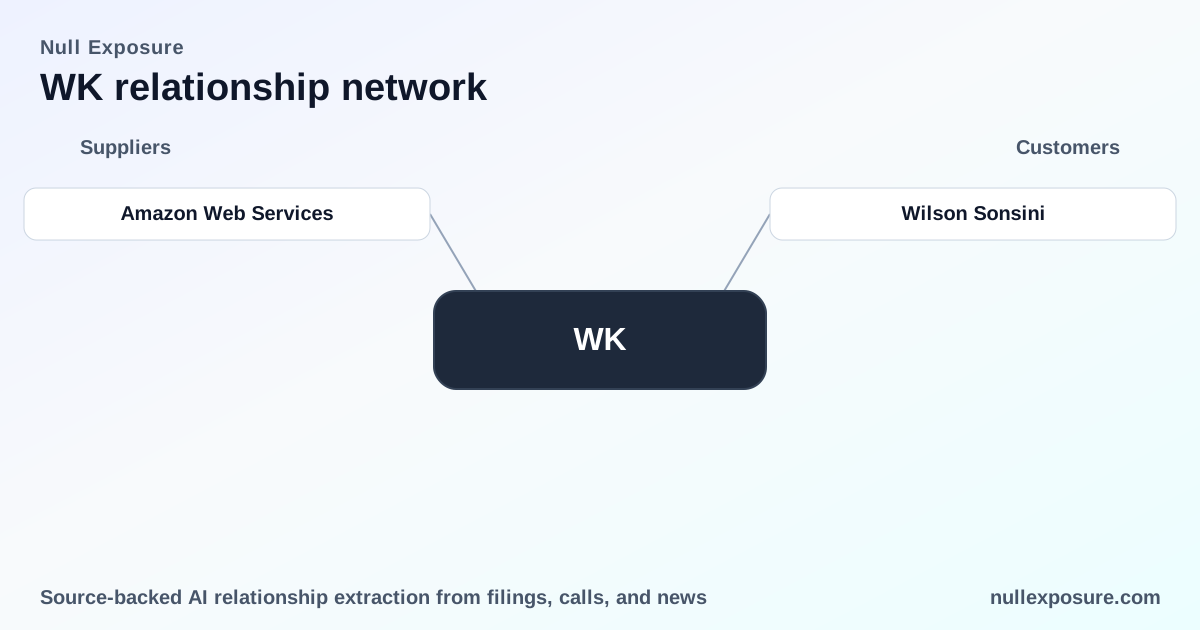
Workiva (WK) — supplier profile and cloud dependency that matters to investors
Workiva operates a global, cloud-native platform for compliance and regulatory reporting, generating revenue primarily from recurring commercial customers that consume its hosted software and related services. The company’s economics are driven by SaaS-style scale: subscription revenue and usage of hosted functionality, offset by material third-party cloud infrastructure costs that underpin delivery. For active investors and procurement teams evaluating supplier concentration and operational resilience, the cloud vendor footprint is a primary lever of both cost volatility and service risk.
Learn how NullExposure maps supplier relationships and contractual commitments at https://nullexposure.com/.
One-sentence investor thesis up front
Workiva monetizes through a subscription-backed cloud reporting platform whose operational scalability and margin profile are tightly coupled to third-party cloud infrastructure spend; monitoring cloud vendor concentration and non-cancelable commitments is essential to assess earnings leverage and outage exposure.
Supplier relationship: where server spend goes
- Amazon Web Services — Workiva identifies AWS as the source of the bulk of its server fees. According to Workiva’s FY2024 10‑K filing, “Costs of server usage are comprised primarily of fees paid to Amazon Web Services,” indicating AWS is the dominant runtime provider for Workiva’s hosted services. (Workiva 10‑K, fiscal year ended Dec 31, 2024.)
What the contract footprint tells investors
Workiva discloses $156.4 million of total commitments under non‑cancelable agreements that are primarily for cloud infrastructure and cloud services. That disclosure, presented at the company level in the FY2024 reporting, signals a material forward-cost obligation for hosting and related cloud services that will flow through operating cash requirements and gross margin. These commitments reflect a contracting posture that locks in capacity and price exposure over multi‑period terms; for investors this translates into both predictable capacity and limited short‑term supplier flexibility.
Why concentration and criticality matter for valuation
Workiva’s financial statements show scale—$884.6 million in revenue (TTM) and $694.1 million in gross profit (TTM)—but also pressure on profitability (reported trailing profit margin of about -3.0%). When a SaaS provider concentrates server and infrastructure usage with a single hyperscaler, two valuation-relevant effects follow:
- Cost volatility: hyperscaler price changes or shifts in instance mix feed directly into gross margin and operating leverage.
- Operational risk: a major outage, regional disruption, or contractual dispute with the cloud provider can interrupt client deliverables and renewals, which is material for a compliance-focused platform where uptime and data integrity are critical.
Workiva explicitly ties server costs to Amazon Web Services in its FY2024 10‑K, confirming that the company’s delivery stack and cost base are aligned with a single large supplier. (Workiva 10‑K, FY2024.)
Learn more about supplier concentration analysis and see the full mapping at https://nullexposure.com/.
Contracting posture and maturity signals
- The presence of non‑cancelable, multi‑year commitments ($156.4M) is a signal of contractual maturity: Workiva has moved beyond ad‑hoc consumption to formal capacity commitments, which typically yield predictable unit economics but reduce short-term vendor negotiation flexibility.
- High institution ownership (roughly 96.7% of shares held by institutions) increases scrutiny on margin expansion and cost control; investors will be attentive to whether committed spend is being optimized against growth targets.
These constraints are presented as company-level disclosures and are not attributed to any single vendor in the commitments excerpt. They nevertheless contextualize the supplier relationship profile for capital allocators.
Operational implications for customers and operators
- Resilience planning: Internal runbooks and multi‑region deployment patterns are crucial given the concentration of server usage with AWS. Investors should ask management how redundancy and failover are structured to protect regulatory reporting commitments.
- Cost engineering: Continuous instance rightsizing, reserved instance or savings plan uptake, and storage-tier optimization are the practical levers that convert committed cloud spend into margin improvement. Monitor disclosure on reserved vs. on‑demand commitments and recognized benefits.
- Contract renegotiation runway: Non‑cancelable commitments create limited immediate flexibility; the company-level $156.4M figure suggests that meaningful renegotiation windows will arrive at contract renewals, not mid‑term.
Risk checklist for investment due diligence
- Confirm the percentage of hosting spend concentrated with AWS and any secondary providers used for redundancy. (Workiva’s FY2024 10‑K names AWS as the primary server-fee recipient.)
- Track the amortization or recognition pattern of the $156.4M commitments and how they flow into future cash outlays.
- Monitor AWS pricing changes, announced region retirements, and major outages as event-driven catalysts for short-term revenue or margin shocks.
- Evaluate product architecture disclosures for multi-cloud capability or lock-in mitigation; absence of multi‑cloud strategy increases systemic vendor risk.
Relationship-by-relationship précis
- Amazon Web Services: Workiva’s FY2024 10‑K states that server usage costs are comprised primarily of fees paid to Amazon Web Services, establishing AWS as the leading provider of hosting services that run the Workiva platform. (Workiva 10‑K, fiscal year ended Dec 31, 2024.)
Bottom line and recommended investor actions
Workiva runs a subscription-delivered compliance platform whose operational cost base is materially tied to cloud infrastructure spend. The FY2024 disclosures identify AWS as the principal server vendor and record $156.4M in non‑cancelable cloud commitments at the company level—factors that directly influence margin trajectory and operational risk. For investors, the priority actions are: (1) insist on disclosure of vendor concentration metrics and cost-mitigation plans, (2) quantify committed vs. variable hosting spend in model scenarios, and (3) track contract renewal windows for potential margin improvement opportunities.
For a deeper read on supplier concentration and contract-level exposure across portfolios, visit https://nullexposure.com/.