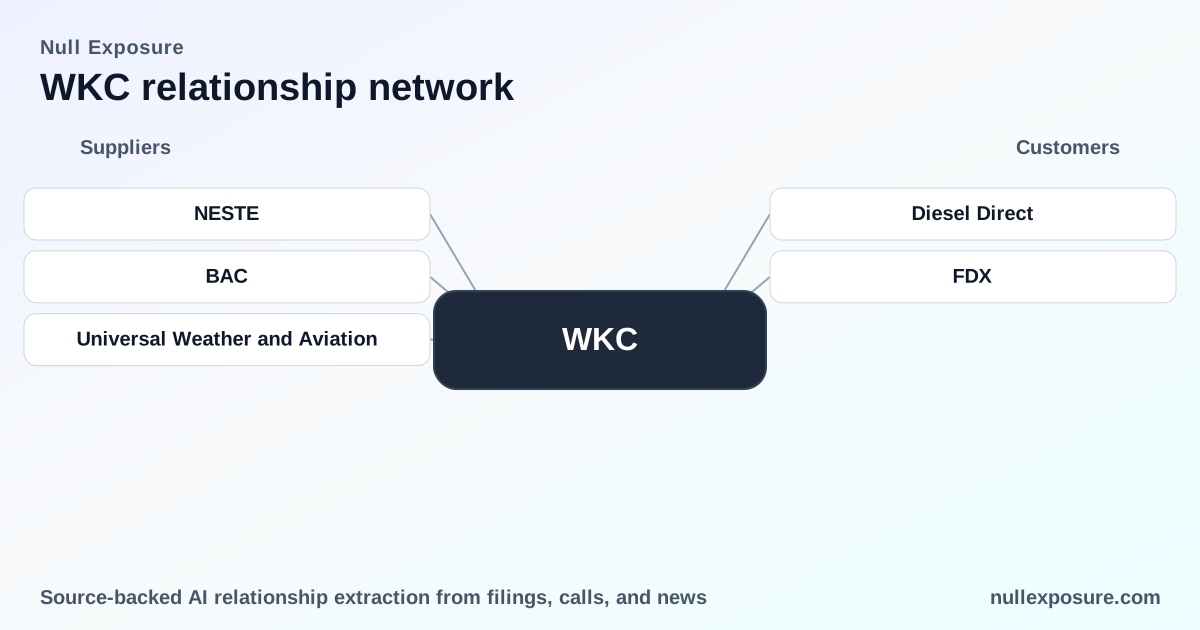
World Kinect (WKC) — Supplier Relationships and Strategic Signals
World Kinect operates as a global distributor of fuel and associated services to aviation, marine and land transportation customers, monetizing through fuel margins, logistics and service fees, and incremental revenue from value-added trip support and fleet services. Revenue-driven scale and on-the-ground service delivery are the business model’s core: commodity sales generate volume while services—fueling operations, trip support and logistics—capture higher-margin, recurring income. For a concise vendor-risk view and supplier mappings, visit https://nullexposure.com/.
How World Kinect’s supplier posture drives cash flow and operational risk
World Kinect’s operating model combines commodity distribution with service delivery. The company sources aviation fuel globally and operates an extensive network of on-airport fueling operations and third-party service providers, which makes supplier relationships both a procurement and an operational dependency. The corporate profile shows large top-line scale (Revenue TTM ~$36.9B) with compressed profitability (EBITDA ~$305.5M; diluted EPS negative), which forces management to prioritize liquidity and asset-backed financing as strategic levers.
- Contracting posture: The firm uses a mix of direct supplier purchases and third-party on-airport service providers, which spreads commercial counterparty exposure but increases operational coordination demands.
- Concentration and criticality: Global sourcing reduces single-vendor concentration but creates multi-jurisdictional supply chains that are critical to day‑to‑day operations; fuel availability and service continuity are mission-critical for airline and airport customers.
- Maturity and scale: World Kinect is large and established in commodity flows, yet profitability and earnings volatility indicate a business sensitive to fuel price cycles and working-capital dynamics.
If you are benchmarking supplier risk or mapping counterparties, start with a full supplier view at https://nullexposure.com/.
What the recent supplier and finance relationships tell investors
Neste — strategic SAF delivery and electrified ground equipment
World Kinect is distributing Neste MY Sustainable Aviation Fuel (SAF) at Toulon Hyères Airport using converted all‑electric refueling vehicles, demonstrating a combined push into SAF supply and lower-emission ground operations. According to AviationPros (March 10, 2026), the redesigned all-electric refuelers delivered Neste MY SAF to business and commercial operators at Toulon Hyères. This relationship signals operational adoption of SAF and complementary technology investments that support customer decarbonization commitments.
Bank of America — liquidity by syndicate-led credit amendment
An amendment to World Kinect’s revolving credit facility was led by Bank of America and extended the company’s borrowing capacity to $2 billion, improving liquidity to support strategic growth. A company press release reported via The Globe and Mail (March 10, 2026) states the amendment reflects support from a diversified syndicate of global financial institutions and enhances World Kinect’s financial agility. This financing relationship is a corporate-level lever that reduces short-term refinancing risk and underwrites acquisition and working-capital needs.
Universal Weather and Aviation — acquisition of Trip Support Services
World Kinect completed the acquisition of the Trip Support Services division from Universal Weather and Aviation, adding trip planning and ground support capabilities to its aviation services suite. Business Airport International covered the transaction (March 10, 2026), noting the completed acquisition expands World Kinect’s service footprint. The deal enhances cross-selling to flight operators and tightens the company’s hold on aviation end-to-end services, raising the operational significance of supplier-and-service integration.
Strategic implications for investors and operators
The three relationships together illustrate a deliberate strategy: combine commodity supply with adjacent services and secure liquidity to scale. Each relationship contributes a distinct vector:
- Commercial decarbonization vector: The Neste collaboration signals revenue capture in SAF channels and operational investment in electrified ground equipment, positioning World Kinect to participate in airline sustainability programs.
- Financial flexibility vector: The Bank of America–led facility amendment is a working-capital and acquisition financing enabler, lowering tactical liquidity risk and allowing continued inorganic expansion.
- Service expansion vector: The Universal Weather Trip Support Services acquisition accelerates vertical integration into flight operations services where higher margins and recurring revenue profiles exist.
Collectively, these developments reduce reliance on pure commodity margins by increasing service penetration—an important de‑risking mechanism for a company with thin operating margins and negative EPS.
Key risk signals and operational constraints
- Global sourcing and operational complexity: Company disclosures confirm aviation fuel purchases from suppliers worldwide; global procurement lowers single-supplier exposure but raises geopolitical, logistics and compliance complexity.
- Service-provider operating model: World Kinect explicitly relies on a network of on-airport fueling operations and third-party service providers, which creates execution risk at airports and during peak travel periods.
- Financial structure and margin sensitivity: Large top-line revenue coexists with low profitability; investors should monitor leverage metrics and covenant headroom despite the recent $2 billion facility amendment.
- Integration execution: The Universal Weather transaction expands capabilities but requires effective integration to realize cross-sell economics and service-margin improvement.
For an operationally focused assessment and supplier-risk mapping, explore practical tools at https://nullexposure.com/.
Actionable takeaways for decision-makers
- Operators: Prioritize counterparty resilience—confirm local supplier redundancies at critical airports and validate third-party fueling performance standards.
- Investors: Focus on liquidity metrics, working-capital trends, and margin expansion from service revenue; track SAF volumes as an early indicator of higher-value billing.
- Procurement teams: Leverage the company’s global sourcing to negotiate structured SAF and logistics commitments where possible; electrified refueling adoption will change maintenance and lifecycle cost profiles.
Bottom line
World Kinect is executing a scale-plus-services strategy: global fuel distribution underpins cash generation while targeted acquisitions and strategic supplier pairings (SAF suppliers, financing partners, and trip-support businesses) shift the revenue mix toward higher-value services. These supplier relationships materially affect operational continuity and the company’s ability to convert scale into sustainable margins. For a deeper supplier-risk analysis and ongoing monitoring solutions, visit https://nullexposure.com/.