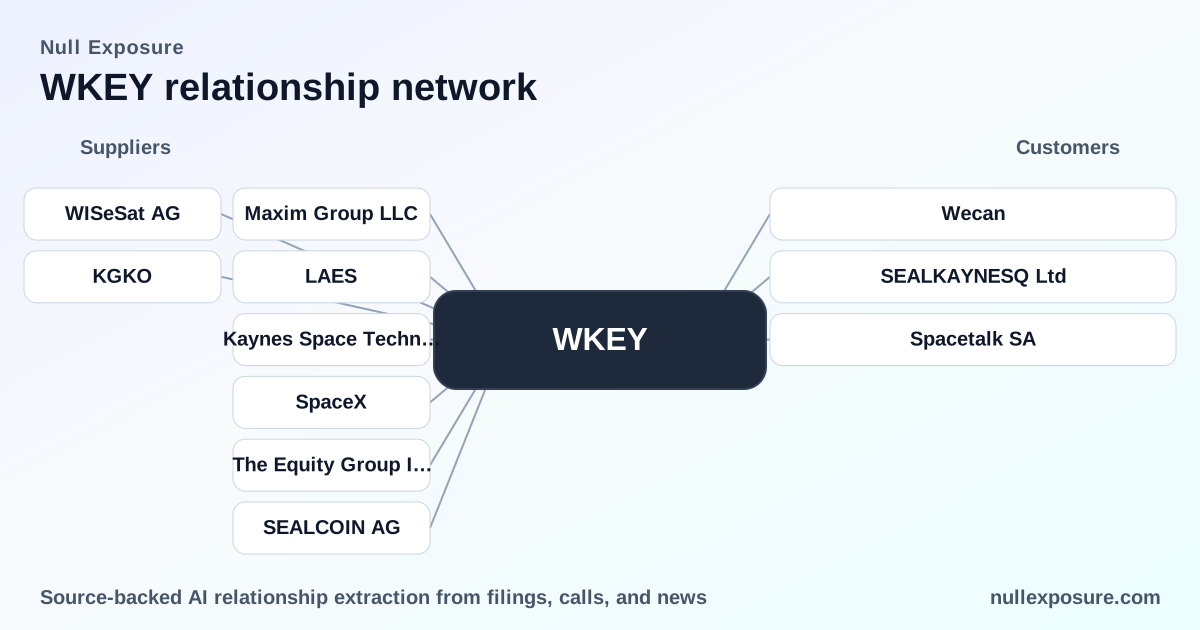
WISeKey (WKEY) supplier map: who powers the quantum‑resilient satellite push
WISeKey monetizes through integrated cybersecurity and identity products, supplemented by an emerging space‑services arm that sells secure IoT satellite capacity and related hardware/software integrations. Revenue mixes direct cryptographic solutions and licensing for identity and root‑of‑trust services, while the WISeSat initiative leverages third‑party manufacturing, launch, and transaction partners to commercialize a post‑quantum secure satellite constellation for IoT and machine‑to‑machine settlement.
Explore supplier relationships and counterparty exposure on our platform: https://nullexposure.com/
What investors need to know up front
WISeKey’s operating model is platform plus strategic partners: core security IP and identity services are retained in‑house, while capital‑intensive satellite manufacturing, launch, and settlement functions are outsourced to specialized suppliers and affiliates. This structure compresses capital requirements for constellation deployment but creates execution and concentration risk tied to a small set of suppliers and advisors. For a practical supplier map and ongoing monitoring, visit https://nullexposure.com/.
The supplier relationships that matter — concise, investable takeaways
Below are every counterparty cited in company communications and recent press, each summarized in plain English with a source reference.
-
Maxim Group LLC
Maxim Group LLC is acting as WISeKey’s exclusive financial advisor in connection with a business combination, positioning Maxim as the lead capital markets and transaction advisor for corporate deals. (Finance Yahoo, March 2026.) -
SEALSQ Corp (NASDAQ: LAES)
SEALSQ supplies post‑quantum cryptographic semiconductor chips and is described as a subsidiary that provides the hardware root‑of‑trust integrated into WISeSat satellites and WISeKey identity products. (Yahoo Finance and QuantumZeitgeist reporting, March 2026.) -
Kaynes Space Technology Private Limited (KSTPL)
KSTPL is contracted to manufacture next‑generation WISeSats in India and act as a strategic launch/manufacturing partner to industrialize WISeKey’s post‑quantum satellite network. (Finviz and Yahoo/Sahm Capital releases, January–March 2026.) -
SpaceX
SpaceX has provided Falcon 9 launch services for WISeKey’s satellites (20th satellite launched November 2025) and is scheduled for at least one additional WISeSat launch from California in March 2026, making SpaceX a primary launch vendor. (InvestingNews and Finviz coverage, November 2025–March 2026.) -
The Equity Group Inc.
The Equity Group Inc. functions as WISeKey’s U.S. investor relations partner and public communications contact, appearing consistently in press releases and investor materials. (Multiple GlobeNewswire and InvestingNews press releases, 2025–2026.) -
SEALCOIN AG
SEALCOIN is positioned as the transaction and settlement layer for WISeSat satellites, enabling on‑orbit and space‑to‑ground machine payments and authentication workflows embedded in the constellation. (Manila Times / GlobeNewswire, February 2026.) -
WISeSat AG
WISeSat AG operates as WISeKey’s satellite subsidiary, the program owner for the WISeSat constellation and promoter of initiatives like the “Art in Space” program that leverage orbital assets for cultural and commercial uses. (GlobeNewswire releases, February 2026.) -
Latitude (inferred symbol KGKO)
Latitude, a French aerospace company, signed a commercial agreement to assess launch options for WISeSat’s secure IoT constellation, positioning Latitude as an assessed launch partner and adviser on orbital operations. (InvestingNews, 2026.)
How these relationships define WISeKey’s business model and constraints
WISeKey runs a hybrid model: it retains intellectual property and identity services while delegating capital‑intensive elements (manufacturing, launches, transaction rails) to partners and subsidiaries. This delivers several observable operating characteristics for investors to price into the thesis:
-
Contracting posture: WISeKey uses exclusive advisory relationships (Maxim Group) and fixed commercial agreements for manufacturing and launch, reducing in‑house execution burden but increasing dependency on named suppliers for timetable and cost outcomes. These contracts create predictable vendor lines but concentrate risk.
-
Concentration: A small number of suppliers handle mission‑critical functions — SpaceX for launches, KSTPL for manufacturing in India, and SEALSQ/SEALCOIN for hardware and settlement layers. Supplier concentration accelerates deployment when partners perform, and amplifies program risk if a single counterparty faces disruption.
-
Criticality: Several suppliers are mission‑critical rather than optional vendors. SEALSQ’s post‑quantum chips and KSTPL’s manufacturing role are integral to WISeSat’s security claims; SpaceX and Latitude are integral for launch capacity. Loss of any critical partner would materially affect satellite rollout schedules.
-
Maturity and partner mix: The partner set mixes established players (SpaceX, established investor‑relations firms) with newer/affiliate entities (SEALSQ, SEALCOIN, WISeSat AG). This blend reduces pure execution risk on launches but raises technology and commercialization risk where affiliates provide novel cryptographic hardware and settlement systems.
Financial context supports these structural signals: WISeKey is a small‑cap technology company with negative EBITDA and margins, modest institutional ownership, and an asset‑heavy rollout strategy outsourced to partners — an approach that conserves balance‑sheet cash but transfers implementation risk to suppliers (company filings and FY2025–FY2026 releases).
For an investor‑grade supplier risk report and ongoing alerts tied to these counterparties, check our platform: https://nullexposure.com/.
Investment implications and risk checklist
- Positive: Outsourcing manufacturing and launches to specialist partners accelerates time‑to‑market and reduces upfront capital. Partnerships with post‑quantum chip suppliers and a dedicated transaction layer create differentiated product claims for secure IoT in space.
- Negative: High supplier concentration and reliance on a mix of affiliates and third parties create single‑point execution risk; any supplier dispute or technical failure will delay revenue realization. Public communications and investor relations are centralized with The Equity Group Inc., which concentrates messaging risk if operational results slip.
Bottom line and recommended next step
WISeKey’s strategy is bold: commercialize post‑quantum secure infrastructure by combining in‑house identity IP with partner‑provided manufacturing, launch, and settlement services. Investors should value WISeKey as a security‑IP company whose satellite ambitions are execution‑dependent on a tight constellation of suppliers. For a deeper supplier exposure map and to monitor changes across these counterparties in real time, visit https://nullexposure.com/.
Further reading and source snapshots used above include Finance Yahoo, InvestingNews, GlobeNewswire, Finviz coverage, and regional press items published between late 2025 and early 2026.