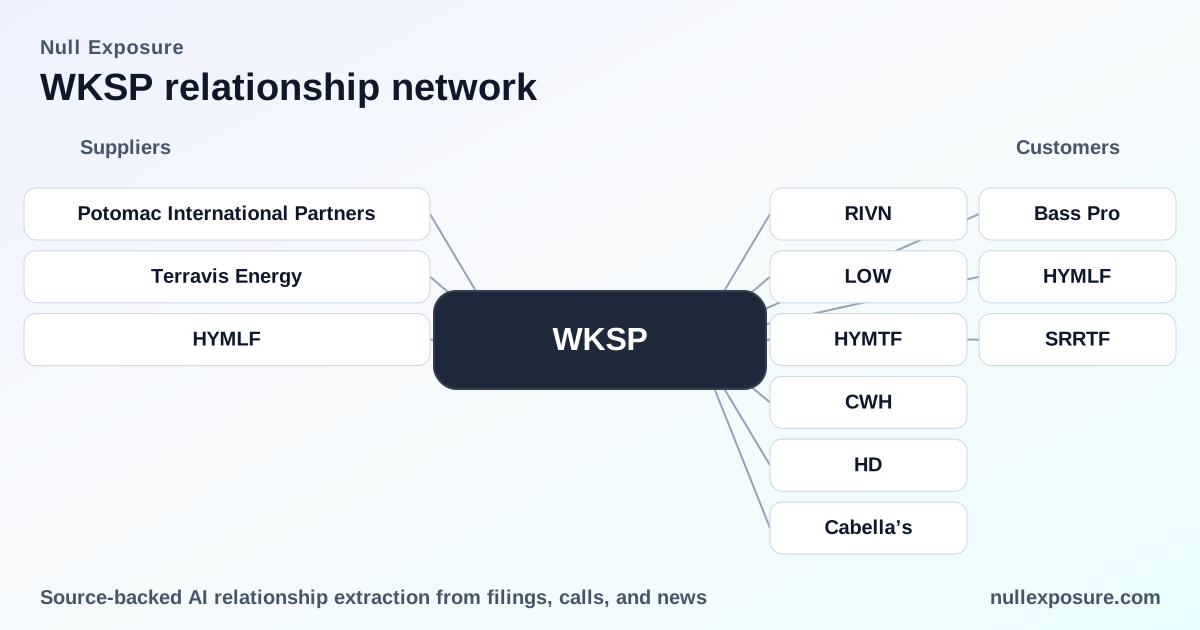
Worksport Ltd. (WKSP) — supplier relationships and strategic signals investors must know
Worksport designs, manufactures and sells truck tonneau covers in North America and is commercializing a clean‑energy product line (SOLIS solar cover, COR portable nano‑grid, and heat pump technology) to generate new revenue streams beyond its core accessories business. The company monetizes through product sales, distribution of U.S.‑manufactured covers, and licensing/partnership channels tied to its clean‑energy modules, while pursuing government and commercial contracts to accelerate adoption. Revenue trailing twelve months is roughly $14.3M against a small market capitalization (~$15.4M) and persistent operating losses, so partnerships that de‑risk go‑to‑market execution and open federal procurement channels are material to valuation. For further supplier intelligence and monitoring, visit https://nullexposure.com/.
What the public relationships are and why they matter
Below I cover every named external relationship observed in public releases and press coverage. Each entry is a plain‑English take with a concise source note.
Potomac International Partners — government engagement lead
Worksport announced a strategic partnership with Potomac International Partners to lead its federal government engagement and commercial go‑to‑market work for the clean‑energy ecosystem, leveraging a multidisciplinary team with experience across six U.S. administrations; the arrangement is positioned to accelerate federal procurement discussions. According to an AccessWire/Press release dated March 10, 2026, Potomac will handle government engagement strategy for Worksport’s clean‑energy initiatives. (AccessWire / March 10, 2026)
Terravis Energy — product branding and clean‑energy expansion
Public releases tie Terravis Energy to the company’s clean‑energy product line, noting Solis solar cover and Terravis’s Zerofrost heat pump among items advanced alongside the core tonneau cover business, with marketing framed around recent e‑commerce milestones. Multiple press releases reporting on Worksport’s online sales performance referenced Terravis Energy’s role in the clean‑energy portfolio. (Citizen‑Times / March 10, 2026)
Hyundai — OEM partnership for SOLIS solar cover
Worksport confirms an active partnership with Hyundai related to the SOLIS Solar cover, and public disclosure notes that government evaluation of Worksport’s Aetherlux heat pump has been accelerated for potential long‑term supply and certification pathways that would affect OEM and fleet channels. This was reported in a company press release published via The Globe and Mail. (The Globe and Mail / March 10, 2026)
Operating model signals and supplier constraints investors must price
The evidence set delivers a cohesive picture of Worksport’s supplier posture: geographically diversified sourcing for raw materials, concentrated finished‑goods manufacturing for soft tonneau covers, and a mixed roster of professional services at modest spend levels. These are company‑level signals synthesized from filings and press excerpts.
- Concentration of finished‑goods manufacturing: Worksport reports that soft tonneau covers are manufactured in two facilities (Meizhou and Foshan, China) under its specifications, and the company maintains strategic inventories to mitigate the concentration risk. This creates a single‑product supply dependency for the core accessory business and raises operational sensitivity to China‑regional disruptions.
- Geographic sourcing footprint: The company states it sources raw materials from Europe, Southeast Asia, and North America, and references suppliers in the U.S., China, Romania, Türkiye, and Canada—indicating a broadly international supplier base for components and raw materials.
- Professional services are low spend and vendor‑level: A named professional services provider, Forbes Anderson Limited (an accounting firm managed by the CFO), received $54,767 (CAD $75,000) for FY2024 services, consistent with a sub‑$100k spend band for certain service relationships.
- Active supplier posture: Multiple excerpts emphasize active supplier relationships and inventory strategies in place as of year‑end 2024, signaling operational continuity but limited supplier redundancy for key finished goods.
Taken together, the company runs a mixed maturity supply model: consumer hardware production executed through concentrated offshore manufacturing, while go‑to‑market and government engagement is being outsourced to experienced, external specialists to accelerate adoption of newer clean‑energy products.
For a deeper commercial risk and counterparty map, check https://nullexposure.com/.
How these relationships alter the risk/reward calculus
The Potomac and Hyundai ties are strategically meaningful because they represent two distinct value levers: government contracting and OEM channel entry. Potomac’s role is to convert product capability into procurement conversations; Hyundai’s engagement signals OEM interest that could scale volumes if certification and supply commitments are secured. Conversely, the core revenue remains highly dependent on relatively small volumes of tonneau covers, produced in two Chinese plants; this concentration is the most tangible operational risk.
Key investment implications:
- Upside pathway: Successful federal contract wins or an OEM supply agreement with Hyundai would materially de‑risk scaling and could re‑rate revenue multiples for the clean‑energy line.
- Downside exposure: Continued negative EBITDA and supplier concentration in China preserve execution risk; a supply disruption would directly affect product availability for the company’s primary revenue stream.
- Capital and liquidity sensitivity: The small market cap and low institutional ownership mean outcomes tied to these partnerships will be reflected quickly in price if material contracts are announced.
Practical next steps for investors and procurement teams
- Track federal procurement milestones and Potomac engagement outputs closely—contract awards or RFP shortlists are binary events that change growth visibility.
- Monitor Hyundai and any OEM certification updates; certification acceleration is cited in press materials and will be the principal gating item for volume OEM sales.
- Validate inventory levels and alternative sourcing options disclosed in quarterly filings to assess how well Worksport can absorb supplier shocks.
If you need ongoing monitoring or supplier‑risk scoring for Worksport and comparable suppliers, start with a detailed supplier report at https://nullexposure.com/.
Bottom line — a clear watchlist for value catalysts
Worksport’s public relationships are strategically valuable but execution‑dependent: Potomac buys the company time and access to federal channels, Hyundai provides an OEM proof point, and Terravis frames the commercial narrative for its clean‑energy suite. The central operational constraint remains manufacturing concentration for its core product and modest scale relative to the contracts it seeks; investors should price both the potential upside from government/OEM wins and the tangible supply‑chain fragility into any valuation.
For targeted supplier due diligence, scenario modeling, or to commission a tailored relationship risk brief, visit https://nullexposure.com/ and request a supplier intelligence package.