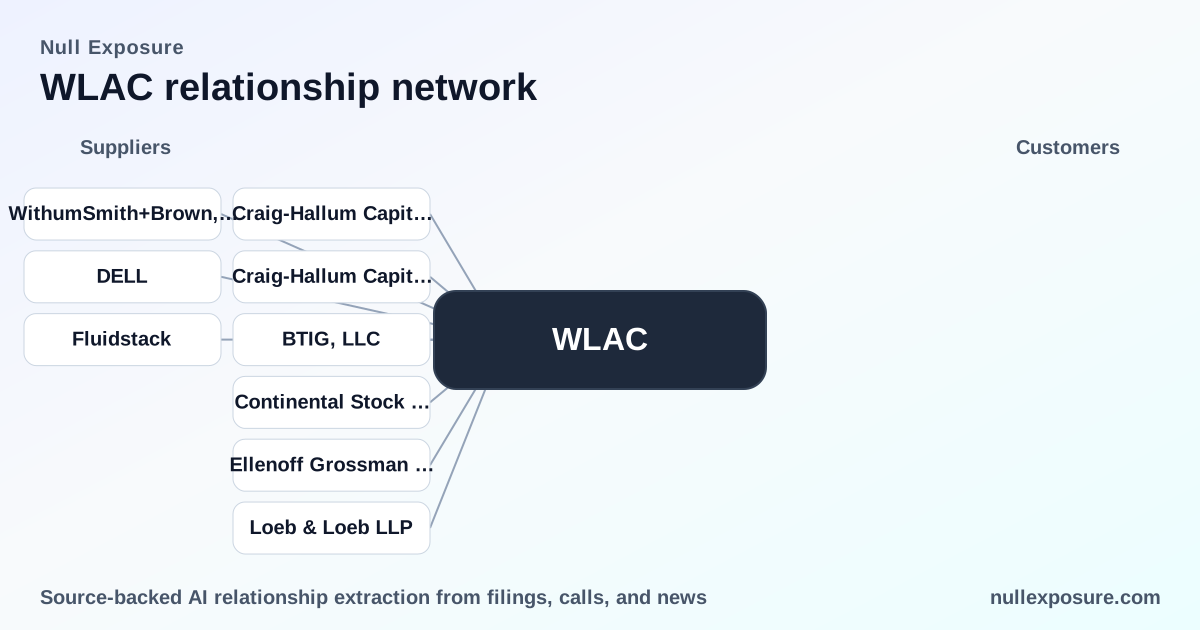
WLAC Supplier Relationships: who runs the IPO engine and supports post‑deal infrastructure
Willow Lane Acquisition Corp. (WLAC) is a sponsor‑backed SPAC that monetizes by raising public capital through an IPO, placing proceeds into a trustee‑held trust, and then pursuing a business combination with a target company where the sponsor and underwriters capture underwriting fees, promote economics, and follow‑on financing rights. Revenue is not generated from operations today; value accrues through the quality of the deal flow WLAC sources, the economics negotiated with underwriters and advisors, and the structural protections embedded in sponsor and trustee arrangements. For investors evaluating supplier risk, WLAC’s supplier base reveals a classic SPAC operating posture: short, concentrated, service‑oriented contracts with predictable low spend but high strategic importance. Learn more at https://nullexposure.com/.
The investor takeaway up front
- WLAC’s supplier relationships are predominantly professional services and capital markets partners — underwriters, counsel, trustee, auditor, and sponsor affiliates — not long‑term operating vendors.
- The economics and contractual flex (underwriter overallotment, sponsor loans, and administrative fee arrangements) determine the immediacy and scalability of WLAC’s deal‑making capacity.
- Counterparties are established capital markets firms; the risk profile is execution and counterparty concentration rather than procurement or operational vendor failure.
Counterparty map: who WLAC contracts with and why it matters
Craig‑Hallum Capital Group / Craig‑Hallum Capital Group LLC
Craig‑Hallum plays a dual role in WLAC’s capital markets execution. In FY2026 WLAC entered a letter agreement with Craig‑Hallum that reduced deferred underwriting commissions by $500,000 in exchange for a 12‑month right to participate in subsequent financings, shifting near‑term cash obligations and creating a follow‑on investment channel (TradingView, March 10, 2026). Earlier, in FY2024 Craig‑Hallum served as a co‑manager on WLAC’s $110 million IPO, underwriting placement and distribution responsibilities (CityBiz, FY2024).
BTIG, LLC
BTIG acted as the sole book‑running manager for WLAC’s IPO, carrying primary execution risk for the initial equity placement and over‑allotment activity (SPACInsider, FY2024). BTIG’s role concentrated distribution risk and gives WLAC a single‑point underwriter for aftermarket stabilization and block placement.
Continental Stock Transfer & Trust Company
Continental serves as trustee for WLAC’s IPO trust account where the net proceeds and portions of private placement proceeds are held — a regulatory and liquidity control function central to any SPAC structure (SPACInsider, FY2024). This trustee relationship is custodial and contractually critical: it determines liquidity release conditions at the business combination.
Ellenoff Grossman & Schole LLP and Loeb & Loeb LLP
Ellenoff Grossman & Schole functions as issuer’s counsel while Loeb & Loeb serves as underwriter’s counsel for the IPO, providing legal opinion, disclosure support, and transactional documentation for both issuer and underwriter sides (SPACInsider, FY2024). Legal coverage splits risk across issuer and underwriter representations and is standard for transaction completeness.
WithumSmith+Brown, PC
Withum acts as WLAC’s auditor and provided the audited financial statements for the pre‑combination period, charging aggregate fees just under $100k for initial public reporting and required filings (SPACInsider, FY2024). Audit spend is low but mandatory; the relationship supports SEC disclosure integrity and investor confidence.
Dell
WLAC announced agreements tied to Boost Run that include a partnership with Dell intended to bolster AI infrastructure capabilities for the acquired operating business, indicating WLAC’s target selection favors capital‑intensive, infrastructure‑dependent assets (The Globe and Mail via TipRanks, FY2025). Dell’s involvement signals enterprise‑grade infrastructure suppliers in post‑deal operations.
Fluidstack
A reported $127 million contract with Fluidstack was disclosed in connection with WLAC’s portfolio strategy for Boost Run, representing material third‑party infrastructure spend for the operating company WLAC targets to acquire (The Globe and Mail via TipRanks, FY2025). This is a large commercial exposure tied to the target’s go‑forward platform and thus relevant to post‑transaction cash flow and vendor concentration.
How the supplier footprint translates into operating constraints and signals
The public filings and press items surface several company‑level constraints that instruct investor diligence:
- Short‑term contract posture. Sponsor loans for IPO expenses (up to $300k, non‑interest bearing and short maturity) indicate WLAC relies on short, sponsor‑backstopped funding rather than long‑dated vendor credit. This reinforces a transaction‑driven operating model rather than a recurring supplier base.
- Subscription‑style admin services. WLAC pays an affiliate of the sponsor $10,000 per month for office and administrative support under an Administrative Services Agreement, creating a small but recurring operating cost that persists until the business combination or liquidation.
- Geographic concentration in North America. Executive offices are in New York City and administrative services are performed locally, implying on‑shore governance and regulation.
- Service‑provider orientation. The supplier universe is overwhelmingly professional services (advisors, auditors, counsel, trustees, underwriters) — relationships are critical for transaction execution but low in direct operational lock‑in.
- Active relationship stage. Administrative agreements and counsel/auditor appointments are active as of the 2024–2025 filing periods, meaning these supplier commitments are current and enforceable.
- Low spend band for recurring services. Audit and administrative fees reported were under $100k in the initial reporting period, signaling limited ongoing cash burden ahead of a business combination.
These constraints collectively indicate a capital‑markets execution posture: low recurring vendor spend, concentrated reliance on a few high‑impact counterparties, and sponsor‑dependent liquidity mechanics.
Learn more about supplier risk frameworks at https://nullexposure.com/.
Investment implications and risk checklist
- Concentration risk: A small set of underwriters and legal counsels centralize execution risk; any underwriter dispute or withdrawal can materially delay deal timing.
- Execution dependency: Trustee and auditor relationships are non‑substitutable for SEC compliance and trust control; disruption would be disruptive to any deal timetable.
- Post‑deal vendor exposure: Material third‑party contracts disclosed for the target (e.g., Fluidstack) create operating counterparty risk in the pro forma company that investors should stress‑test.
- Cash and governance friction: Sponsor loans and monthly admin fees are small but illustrate the dependency on sponsor economics and incentives; governance terms around these agreements deserve scrutiny in proxy and merger documents.
Bottom line and recommended next steps
WLAC’s supplier network is a classic SPAC ecosystem: professional services and capital markets partners that enable deal execution rather than long‑term operational scale. For investors the decision hinges on deal‑level diligence: assess underwriter economics (including the Craig‑Hallum letter agreement giving follow‑on rights), trustee controls, material post‑deal vendor contracts (Fluidstack and Dell arrangements), and the sponsor’s willingness to fund short‑term obligations.
If you track sponsor economics, counsel alignment, or counterparty concentration in SPACs, start with a focused review of WLAC’s underwriting agreements and the trustee terms disclosed in the IPO filings. Visit https://nullexposure.com/ for further supplier‑centric intelligence and to access comparative supplier risk profiles across SPACs.