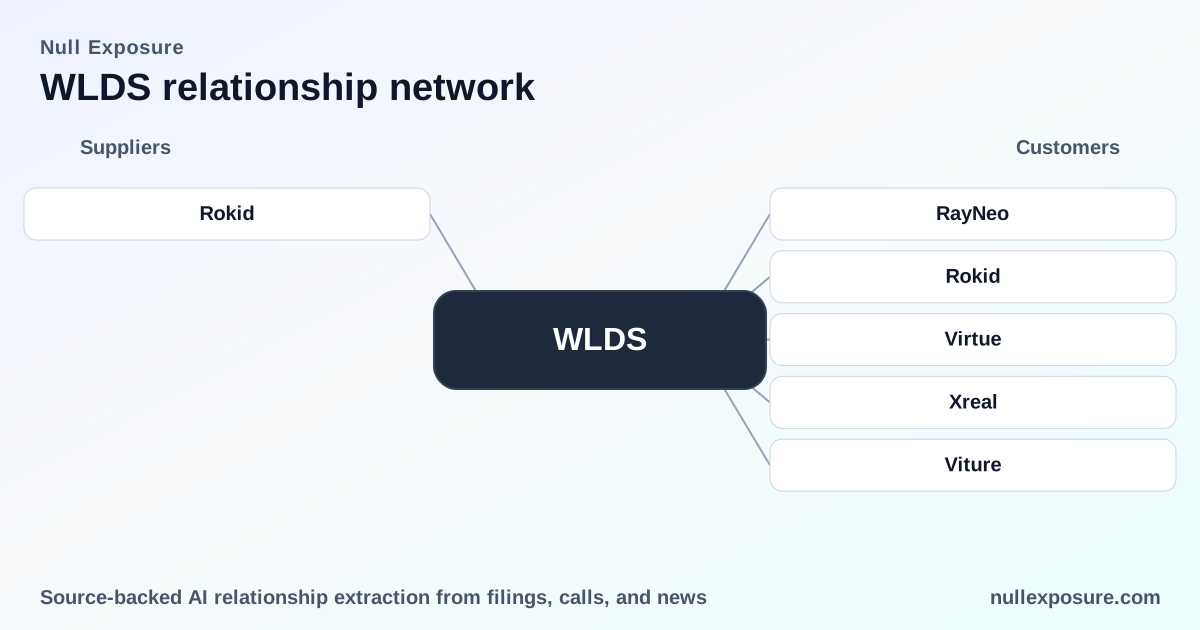
Wearable Devices Ltd. (WLDS): Small supplier, strategic AR pivot — what Rokid tells investors
Wearable Devices Ltd. develops the Mudra Link wristband, a non‑invasive neural input interface that converts subtle finger movements into digital commands. The company monetizes through hardware sales and strategic OEM bundles, licensing integrations with augmented reality (AR) device makers, and commercial partnerships that push its sensor hardware into consumer AR bundles. According to the company’s filings and public materials through FY2025, WLDS is an early‑stage hardware supplier with limited revenue today but clear commercialization intent via partner channels.
Explore deeper coverage at https://nullexposure.com/
Why the Rokid bundle matters for revenue trajectories and go‑to‑market
Wearable Devices has secured a product‑level partnership with Rokid to ship a consumer bundle pairing the Mudra Link wristband with Rokid Glasses. A March 2026 press release covered by Quiver Quant reported the bundle will enable touchless AR control and is slated to launch in Q2 2026, positioning WLDS to move from pilot installs to packaged consumer offerings. This is a distribution and validation event: Rokid provides an installed AR platform while WLDS contributes the novel input hardware that converts movement into control signals.
- Key relationship: Rokid — WLDS will bundle the Mudra Link wristband with Rokid Glasses for touchless AR interaction, launching Q2 2026, according to a March 10, 2026 news report. (Quiver Quant, March 2026)
The partnership landscape: Rokid (the full relationship list)
Rokid — Wearable Devices and Rokid will ship a consumer bundle integrating the Mudra Link wristband with Rokid Glasses to enable touchless control of AR features; the partnership and bundle launch were announced in March 2026 and targeted for Q2 2026. (Quiver Quant news coverage, March 10, 2026)
What the Rokid deal reveals about WLDS’s operating model
The Rokid partnership exposes several structural characteristics of WLDS’s business model:
- Partner‑led commercialization. WLDS executes go‑to‑market through device OEMs and consumer hardware partners; Rokid functions as a distribution and user‑experience multiplier rather than a channel reseller only.
- Supplier posture over platform owner. WLDS sells hardware and integration value to larger device manufacturers rather than controlling the end user relationship at scale.
- Early revenue concentration. With trailing twelve‑month revenue of approximately $647k and a market capitalization near $5.2M as of the company’s FY2025 filings, WLDS is a microcap supplier dependent on a small set of partner wins to scale revenue.
- Commercial maturity and execution risk. The company reports negative EBITDA and materially negative EPS in FY2025, indicating WLDS is in a commercialization phase where partner rollouts — not organic consumer demand yet — drive short‑term revenue inflection.
These characteristics create a business that is high‑beta to partner success: partner product integrations convert into near‑term revenue, while partner delays or cancellations directly compress WLDS cash flows.
Financial and governance signals investors should weigh
Use the following market and governance indicators to frame supplier risk and upside:
- Small operating base. WLDS reported revenue TTM of $647k and a gross loss in the same period, signaling that scale and margin improvement depend on volume from partners like Rokid (company filings, latest quarter 2025‑12‑31).
- Capital and profitability profile. Negative EBITDA and diluted EPS indicate continued capital needs to support production and commercialization; value realization hinges on partner‑led volume ramps.
- Concentrated ownership and low institutional coverage. Shares outstanding and a small float (approximately 780,600 shares) with modest institutional ownership indicate potential for liquidity volatility and concentrated insider influence (market data, FY2025).
- Product relevance vs. bargaining power. Mudra Link delivers a differentiated input modality for AR systems, but WLDS’s bargaining power is limited by its small scale, putting the company in a supplier role where contractual terms and margin are shaped by larger OEM partners.
Constraints and supplier risk profile (company‑level signals)
There are no formal constraint entries listed in the sourced supplier constraints for WLDS; treat this as an explicit absence of documented contractual constraints in the reviewed supplier records. From the company‑level metrics and partnership evidence, construct the following operational constraints and implications:
- Contracting posture: Project and bundle‑level agreements that tie revenue to milestone rollouts rather than steady recurring fees. This increases revenue volatility.
- Concentration: Current public evidence shows a single disclosed product partnership with a prominent AR OEM; single‑partner dependence is a material risk until additional OEM or channel relationships are secured.
- Criticality: For Rokid, Mudra Link offers a user interface enhancement that increases product stickiness, but WLDS is not yet a mission‑critical supplier across multiple platforms.
- Maturity: WLDS is an early commercial hardware supplier; product validation is progressing, but margin and scale efficiency are immature.
Practical implications for investors and operators
Operators negotiating with WLDS should expect projectized contracts and technical co‑development clauses, while investors should discount short‑term revenue volatility but credit the company for a tangible commercialization pathway through partners like Rokid. For an investor thesis:
- Bull case: Successful Rokid bundle rollouts convert to repeatable consumer revenue, enabling scale and margin recovery.
- Risk case: A stalled or limited rollout keeps WLDS as a small supplier with cash‑burn pressures and deep valuation discount.
Take action: review partner agreements for revenue recognition triggers and minimum purchase obligations before underwriting upside. For more in‑depth supplier analysis and tracking of upcoming partner deals, visit https://nullexposure.com/
Bottom line: what to watch next
- Q2 2026 Rokid bundle launch execution and shipment volumes — the definitive near‑term catalyst for WLDS revenue.
- Additional OEM partnerships or repeat orders that would reduce partner concentration and demonstrate product stickiness.
- Cash runway and production scale — follow quarterly filings for capex and inventory dynamics.
Bold takeaway: WLDS is a small, partner‑dependent hardware supplier whose near‑term valuation and revenue trajectory are governed by partnership execution — Rokid is the first public proof point. For ongoing tracking of WLDS supplier relationships and commercial milestones, return to https://nullexposure.com/ for regular updates and deal mappings.