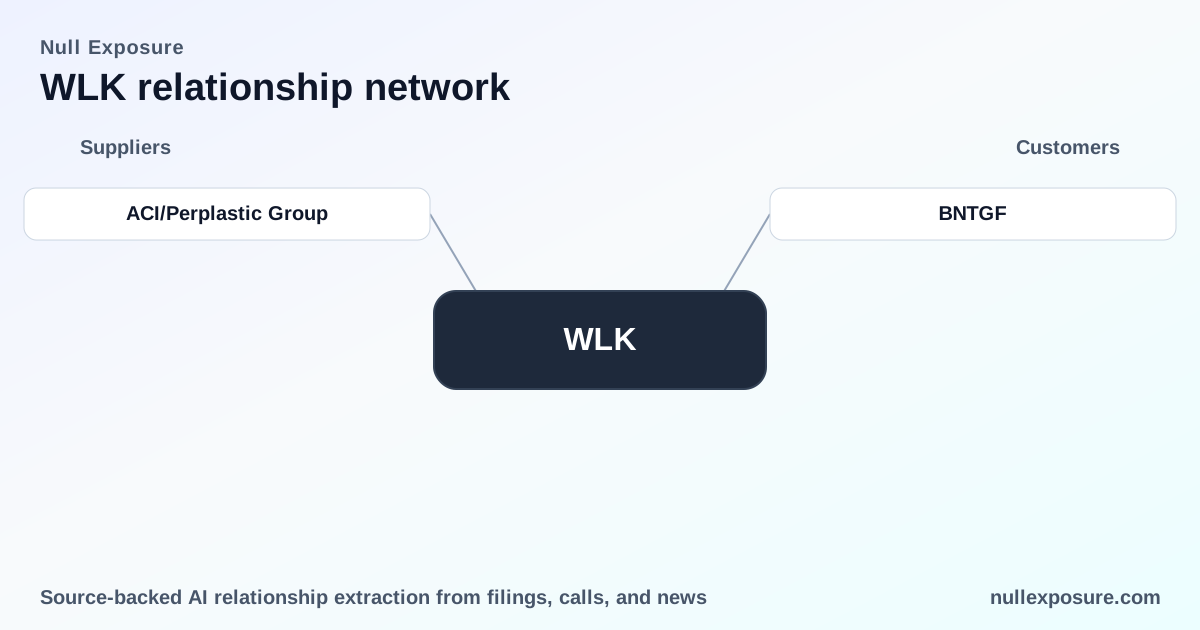
Westlake Chemical (WLK): Supplier Relationships and What Investors Should Price In
Westlake Chemical operates and monetizes as an integrated petrochemicals and polymers manufacturer, selling olefins, vinyls and value‑added fabricated products into construction, automotive and packaging channels. Revenue is driven by commodity and specialty product sales across Olefins and Vinyls, supplemented by strategic M&A to expand downstream capabilities, while procurement of feedstocks and utilities underpins cost structure and margin variability. For a focused view of how supplier relationships change Westlake’s operational risk profile and where value can be captured, read on. For additional supplier intelligence and supplier‑risk mapping, visit https://nullexposure.com/.
The strategic move: ACI/Perplastic expands Westlake’s compounding footprint
Westlake completed the acquisition of the global compounding solutions businesses of ACI/Perplastic Group, a Portugal‑based specialty materials maker serving the wire and cable market. This deal broadens Westlake’s downstream compounding capabilities and positions the company to capture higher‑margin, application‑specific sales in wiring and cable applications. Indian Chemical News reported the completion on March 10, 2026 (https://www.indianchemicalnews.com/chemical/westlake-acquires-acis-compounding-businesses-to-expand-global-footprint-28816).
A second contemporaneous report echoed the same completion and linked the transaction to a positive market reaction in early March 2026; the Tech Sector 2 (TS2) write‑up documented the filing and stock movement on March 10, 2026 (https://ts2.tech/en/why-westlake-stock-is-jumping-today-after-its-aci-deal-filing/). Taken together, these sources confirm an executed bolt‑on acquisition that strengthens Westlake’s position in specialty compounding.
Every supplier relationship flagged in the public record
- Westlake’s acquisition of the ACI/Perplastic Group compounding businesses was reported by Indian Chemical News in FY2026; the article states Westlake finalized the purchase of ACI/Perplastic’s global compounding solutions unit serving wire and cable customers (Indian Chemical News, March 10, 2026 — https://www.indianchemicalnews.com/chemical/westlake-acquires-acis-compounding-businesses-to-expand-global-footprint-28816).
- A parallel FY2026 news item from TS2 reiterated that Westlake completed the previously announced ACI/Perplastic transaction and noted the stock reaction after the filing (TS2, March 10, 2026 — https://ts2.tech/en/why-westlake-stock-is-jumping-today-after-its-aci-deal-filing/).
Key takeaway: both items document the same counterparty and transaction timing; they corroborate an executed acquisition that expands Westlake’s supplier and product footprint in specialty compounding.
What Westlake’s procurement disclosures tell investors about operating risk
Westlake’s public disclosures show a mixed contracting posture: the company purchases several critical feedstocks under multi‑year contracts, while retaining spot exposure in pockets—especially for certain regional PVC inputs. Specifically, Westlake states it purchases butene and hexene under multi‑year contracts and electricity for some facilities under long‑term agreements, while VCM for the Asian PVC plant is sourced on both contract and spot bases. These are company‑level procurement signals drawn from filings.
- Long‑term contracts provide supply stability and cost visibility for key feedstocks and power.
- Spot purchases introduce price and margin volatility for specific plants and regions.
- Westlake acts principally as a buyer of critical raw materials—the company discloses significant purchases of ethane, natural gas, ethylene, salt and utilities from external suppliers and affiliates. That buyer posture concentrates operational risk on feedstock markets and supplier continuity.
These procurement characteristics create a clear operating model: stable, contract‑backed supply for core inputs combined with selective spot exposure that drives short‑cycle margin swings. Investors should price upstream commodity sensitivity into forecasts rather than treating Westlake as a pure specialty, margin‑stable operator.
(If you want a supplier risk scorecard tailored to Westlake’s feedstock mix and contract tenor, explore our tools at https://nullexposure.com/.)
How the ACI/Perplastic deal influences supplier dynamics and margin capture
Acquiring a compounding business shifts Westlake’s supplier map in two ways: (1) it backwards‑integrates downstream value creation, potentially improving gross margins on compounded products by internalizing compounding capability; (2) it creates new supplier relationships for specialty additives and formulations that the compounding business requires. Integration will require aligning procurement policies—converting certain ad hoc or spot purchasing practices to longer, negotiated supply arrangements to stabilize margin on specialty products.
Operational implication: investors should expect an initial integration cost and working‑capital drag followed by the potential for higher blended margins in downstream product lines as compounding volume scales through existing Westlake channels.
Financial context and what it means for supplier risk
Westlake is a large, capital‑intensive company—Market capitalization around $14.2 billion with TTM revenue of roughly $11.2 billion—but the company reported negative trailing earnings metrics in the most recent period (TTM profit margin approximately -13.5%, diluted EPS -11.7). Enterprise multiples (EV/EBITDA ~35x) and a forward P/E near 80x reflect either an earnings trough or market expectations of recovery and operational improvement. These figures reinforce two investor imperatives: (1) monitor feedstock cost trends closely, as volatility can rapidly erode margins given Westlake’s buyer exposure; (2) assess the integration economics of acquisitions like ACI/Perplastic against realized synergies, not just strategic rationale.
For a granular supplier exposure briefing that overlays commodity price sensitivity on Westlake’s cash flows, visit https://nullexposure.com/.
Risks, concentration and monitoring priorities for operators and investors
- Feedstock concentration: Heavy reliance on ethane, natural gas and ethylene means commodity cycles directly transmit to margins. Long‑term contracts reduce but do not eliminate this exposure.
- Regional supply complexity: Spot purchases in Asia for VCM create regional margin variance and operational risk for the PVC plant there.
- Integration execution: The ACI/Perplastic business introduces specialty suppliers and customer relationships that require careful procurement alignment; integration failure would compress expected margin uplift.
- Counterparty and affiliate purchases: Disclosed purchases from affiliates (e.g., industrial gases and utilities) are a normal part of operations but require transparency on pricing to prevent cost leakage.
Bottom line for investors
Westlake is a buyer‑centric, capital‑intensive chemicals operator that enhances scale and downstream margin capture through targeted M&A. The ACI/Perplastic acquisition strengthens specialty compounding capability and should be modeled as a margin‑enhancement initiative contingent on successful procurement harmonization and integration. Meanwhile, feedstock contracting structure—a mix of long‑term contracts and selective spot exposure—is the single largest driver of short‑term earnings volatility.
To evaluate counterparty exposure or to commission a bespoke supplier risk assessment for Westlake, start here: https://nullexposure.com/.