Wiley (WLYB) supplier exposure: what investors should price in
John Wiley & Sons (WLYB) is an information-services company that monetizes content, assessments and learning solutions through subscriptions, licensing and professional services. Revenue comes from scholarly publishing, corporate learning and assessments, with digital migration and platform partnerships driving margin expansion while lowering capital intensity. For investors assessing counterparty and operational risk, supplier relationships—technology managed services, distribution agreements and outsourced printing—are direct levers on cost structure, execution risk and scalability. Explore a focused map of those supplier ties and what they imply for valuation and operational resilience. For an in-depth supplier-risk view visit https://nullexposure.com/.
The headline deal: Virtusa handles Wiley's tech operations
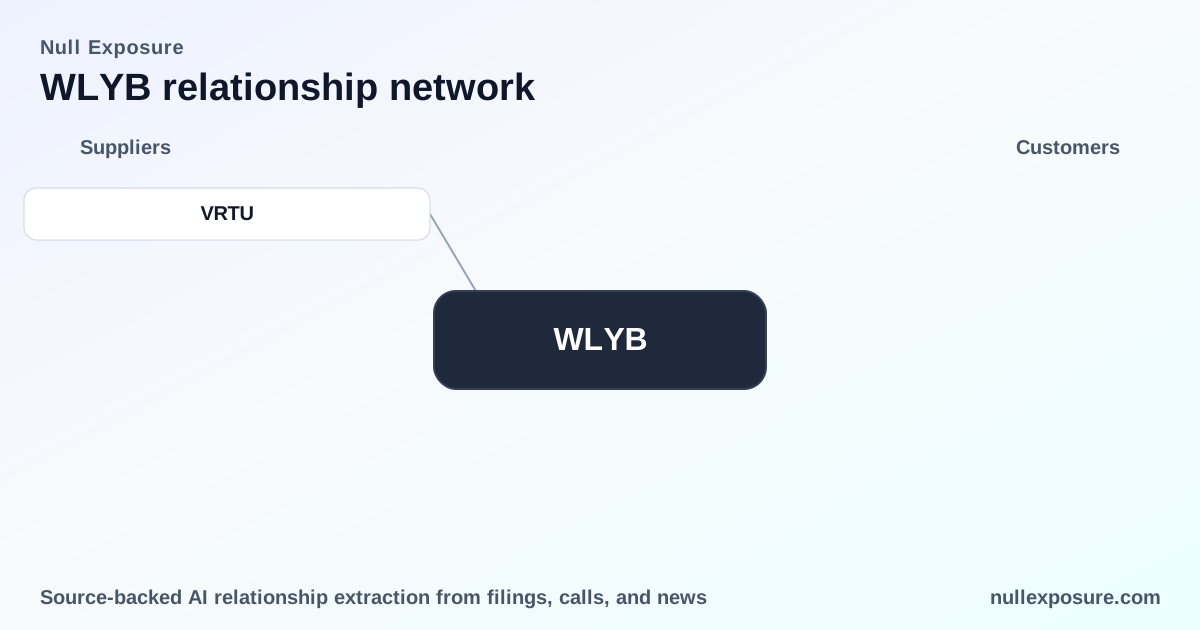
According to a Feb. 10, 2026 press release, Virtusa Corporation signed a multi‑year managed services agreement to provide infrastructure and application services to Wiley, supporting Wiley’s strategic technology initiatives and cloud/engineering execution (https://www.sahmcapital.com/news/content/virtusa-and-wiley-form-a-multi-year-partnership-to-accelerate-wileys-technology-transformation-2026-02-10). This is a clear operational decision to externalize the platform and application layer to a specialist partner, shifting Wiley’s cost base toward variable, vendor-driven spend while accelerating platform modernization.
- Takeaway: Technology operations are now a vendor-managed function; productivity and uptime outcomes are directly linked to Virtusa’s delivery performance and contract terms.
Distribution and print: a deliberate outsourcing posture
Wiley’s filings disclose two persistent supplier patterns that shape operating risk and flexibility:
-
Wiley has an explicit agreement to outsource US book distribution to Cengage Learning, positioned to convert fixed distribution cost into a more variable model and to improve distribution efficiency. This is a named contractual relationship disclosed in company disclosures and investor materials (company filings, FY2026).
Implication: North American physical distribution is concentrated with a third party; logistics performance and commercial terms with Cengage directly affect gross margins on print and hybrid product lines. -
Wiley does not own printing facilities and contracts independent printers and binderies globally to support its publishing needs, using a variety of suppliers and materials (company disclosures).
Implication: Printing is deliberately decentralized to preserve flexibility and capex lightness, but it also creates exposure to supplier capacity constraints, materials price swings and regional logistics disruption.
What these supplier choices tell you about Wiley’s operating model
Wiley’s supplier posture is strategic and consistent with a capital-light, content-first publisher:
- Contracting posture: Wiley favors outsourcing for non-core, scalable functions—printing, distribution and IT operations—translating fixed cost into variable supplier spend. That reduces capex and balance-sheet intensity while transferring operational execution risk to vendors.
- Concentration versus diversification: The US distribution arrangement with Cengage represents concentrated counterparty risk for an important operational flow, whereas printing is broadly diversified across independent presses. Concentration in distribution should be treated as a higher-impact risk event for North American fulfillment.
- Criticality: Technology and distribution are both critical — Virtusa controls core platform uptime and modernization velocity; the distribution partner governs physical fulfillment and returns processing. Failures or contract renegotiations with either class of supplier have immediate P&L and service consequences.
- Maturity: These supplier relationships reflect a mature outsourcing strategy intended to scale digital offerings and control cost structure, consistent with Wiley’s transition from print-heavy revenue to a higher mix of digital and services revenue (Revenue TTM $1.67B; EBITDA $326M).
All identified supplier relationships and what they do for Wiley
Virtusa Corporation — Virtusa signed a multi‑year managed services deal to provide infrastructure and application services to Wiley, outsourcing day‑to‑day technology operations and supporting Wiley’s modernization efforts (PR Newswire via Sahm Capital, Feb. 10, 2026: https://www.sahmcapital.com/news/content/virtusa-and-wiley-form-a-multi-year-partnership-to-accelerate-wileys-technology-transformation-2026-02-10).
Cengage Learning — Wiley disclosed an agreement to outsource its US-based book distribution operations to Cengage Learning to improve distribution efficiency and move to a more variable cost model (company investor filings, FY2026). This places US physical fulfillment under a third-party logistics and distribution partner.
Independent printers and binderies (global) — Wiley does not own printing facilities and contracts independent printers and binderies worldwide for its printing needs, relying on a network of suppliers to service its product line (company disclosures). This operational model minimizes capital expenditure but increases exposure to supplier capacity and input cost dynamics.
Investment implications: where supplier exposure moves the valuation needle
- Operational leverage sits with vendor performance. With Revenue TTM of $1.67B and EBITDA of $326M, supplier execution directly influences margins; a 1–2% swing in distribution or IT-related cost could have a measurable impact on operating income.
- Concentration risk is asymmetric. The Cengage distribution relationship is a single-point dependency for US physical fulfillment; any contract disruption or price reset would be immediately visible to revenue recognition and logistics cost lines.
- Transition risk becomes execution risk. Outsourcing technology to Virtusa accelerates product development but transfers implementation risk to the partner; successful delivery is a prerequisite for subscription growth and retention in digital offerings.
- Supply flexibility is built into the model. Decentralized printing reduces capex and allows volume routing to lower-cost suppliers, supporting margin management in a mixed-format product portfolio.
Practical checklist for investors and operators
- Confirm contract length, termination clauses, SLAs and price escalators for the Virtusa and Cengage agreements. Contract terms are the single most important determinant of risk.
- Monitor operational KPIs tied to supplier performance: platform uptime, release cadence, fulfillment lead times and return rates.
- Stress-test margin sensitivity to a distribution cost reset or temporary printing capacity shortfall; quantify the P&L impact at 1% and 3% cost movements.
- Evaluate counterparty credit and concentration: a single major distribution partner creates a counterparty credit risk vector that must be priced.
For a deeper supplier-risk score and to benchmark these relationships against peers visit https://nullexposure.com/.
Conclusion — what to price in now
Wiley’s supplier posture is intentional: outsourced technology, a concentrated US distribution agreement, and decentralized printing together reduce capex and accelerate digital growth while transferring operational risk to third parties. Investors should price in the benefits of lower capital intensity and faster digital execution, but also the asymmetric downside of concentrated distribution and vendor-delivered technology outcomes. Active monitoring of contract terms and vendor KPIs is essential to convert Wiley’s supplier strategy into predictable cash-flow upside.
If you want a tailored supplier-risk briefing or to integrate these signals into a portfolio dashboard, start here: https://nullexposure.com/.