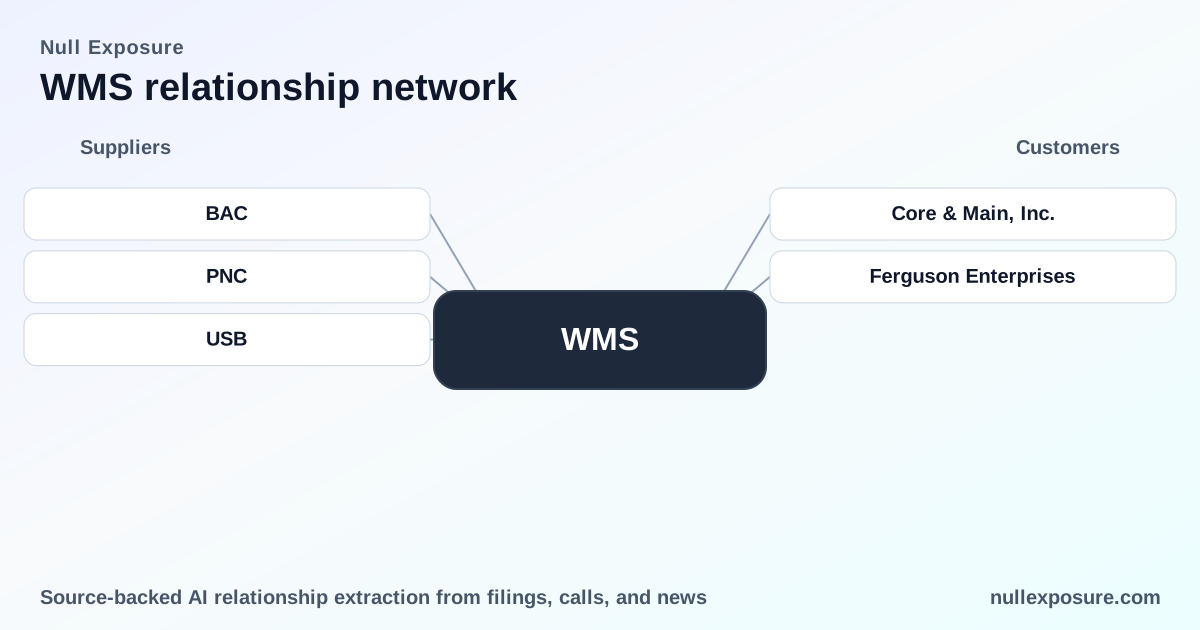
Advanced Drainage Systems (WMS): supplier posture and the bank counterparties underwriting growth
Advanced Drainage Systems designs, manufactures and sells thermoplastic corrugated pipe and water-management solutions and monetizes through volume-driven product sales to infrastructure, residential, and commercial projects. The business converts raw resin into differentiated drainage products, leverages scale to secure supply, and funds capital allocation through a mix of cash flow and capital markets — Revenue TTM ~$2.99B, EBITDA ~$900M, market cap ~$10.93B. For investors evaluating supplier and financing counterparties, the firm’s operating model is defined by bulk resin procurement, long-term supplier commitments, and recurring working-capital and long-term financing relationships. Learn more at https://nullexposure.com/.
Why the supplier story matters to investors: procurement defines margins and leverage
ADS is a high-volume buyer of polymer resin — the feedstock for its pipes — purchasing in excess of 1.0 billion pounds annually from roughly 400 suppliers. The company reports multi-year supply agreements with major resin suppliers that generally do not fix prices, which means margins depend on both procurement scale and commodity price cycles. Given that resin is derived primarily from North American natural gas liquids and crude derivatives, the procurement footprint is regionally concentrated and sensitive to energy and feedstock swings.
- Contracting posture: ADS negotiates multi-year commitments that secure volume but leave price exposure intact, transferring commodity risk to the P&L rather than locking cost.
- Concentration and scale: A diversified supplier count (≈400) reduces single-vendor concentration risk, yet the sheer volume purchased concentrates the company’s exposure to resin price direction.
- Criticality and maturity: Resin is a mission-critical input; ADS’s scale gives it negotiating leverage and operational maturity, but procurement risk remains a primary margin driver.
These are company-level operating signals: ADS is a buyer in North America with long-term supply relationships that prioritize volume certainty over price certainty. For investors focused on supplier relationships, that combination implies demand-side stability but cost-side cyclicality. For strategic diligence and modeling, factor in price pass-through assumptions, inventory strategies, and the timing of capital programs. If you want a deeper read on counterparties and credit interplay, visit https://nullexposure.com/ for targeted exposure analysis.
Financing counterparties tied to recent capital moves
A March 10, 2026 report tracked a financing package in which ADS priced new notes and expanded credit facilities; the bank roles in that package are the three relationships covered below. Each relationship is contextualized by the financing act — issuance of $500 million 2034 notes and an amendment/expansion of credit facilities.
Bank of America
- Bank of America served as the term agent in ADS’s financing package tied to the $500 million 2034 notes and facility expansion. According to a TradingView report on March 10, 2026, Bank of America acted as the term agent alongside other lenders in the deal.
- Source: TradingView coverage of ADS’s March 10, 2026 financing announcement.
PNC Bank
- PNC Bank was listed as the revolver agent for ADS’s expanded credit facilities, managing the company’s revolving-lending mechanics and short-term liquidity provisions. TradingView’s March 10, 2026 article identifies PNC as the revolver agent in the transaction.
- Source: TradingView coverage of ADS’s March 10, 2026 financing announcement.
U.S. Bank Trust Company
- U.S. Bank Trust Company was engaged as trustee for the note issuance, a standard role to administer bondholder interests and document handling for the $500 million notes due 2034. TradingView’s March 10, 2026 report lists U.S. Bank Trust Company in this capacity.
- Source: TradingView coverage of ADS’s March 10, 2026 financing announcement.
What these banking relationships reveal about capital strategy
The split of roles — PNC as revolver agent, Bank of America as term agent, and U.S. Bank Trust as trustee — signals a conventional but important financing structure: short-term working capital managed through a revolving facility, discrete term debt for longer-dated capital needs, and a trustee to formalize noteholder rights. This structure supports both operational liquidity and balance-sheet flexibility while allowing ADS to access capital markets for longer-term duration. TradingView reported the package on March 10, 2026, describing the $500M 2034 notes issuance and credit facility expansion that assigned these roles.
How supplier constraints translate into investment risk and opportunity
Treat procurement constraints as company-level exposures that flow through margins, cash generation, and leverage:
- Price volatility risk is material. Long-term volume agreements without fixed pricing leave margins exposed to resin cost swings; investors should stress-test gross margins for feedstock price scenarios.
- Operational scale is an asset. Buying >1B pounds a year and dealing with ~400 suppliers gives ADS negotiating leverage and supply redundancy — a competitive advantage in tight markets.
- Geographic sourcing is relevant. Resin sourcing is predominantly North American, tying ADS’s feedstock cost and availability to regional energy markets and logistics.
- Financing cadence reduces refinancing risk. The recent term and revolver roles assigned to established banks indicate credible access to both bank capital and capital markets, which reduces short-term refinancing risk while supporting capex and working-capital cycles.
From a valuation perspective, incorporate these constraints into cash-flow scenarios and covenant stress tests: procurement-driven margin compression influences the company’s EBITDA trajectory, which in turn affects leverage ratios and refinancing capacity.
Practical next steps for relationship diligence
For operators and investors assessing WMS supplier relationships, prioritize the following actions:
- Map feedstock contract tenure and the degree of price pass-through in end-market pricing.
- Quantify short- and long-term exposure to resin price moves under several demand scenarios.
- Review financing covenants tied to the recent facility expansion and note issuance to determine covenant headroom.
If you need a firm-level counterparty audit or tailored exposure analysis, start your review at https://nullexposure.com/ — we provide structured credit and supplier mapping for market participants.
Bottom line
Advanced Drainage Systems operates as a scale-driven manufacturer whose margin profile is dictated by raw-resin procurement and commodity price dynamics, while corporate financing is supported by major banks in conventional agent and trustee roles. Investors should weigh procurement price exposure and financing structure together: stable demand and purchasing scale are strategic strengths, but long-term, unfixed-price supply agreements create cyclicality in earnings that translates into sensitivity in leverage and valuation. For a deeper read into counterparties and exposures, visit https://nullexposure.com/.