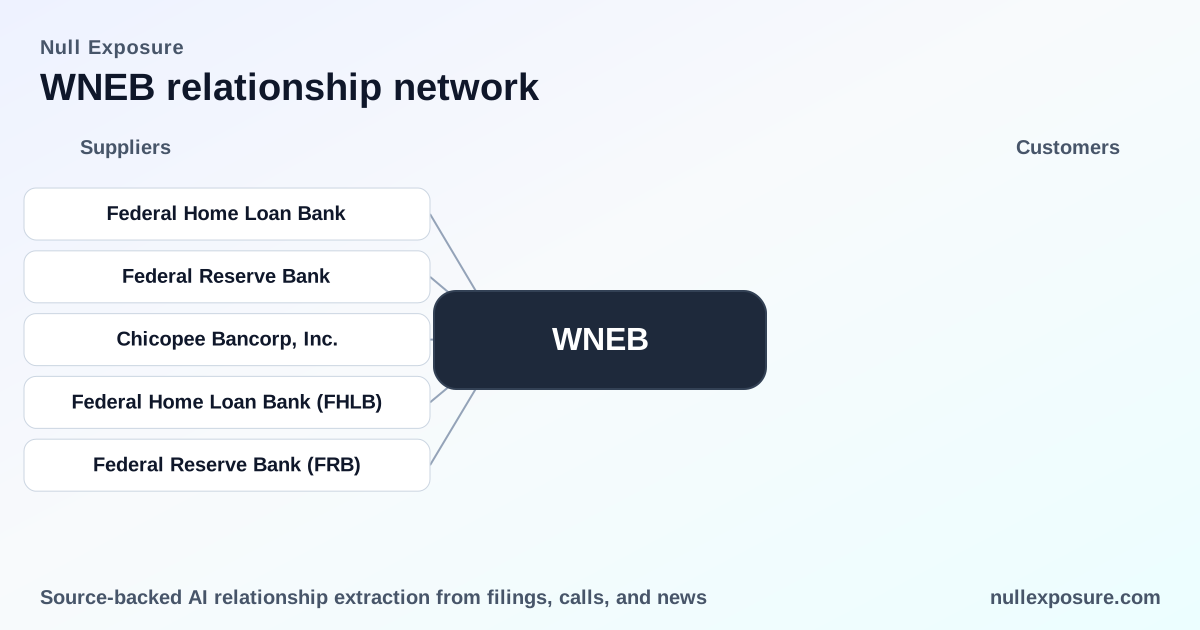
Western New England Bancorp (WNEB): Supplier and Counterparty Brief for Investors
Western New England Bancorp operates as the holding company for Westfield Bank, monetizing a traditional regional banking franchise through net interest income on a $0.82 billion revenue base, fee income, and a modest dividend return to shareholders. The bank supports its lending and liquidity profile with secured and unsecured borrowing lines and relies on third-party service providers for core processing and ancillary operations. For investors, the supplier map is a near-term proxy for liquidity resilience, operational continuity, and concentration risk—each of which materially impacts capital deployment and the bank’s return profile.
Explore connected-party intelligence and supplier risk for your portfolio at https://nullexposure.com/.
Why counterparties matter more than they look
Regional banks are simple in business model but complex in counterparty exposure. Western New England Bancorp’s balance sheet management depends on a small set of high-impact relationships: secured funding through the Federal Home Loan Bank, contingency access to the Federal Reserve Discount Window, and ongoing vendor contracts that underpin daily operations. These relationships are not theoretical: they are active, contracted, and sized to be consequential to liquidity and operational continuity.
Key operating model signals from the company disclosure:
- Short-term contracting posture: the bank uses short-term advances and overnight lines as a routine liquidity tool, consistent with its asset-liability management approach and use of brokered deposits.
- Long-term vendor commitment: a core systems contract in place since 2016 creates a multi-year service dependency and a defined spend profile.
- Critical materiality for FHLB access: at the company level, the FHLB relationship is integral to the bank’s funding program and collateral strategy.
These are company-level characteristics that shape counterparty risk and procurement strategy. For granular sourcing and relationship specifics, read on.
The active counterparty map and what each relationship delivers
Federal Home Loan Bank (FHLB)
Western New England Bancorp maintains substantial pledged collateral and formal borrowing capacity with the FHLB, making that relationship a central source of secured liquidity for the bank. According to the company’s disclosures, the bank had $538.6 million of additional borrowing capacity at the FHLB as of December 31, 2025, and historically pledged $906.0 million of eligible collateral to support FHLB borrowing capacity as of December 31, 2024. (GlobeNewswire press release, January 27, 2026; company filings for year-end 2024).
Federal Reserve Bank (FRB) — Discount Window access
The bank retains contingent access to the Federal Reserve Discount Window, reported as $349.0 million of additional borrowing capacity at year-end 2025, providing a secondary priced source of liquidity. The company explicitly lists this capacity alongside FHLB availability in its January 27, 2026 results release. (GlobeNewswire press release, January 27, 2026).
Chicopee Bancorp, Inc.
A historical asset transfer continues to have modest financial impacts: the bank recorded a $624,000 recovery on a previously charged-off commercial relationship acquired from Chicopee Bancorp, Inc., with the relationship ultimately paid in full as of mid‑2025. This item is disclosed in the company’s FY2025 results and explains a small, one-off credit recovery rather than an ongoing operational linkage. (GlobeNewswire press release republished by ManilaTimes, January 28, 2026).
Contracting posture, spend profile and vendor concentration
The company’s disclosures show a mixed contracting posture: routine use of short-term liquidity facilities and brokered deposits as part of asset-liability management, combined with a long-term contractual commitment for core banking services that began in 2016. Total remaining contractual obligations to that unnamed core vendor were estimated at $7.1 million as of December 31, 2024, with $6.1 million due within one year and $1.0 million over the following three years—placing the vendor spend squarely in a $1–10 million band. These obligations indicate an active and material service-provider relationship that the bank relies on for daily operations (company disclosures for year-end 2024).
Liquidity and funding implications: short-term flexibility, long-term lock-in
Western New England Bancorp’s funding strategy combines ample committed secured capacity (FHLB), contingent central bank liquidity (FRB Discount Window), and tactical use of brokered deposits and overnight lines to manage growth beyond internal deposit generation. The availability numbers—$538.6 million at FHLB and $349.0 million at the FRB Discount Window as of December 31, 2025—signal ample runway for near-term asset growth or stress absorption, while the long-term core contract ties the bank into a multi-year operational relationship that is both a continuity benefit and a contractual rigidity. (GlobeNewswire press release, January 27, 2026; company disclosures as of December 31, 2024).
If you want a consolidated view of a bank’s counterparty exposures and contractual commitments, visit https://nullexposure.com/ for an investor-grade supplier map.
What to watch: concentration, counterparty health, and timing risks
- FHLB concentration: the pledged-collateral relationship is explicitly material; monitor FHLB pricing and collateral eligibility rules for any changes that could reduce usable capacity. (Company filings for year-end 2024).
- Central-bank access: Discount Window capacity provides frictionless backstop, but usage has price and signaling consequences; track any move from capacity to drawdowns in stress scenarios. (GlobeNewswire, January 27, 2026).
- Vendor termination and replacement risk: the long-term core provider contract reduces short-term migration risk but creates execution and vendor-concentration risk if problems arise; the remaining contractual obligation magnitude is meaningful relative to the bank’s administrative spend. (Company disclosures for year-end 2024).
Investment implications and a short action checklist
- Balance-sheet resilience: The combination of FHLB and FRB capacity materially reduces immediate liquidity risk; stress tests should assume haircuts on pledged collateral to model usable liquidity.
- Operational dependency: The long-term core vendor relationship is an operational single point of failure; confirm vendor SLAs and contingency arrangements in diligence.
- Credit tail events: Small recoveries like the Chicopee acquisition recovery are immaterial to the bank’s earnings base but illustrate the benefits of disciplined workout and acquired-asset management.
For investors performing counterparty due diligence, download a supplier risk snapshot and related filings at https://nullexposure.com/.
Bottom line
Western New England Bancorp runs a conservatively funded regional banking model supported by significant secured borrowing capacity at the FHLB, contingency access to the Federal Reserve, and a defined long-term vendor relationship for core services. FHLB access is the most critical supplier relationship, FRB access is an important contingency, and the core provider contract is the key operational dependency. These three axes—funding, contingency, and operations—should drive any investor or operator diligence on the name.
To get a tailored view of WNEB’s counterparty network and supplier risk scoring, visit https://nullexposure.com/ and request the supplier brief.