WNS supplier relationships: liquidity lines, cloud partnerships, and operational constraints investors should price in
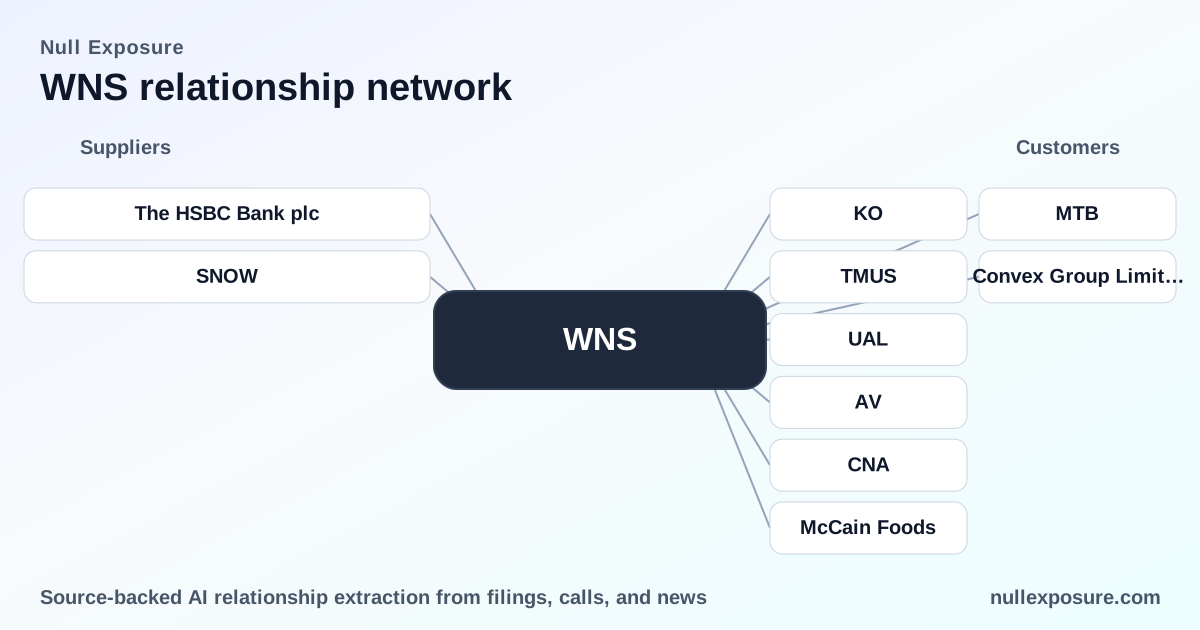
WNS Holdings operates as a global provider of business process services, monetizing through long‑term client contracts and by coordinating a network of third‑party suppliers and technology partners to deliver outsourced processes. Its economics depend on fee income from client engagements, the ability to control supplier costs for subcontracted services, and selectively leveraging bank credit for working capital needs. For investors and procurement leaders, the supplier footprint combines routine banking relationships with strategic cloud partnerships and operational subcontracting that together shape margin risk and service continuity.
Learn more about supplier risk analytics at https://nullexposure.com/.
Why two simple filings matter: what the HSBC lines reveal about working capital posture
According to WNS’s FY2025 Form 10‑K, WNS Global Services Philippines Inc. holds an unsecured $15.0 million line of credit from The HSBC Bank plc, and WNS North America Inc. holds an unsecured $40.0 million line of credit from the same bank for working capital purposes. Those facilities are explicitly unsecured and structured at the subsidiary level, which means WNS uses bank credit to smooth cash flow within legal entities rather than relying exclusively on centralized corporate funding.
Financial implications are straightforward: unsecured subsidiary facilities signal routine short‑term liquidity management rather than asset‑backed borrowing, and they reflect banking counterparties’ comfort with WNS’s operational cash generation in those jurisdictions. Investors should price in the possibility that rolling these lines or scaling them materially would be a function of ongoing operating cash performance and counterparty relationships.
Snowflake collaboration: a capability play that changes delivery economics
A July 2025 news report identified a collaboration between WNS and Snowflake to accelerate AI and data modernization initiatives across client verticals. The partnership centers on leveraging Snowflake’s data platform to enhance WNS’s analytics and AI‑driven service offerings.
This is a strategic tech partnership rather than a transactional supplier arrangement: it broadens WNS’s product stack, increases technical stickiness with data‑centric clients, and shifts some delivery economics from labor‑heavy workflows to platform‑enabled outcomes. For clients and investors, the value lies in faster time‑to‑insight and potential margin expansion as analytics become embedded in higher‑value services.
Catalog of supplier relationships visible in public records
- The HSBC Bank plc – WNS Global Services Philippines Inc.: WNS’s FY2025 10‑K discloses an unsecured $15.0 million line of credit to the Philippines subsidiary for working capital needs, indicating a direct banking relationship at the local entity level (FY2025 10‑K filing).
- The HSBC Bank plc – WNS North America Inc.: The same FY2025 10‑K shows an unsecured $40.0 million line of credit to the North American subsidiary for working capital purposes, confirming decentralized treasury facilities with the bank (FY2025 10‑K filing).
- Snowflake (SNOW): A July 2025 industry report describes a collaboration to boost AI and data modernization, positioning Snowflake as a technology partner in WNS’s data strategy and delivery model (news report, July 2025).
What the service‑provider constraint tells about WNS’s supplier model
Public constraint excerpts classify WNS’s supplier interactions in its BFSI segment as payments to third‑party repair centers where WNS acts as the principal and then evaluates revenue net of repair payments. That is a company‑level signal showing WNS frequently subcontracts operational tasks and re‑bills or bundles them within client contracts. The practical implications:
- Contracting posture: WNS often acts as the principal in client relationships and retains responsibility for third‑party suppliers’ deliverables rather than acting merely as an agent. This increases legal and operational responsibility for supplier performance.
- Criticality and maturity: Using subcontracted repair centers for BFSI processing indicates an operationally critical supplier layer with established processes for revenue recognition and expense management, consistent with a mature outsourcing model.
- Cost and margin transmission: When WNS evaluates revenue net of supplier payments, supplier cost shocks have a direct and visible impact on segment margins.
These are company‑wide characteristics and are not assigned to any single named supplier unless the constraint explicitly identifies one.
Risk and concentration considerations investors should price
WNS’s public disclosures produce a compact but actionable risk map:
- Liquidity risk: Subsidiary unsecured lines are a positive short‑term tool but represent rolling reliance on bank counterparty goodwill; lenders could reprice or restrict access under stress.
- Vendor concentration risk: The filings do not disclose the breadth or concentration of repair centers or cloud partners; absence of disclosure is itself a risk that requires diligence.
- Operational dependency: Acting as principal for subcontracted services increases WNS’s operational exposure to third‑party failures, especially in BFSI where repair/service continuity is critical.
- Upside from tech partnerships: The Snowflake collaboration is value‑accretive, likely improving product differentiation and client retention; however, it introduces platform‑dependency that should be monitored for commercial terms and upgrade costs.
For procurement and risk teams, the immediate questions are: how concentrated are repair suppliers by geography and client; what are the SLA and indemnity terms with cloud partners; and how material are subsidiary bank lines relative to operating cash requirements?
Get deeper supplier intelligence at https://nullexposure.com/ to support those diligence steps.
Recommended next steps for investors and operators
- Request the schedule of material third‑party suppliers and their revenue or spend share to quantify concentration.
- Review contractual terms where WNS acts as principal — focus on indemnities, pass‑through pricing, and downtime remedies.
- Ask for details on the Snowflake engagement: data residency, cost sharing, revenue‑sharing clauses, and long‑term commercial exclusivity, if any.
- Model scenarios that stress supplier costs and working capital access to see margin and liquidity sensitivity.
Bottom line: WNS combines routine banking relationships for working capital with strategic cloud partnerships and a subcontracting model in key verticals. These features support scale and capability expansion but also concentrate operational responsibility and counterparty risk. Investors should treat supplier controls, contract terms, and the structure of subsidiary financing as active inputs to valuation and operational risk assessment.
For more supplier risk profiles and actionable diligence tools, visit https://nullexposure.com/.