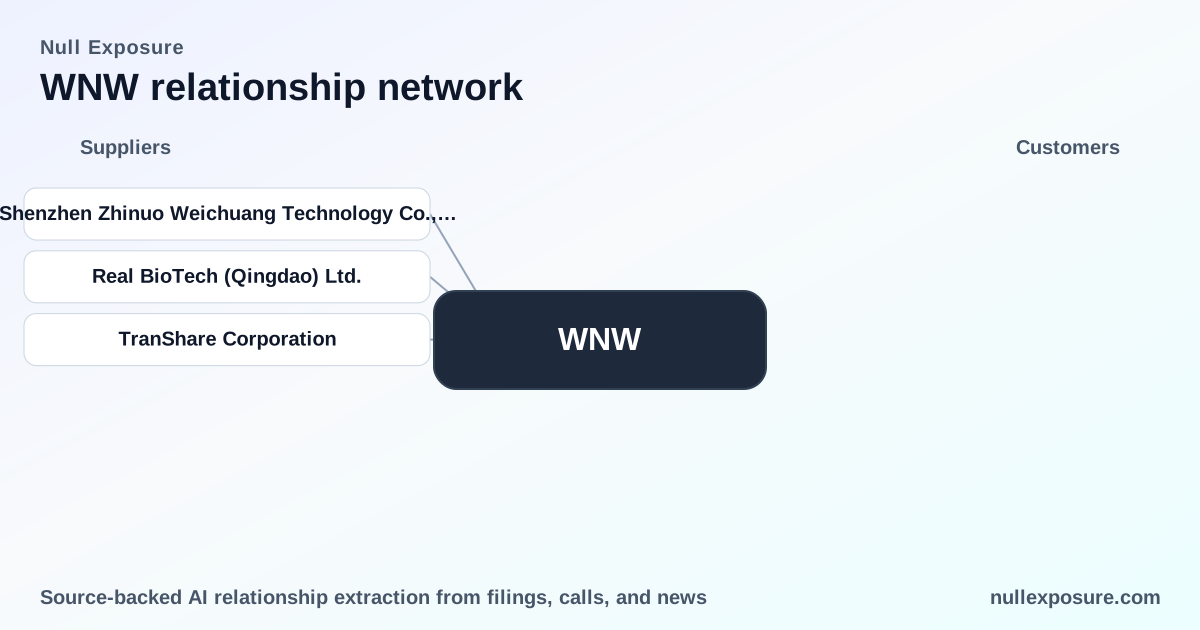
Meiwu Technology (WNW): supplier map and what it means for investors
Meiwu Technology Co Ltd (ticker WNW) operates an online grocery and food retail platform in China and monetizes primarily through retail sales on its platform and ancillary commercial partnerships. Recent public disclosures show a small-cap Nasdaq-listed operator supplementing core retail activity with marketing engagements, R&D memoranda of understanding, and routine corporate services such as transfer-agent arrangements — each relationship offering a window into the company’s commercialization and growth posture. For deeper supplier mapping and supplier-risk scoring, visit https://nullexposure.com/.
The business in plain terms: how WNW runs and earns
WNW is a consumer-cyclical internet retailer focused on online food sales in China. The company reports Revenue TTM of 2,550,200 USD and Gross Profit TTM of 340,780 USD, while carrying a small market capitalization (approximately 115.3 million USD) and a lean public float (Shares Float: 2,370,400). Operating results show negative EBITDA (-1,917,870 USD) but a positive reported EPS figure, reflecting the unusual accounting and capital structure dynamics of a small Chinese ADR-like listing.
These financials combine with the revealed supplier relationships to paint an operating model characterized by:
- Outsourced marketing and product development for growth initiatives rather than fully in-house execution.
- Low supplier disclosure density in public filings and press releases, which puts a premium on active supplier due diligence.
- High concentration risk at the investor level: small float, low institutional ownership (14%), and limited insider dilution suggest that supplier disruptions could have outsized operational impact.
If you are screening counterparties or sizing vendor risk, get the full supplier dossier at https://nullexposure.com/.
Supplier relationships: who WNW is working with (complete list)
Each relationship below corresponds to a public disclosure aggregated across the company’s FY2025 communications.
-
Shenzhen Zhinuo Weichuang Technology Co., Ltd.
WNW engaged Shenzhen Zhinuo Weichuang for comprehensive marketing services under a term running from July 1, 2025 to June 30, 2026, signaling the use of external agencies to drive customer acquisition and brand activity. See the company’s strategic-partnership announcement on GlobeNewswire (June 17, 2025) and reporting on MacauBusiness (March 10, 2026): https://www.globenewswire.com/news-release/2025/06/17/3100644/0/en/Meiwu-Technology-Company-Limited-and-Shenzhen-Zhinuoweichuang-Technology-Co-Ltd-Form-Strategic-Partnership.html and https://macaubusiness.com/meiwu-technology-company-limited-and-shenzhen-zhinuo-weichuang-technology-co-ltd-form-strategic-partnership/. -
Real BioTech (Qingdao) Ltd.
Meiwu signed a memorandum of understanding with Real BioTech to leverage the partner’s R&D capabilities and marine biological resources to provide R&D support, technical services, and consulting — an indication WNW is pursuing product and supply-chain innovation via third-party scientific partners. See the GlobeNewswire MOU announcement (Dec 3, 2025): https://www.globenewswire.com/news-release/2025/12/03/3199404/0/en/meiwu-technology-co-ltd-announces-mou-with-real-biotech-qingdao-ltd.html. -
TranShare Corporation
TranShare is referenced in WNW’s share-exchange communications as the company’s transfer agent responsible for issuing updated share certificates as part of the stock exchange process, a routine corporate services relationship rather than an operational supplier. See the investor notice summarized on Yahoo Finance (press release posting): https://finance.yahoo.com/news/meiwu-technology-company-limited-announces-123000485.html.
What these relationships reveal about operating posture and supplier risk
Collectively, the disclosed suppliers show a deliberate, outsourced approach to growth and product development:
- Contracting posture: WNW uses fixed-term marketing contracts and MOUs rather than owning end-to-end marketing or R&D capability, which accelerates go-to-market execution but shifts control and key performance dependencies to service providers.
- Concentration and criticality: The public record lists a small number of named partners across marketing, R&D, and corporate administration; this suggests potential concentration in critical growth functions and the need to verify backup suppliers and SLAs.
- Operational maturity: The presence of formal MOUs and negotiated service terms indicates commercial sophistication, but negative EBITDA and small scale imply the company is still in a growth-investment phase rather than steady-state cash generation.
- Disclosure signal: The available public disclosures show limited supplier transparency, which is a company-level signal — investors should treat supplier visibility as a governance and operational risk factor until further vendor documentation is available.
Key takeaway: marketing and R&D partners are material to execution; transfer-agent arrangements are routine. Investors should prioritize proof points around contract terms, termination rights, and deliverable KPIs for the marketing engagement and the R&D MOU.
Investment considerations and near-term due diligence checklist
- Growth drivers: outsourced marketing spend (Zhinuo Weichuang) and product R&D collaboration (Real BioTech) are explicit levers for revenue expansion.
- Operational risks: small float and low institutional ownership concentrate downside sensitivity; supplier dependence amplifies execution risk.
- Governance: publicly available supplier disclosures are limited; confirm counterparty creditworthiness and contract enforceability in China.
Recommended verification steps before allocating capital:
- Obtain copies of the marketing services agreement and confirm KPIs, fees, and termination provisions.
- Request the Real BioTech MOU deliverables timeline and whether it converts to a binding development contract.
- Validate TranShare transfer-agent arrangements and share-register reconciliation as part of corporate governance checks.
If you need a detailed supplier risk report and contract redlines, explore services at https://nullexposure.com/.
Bottom line: where supplier relationships move the needle
Meiwu’s public supplier record for FY2025 shows targeted externalization of growth-related activities with marketing and R&D partners while retaining standard corporate service relationships. For investors, the core questions are contract quality, counterparty capacity, and the company’s ability to convert outsourced activity into measurable revenue gains. Given the company’s small public float and mixed profitability metrics, supplier performance will have disproportionate impact on near-term results.
Next steps for investors: secure contract-level evidence, stress-test counterparty continuity scenarios, and track operational KPIs tied to the Zhinuo Weichuang marketing program and Real BioTech development milestones. For vendor benchmarking and supplier risk scoring, visit https://nullexposure.com/ for supplier intelligence tailored to WNW and comparable issuers.