Wolfspeed (WOLF): supplier relationships, contract posture, and operational constraints investors should price in
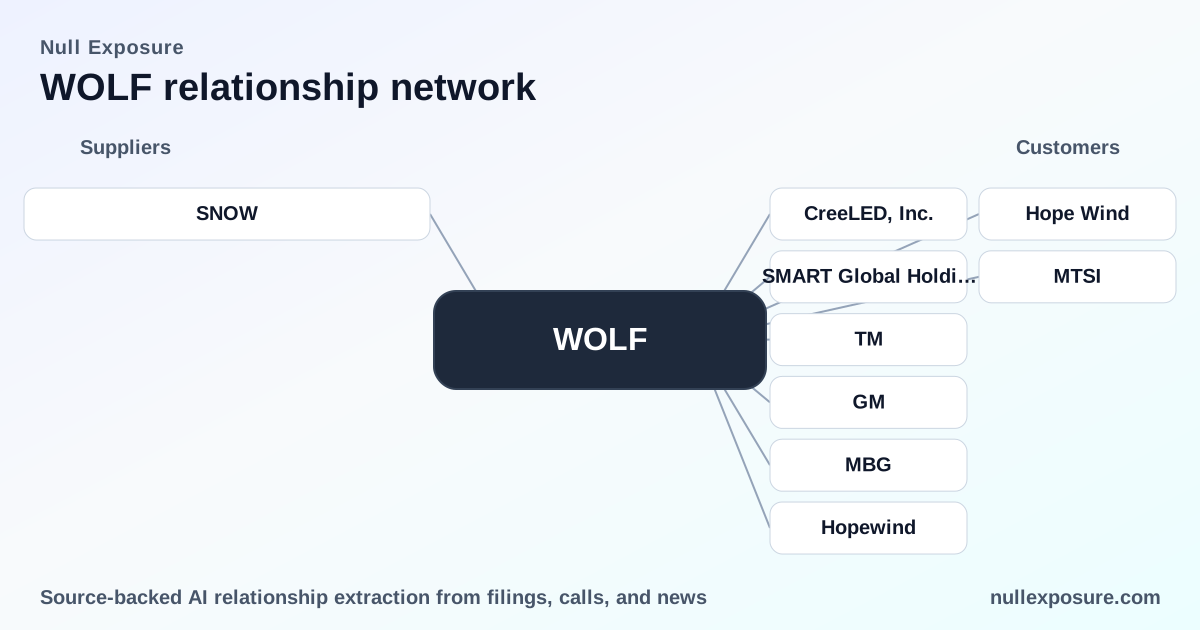
Wolfspeed manufactures and sells silicon carbide (SiC) and gallium nitride (GaN) semiconductor products used in electric vehicles, 5G infrastructure and renewable energy systems; it monetizes by selling manufactured wafers and devices and by locking in capacity through large, long‑dated purchase and reservation commitments that underwrite its capital‑intensive fabs. The company’s commercial model is capital‑heavy and supply‑anchored: revenue comes from device sales and long‑term capacity contracts, while margins and free‑cash‑flow depend on supplier terms for key materials, power and outsourced manufacturing. For a concise supplier risk briefing and relationship map, visit https://nullexposure.com/.
How Wolfspeed’s supplier posture translates to value and risk
Wolfspeed’s operating model is built around scaling proprietary wide‑bandgap production capacity. That creates two structural realities: material long‑term supplier commitments that convert fixed costs into predictable throughput, and concentration of critical inputs—raw materials, specialized equipment and electricity—that are difficult to substitute quickly. The company disclosed take‑or‑pay inventory commitments totaling $202.1 million over the next four years and long‑term electricity supply obligations (approximately $62.4 million over five years and $25.7 million over eight years for specific facilities), which underwrite production but also lock in cash outflows and counterparty exposure.
Financially, Wolfspeed is still in a scaling phase: trailing revenue is $747.7 million with negative gross profit and operating margins, and a diluted EPS loss of -$13.28 (TTM). These figures reinforce that supplier terms and capital scheduling are central to valuation because operating leverage and margin recovery depend on converting contracted capacity into profitable volume.
Public relationships observed in the reporting and media
Below I cover each identified relationship in the source evidence set; each entry is a concise, plain‑English summary with a direct source citation.
Snowflake — Finviz news item (entry 1)
Wolfspeed is using Snowflake’s data and AI capabilities to accelerate manufacturing and operations, signalling a push to centralize production data for efficiency and AI‑driven workflows. Source: Finviz news article, March 10, 2026 (https://finviz.com/news/246087/wolfspeed-just-got-a-698-million-lifeline-heres-why-that-changes-everything).
Snowflake — Finviz news item (entry 2)
A separate Finviz piece reiterated Wolfspeed’s acceleration of AI‑powered manufacturing via Snowflake, highlighting the recurring media narrative that Wolfspeed is investing in cloud data infrastructure and third‑party AI to scale operations. Source: Finviz news article, March 10, 2026 (https://finviz.com/news/253780/if-youd-invested-10000-in-wolfspeed-3-years-ago-heres-how-much-youd-have-today).
Company‑level constraints that drive procurement strategy and counterparty risk
The filings and disclosures present a coherent set of supplier constraints that shape procurement strategy and supplier governance:
- Contracting posture: predominantly long‑term with some spot purchases. Wolfspeed maintains long‑term supplier and utility agreements (including minimum spend/volume requirements) and also uses discrete purchase orders for items bought on the spot market; this mix supports capacity planning while preserving tactical flexibility.
- Spend concentration is material and explicit. Take‑or‑pay inventory commitments ($202.1 million) and multi‑year electricity commitments place Wolfspeed comfortably in the >$100m spend band for certain supplier relationships, with additional supplier spend in the $10m–$100m range for utilities.
- Supplier role and criticality: manufacturer and service provider split. Wolfspeed uses contract manufacturers—some with captive lines—and outsources assembly and testing across Asia, creating critical third‑party manufacturing nodes that are not easily duplicated on short notice.
- Geographic exposure: significant APAC operations. Contract manufacturing and assembly in Asia concentrate operational risk regionally, affecting resilience and lead‑time management in the event of supply disruption.
- Technology/service dependencies. Wolfspeed licenses third‑party AI and software components; continued access to those platforms at scale is a dependency that affects production optimization and analytics capability.
These constraints are company‑level signals about Wolfspeed’s supply chain risk profile and should be incorporated into counterparty risk models and scenario analyses.
For deeper supplier mapping and to track how these contractual exposures evolve, see https://nullexposure.com/.
What this means for investors and procurement operators
Wolfspeed’s supplier relationships and contractual constraints create a profile with clear investment and operational implications:
- Upside pathway: Long‑term commitments and reservation deposits support predictable capacity growth; if demand scales as expected, these agreements convert into durable revenue and margin expansion.
- Downside exposure: The same long‑dated obligations amplify cashburn if revenue growth stalls; take‑or‑pay clauses and multi‑year power contracts create fixed cash outflows that are difficult to renegotiate quickly.
- Counterparty concentration risk: Heavy reliance on contract manufacturers in Asia and on specialized equipment suppliers increases exposure to geopolitics, logistics shocks and supplier failures.
- Operational leverage on software partners: Licensing third‑party AI and cloud infrastructure is a force multiplier for scale, but it introduces vendor availability and pricing risk that will be material as production ramps.
Operators should prioritize scenario planning around demand slippage, renegotiation levers in take‑or‑pay contracts, and alternative sourcing for critical inputs. Investors should model cash needs for committed spend bands and monitor supplier concentration metrics alongside revenue ramp figures.
Relationship monitoring checklist — what to watch next
- Watch renewal or renegotiation outcomes for multi‑year power and inventory commitments; any easing would be a structural positive for cash flow.
- Track evidence of Snowflake (and other analytics) integration delivering yield or throughput improvements in manufacturing KPIs.
- Monitor supplier diversification efforts, especially the degree to which Wolfspeed brings additional capacity in‑house versus expands contract manufacturing in APAC.
- Follow quarterly disclosures for changes in take‑or‑pay exposure and capacity reservation deposits.
For ongoing, tradeable intelligence on Wolfspeed’s supplier exposures and contractual obligations, return to https://nullexposure.com/.
Wolfspeed is executing a classic capital‑intensive semiconductor growth playbook: large, long‑dated supplier commitments that both finance scale and concentrate operational risk. Investors and supplier managers must value the upside from secured capacity and AI‑enabled operations against the cash and concentration risks embedded in those contracts.