Worthington Industries (WOR): Strategic suppliers, counsel, and what they mean for investors
Worthington Industries operates as a vertically integrated metal fabricator that processes and sells value‑added steel and metal products across Consumer and Building Products segments, monetizing through manufacturing margin, targeted M&A, and value‑added service offerings to downstream OEMs and distributors. The company’s economics are driven by steel input management, targeted acquisitions to broaden product breadth, and a mix of long‑term supply arrangements that stabilize input cost volatility. For a consolidated view of supplier relationships and risk signals, visit https://nullexposure.com/.
Deal advisors and legal counsel — the headline relationships
Worthington’s recent M&A activity is coordinated with top‑tier advisors and counsel that shape deal execution and integration.
-
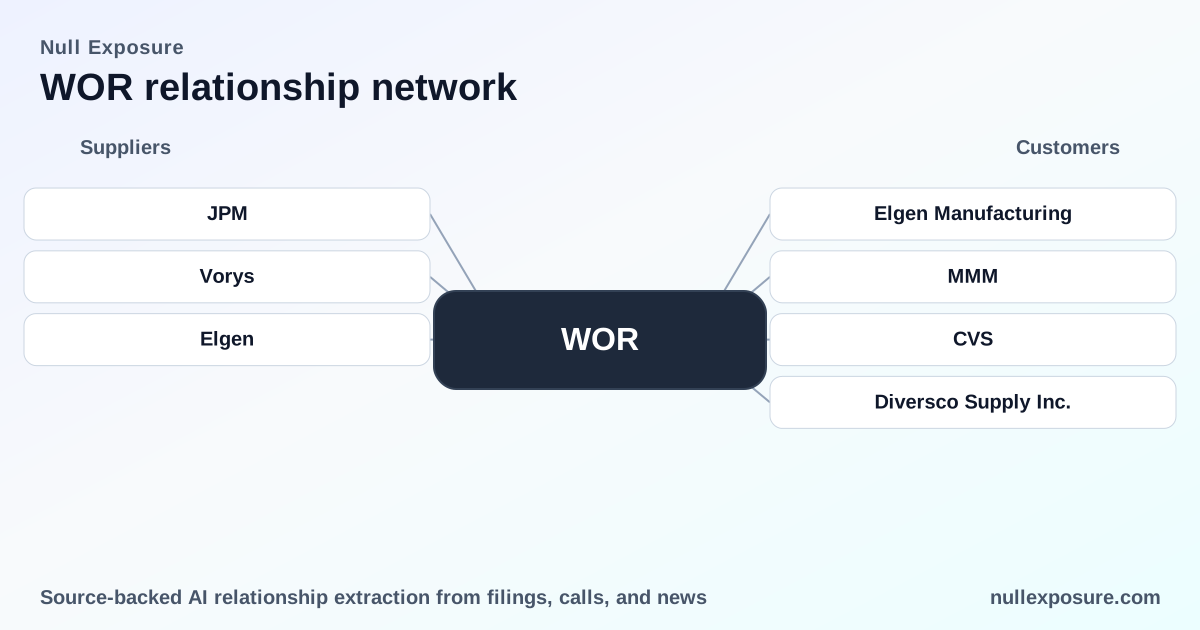
J.P. Morgan Securities LLC is serving as Worthington’s exclusive financial advisor in the announced acquisition activity tied to the LSI Group transaction, providing deal structuring and execution services during FY2025. According to a GlobeNewswire press release dated December 16, 2025, J.P. Morgan was named exclusive advisor on that transaction. (GlobeNewswire, 2025-12-16)
-
Vorys is acting as legal counsel to Worthington Enterprises for the same transaction, supporting regulatory, transactional, and closing activity. The GlobeNewswire announcement identifies Vorys in this advisory role for the LSI Group acquisition. (GlobeNewswire, 2025-12-16)
These relationships signal a conventional M&A contracting posture: external advisors for execution combined with internal integration capability to scale newly acquired product lines into Worthington’s channels.
Operational M&A that broadens product mix
Worthington has been executing bolt‑on acquisitions to expand Building Products and HVAC components exposure.
- Elgen, a provider of HVAC parts and components, was acquired to enhance the Building Products segment’s product portfolio and market position, according to reporting summarizing Worthington’s SEC 10‑Q for FY2026. (TradingView summary of Worthington SEC 10‑Q, FY2026)
This targeted acquisitive growth supports cross‑sell opportunities into existing distribution and fabrication capacity and reduces single‑product exposure.
Company‑level constraints that shape supplier strategy
Worthington’s public filings and disclosures reveal clear procurement and operational constraints that drive supplier selection, contracting posture, and risk exposure.
-
Long‑term contracting posture: Management combines firm‑price contracts for select inputs with index‑based agreements for others to manage volatility and capture cost advantages when prices decline; this reflects a deliberate hedging of procurement risk and an emphasis on supply predictability. (Company disclosure on sourcing strategy)
-
Steel is critical: Steel is identified as the company’s most significant direct material cost across both Consumer and Building Products segments, making steel supply a core strategic and procurement priority. (Company filing on material costs)
-
Buyer and manufacturer roles coexist: Worthington acts as a large‑volume purchaser of raw materials such as cold‑rolled and hot‑rolled steel while simultaneously entering manufacturing and services agreements—one excerpt explicitly references a Steel Supply and Services Agreement with Worthington Steel that assigns manufacturing and ancillary service responsibilities. These dual roles increase both negotiating leverage and operational interdependence. (Steel Supply and Services Agreement excerpt)
-
Active, mature supplier relationships and measurable spend: Relationships are active post‑separation and include transition services and trademark arrangements; purchases from Worthington Steel under the steel agreement were reported as $113,400 and $65,920 for fiscal 2025 and fiscal 2024, respectively, underscoring material spend concentration in steel sourcing. (Company disclosures on Separation agreements and purchase totals)
-
Service provider role and working capital instruments: Worthington maintains stand‑by letters of credit for service providers and engages supplier partners for design, engineering, price risk management, and rework—indicating integrated supplier services beyond raw material provision. (Company statement regarding letters of credit and service arrangements)
These are company‑level signals that define procurement maturity and supplier criticality; they are not assigned to any particular advisor or counsel.
Relationship snapshots investors should track
Below are concise, plain‑English summaries of each supplier/relationship entry surfaced in public reporting, with sources.
-
J.P. Morgan Securities LLC — Exclusive financial advisor. J.P. Morgan is named as Worthington Enterprises’ exclusive financial advisor supporting the LSI Group acquisition and broader deal execution in FY2025. (GlobeNewswire press release, 2025-12-16)
-
Vorys — Legal counsel to Worthington Enterprises. Vorys is cited as the legal advisor on the LSI Group transaction, handling transactional and regulatory legal matters for the company in FY2025. (GlobeNewswire press release, 2025-12-16)
-
Elgen — Acquired HVAC parts and components provider. The acquisition of Elgen is presented as a strategic expansion of the Building Products segment to broaden the company’s product offering and market penetration in FY2026. (TradingView coverage of Worthington SEC 10‑Q, FY2026)
Each relationship is transactional and execution‑focused—advisors drive the M&A, counsel mitigates legal risk, and acquisitions like Elgen expand product depth.
How these relationships shape risk and upside
From an investor and operator perspective, the interplay between procurement constraints and external advisors produces a clear set of risk/reward dynamics:
-
Concentration risk in critical input (steel): Steel is a principal cost driver; long‑term agreements and dedicated supply arrangements are critical to margin stability. Investors should monitor steel pricing and the terms of supply agreements for pass‑through mechanics or price‑fixing structures. (Company filing on material costs)
-
Contracting sophistication reduces volatility but increases dependency: The mix of firm‑price and index‑based contracts reduces short‑run volatility but binds the company to counterparties over multi‑year horizons, increasing counterparty and operational continuity risk if a supplier fails. (Company disclosure on sourcing strategy)
-
M&A execution risk is front‑loaded: Use of J.P. Morgan and Vorys signals professionalized deal execution and integration planning; successful integration of bolt‑ons like Elgen will be the determinant of acquisition ROI. (GlobeNewswire; SEC 10‑Q summary)
-
Operational integration delivers upside: Acquiring complementary product lines and in‑house manufacturing services (design, rework, price risk management) creates margin expansion opportunities through cross‑sell and supply chain optimization, contingent on integration discipline. (Steel Supply and Services Agreement excerpt; SEC 10‑Q)
If you want to map supplier concentration and contractual tenure visually for investment models, explore our platform at https://nullexposure.com/—it consolidates supplier signals and contract attributes for investment diligence.
Recommended investor actions
- Prioritize monitoring of steel supply agreements and reported purchase totals; these are the single largest drivers of input cost and margin sensitivity.
- Treat M&A advisor and counsel appointments as positive execution signals but require post‑deal integration KPIs (cross‑sell rates, margin capture, pro forma cost synergies) before extrapolating earnings upside.
- Track changes in contracting mix between firm‑price and index‑based agreements; shifts toward shorter or index‑only contracts increase raw‑material price exposure.
For a deeper supplier‑level view and ongoing alerts on contract stage, spend bands, and counsel/advisor changes, visit https://nullexposure.com/ to set up tailored monitoring.
Bottom line
Worthington’s strategic posture is to control critical inputs, expand through focused acquisitions, and rely on external advisors for deal execution. Steel supply agreements and the company’s contracting mix are the central operational levers for margin stability and downside protection. Active monitoring of supplier spend, contract tenure, and integration outcomes on acquisitions such as Elgen will determine whether the company translates M&A activity into durable shareholder value. For ongoing supplier intelligence and relationship mapping, go to https://nullexposure.com/.