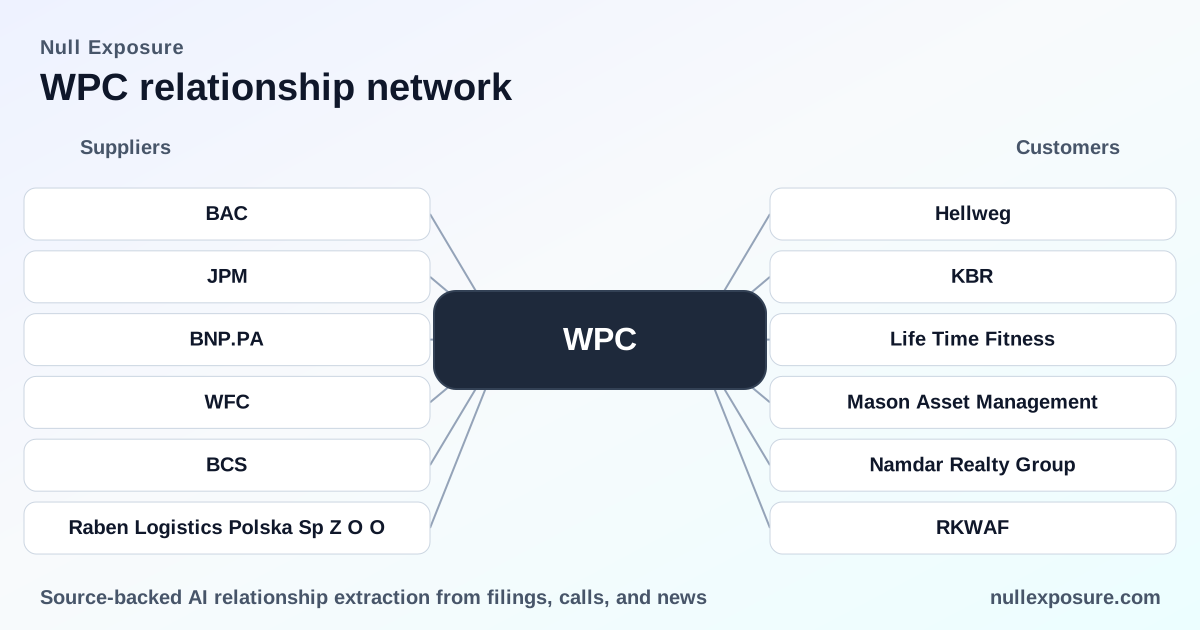
W. P. Carey Inc (WPC): Capital markets partners and counterparties that move the business
W. P. Carey is a large, diversified net-lease REIT that monetizes through long-term, single-tenant net leases and active capital markets activity — acquiring operationally critical commercial real estate, financing it with equity and fixed-income issuances, and returning cash via dividends. Its business model is driven by recurring rental cash flows, opportunistic portfolio acquisitions, and regular access to underwriters and banks to raise capital. For investors and operators evaluating supplier and counterparty relationships, the quality and depth of WPC’s capital markets partners and transaction counterparties are central to execution risk and balance-sheet flexibility. Learn more about how these relationships influence execution and risk at https://nullexposure.com/.
Why counterparties matter more than vendors in a net-lease REIT
WPC’s supplier universe is dominated by two categories: capital markets counterparties (underwriters, book-runners, and banks) and transaction counterparties (asset sellers and local operators tied to acquisitions). This profile shapes contracting posture and criticality:
- Contracting posture: WPC sources liquidity through public offerings and bond issuances; underwriters are transactional but structurally important because they enable equity and debt issuance windows. Recent entries confirm repeated reliance on top-tier global banks for both equity and debt taps.
- Concentration and redundancy: Multiple elite banks (BofA, J.P. Morgan, Barclays, BNP Paribas, Wells Fargo) appear across offerings, providing redundancy and pricing competition — a favorable signal for execution certainty.
- Criticality: Counterparties are high-criticality for financing and acquisition execution, but operational vendor risk (property management, maintenance) is less visible in this supplier feed.
- Maturity and relationships: The counterparties listed are institutional, experienced partners — an indicator of mature capital markets access and low likelihood of one-off execution failure disrupting portfolio strategy.
These points are consistent with WPC’s scale: a portfolio of over 1,200 net-lease properties and an enterprise value reported at roughly $18 billion, with institutional ownership at ~77%, underlining a governance and funding profile tied closely to capital markets sentiment.
Middle-of-deal takeaways
WPC’s recent public financing activity underscores an active financing cadence and willingness to tap both equity and debt to fund acquisitions such as the Poland logistics portfolio noted below — investors should treat underwriter strength and syndicate composition as ongoing underwriting risk signals. For proprietary research or deeper counterparty mapping, visit https://nullexposure.com/.
Deal-by-deal counterparties and what each means for WPC
Below are the relationships extracted from recent disclosures and reporting; each entry includes a plain-English summary and a direct source reference.
BofA Securities (underwriter for equity offering)
WPC priced a public stock offering where BofA Securities acted as a joint book-running manager, supporting distribution and providing a 30‑day option into additional shares tied to market demand. This role underscores BofA’s position as a primary equity underwriter for WPC’s capital raises. (Intellectia news, March 10, 2026)
J.P. Morgan (joint book-running manager for equity offering)
J.P. Morgan joined BofA as co-book-runner on the equity sale, collaborating on marketing, bookbuilding, and the overall execution mechanics that set offering pricing. That partnership signals stable access to institutional investor channels. (Intellectia news, March 10, 2026)
BNP PARIBAS (joint book-running manager for notes offering)
BNP Paribas acted as a joint book-runner on a $1.0 billion senior unsecured notes issuance, supporting syndication and international distribution for WPC’s debt financing. Its participation indicates broad European investor reach for WPC bond deals. (PR Newswire, March 10, 2026)
J.P. Morgan Securities plc (joint book-runner on notes)
J.P. Morgan Securities plc was listed among the joint book-running managers for the $1.0 billion senior unsecured notes, reinforcing J.P. Morgan’s role across both equity and debt transactions for WPC. (PR Newswire, March 10, 2026)
Wells Fargo Securities International Limited (joint book-runner on notes)
Wells Fargo Securities International joined the notes syndicate as a joint book-runner, contributing distribution capacity for institutional fixed-income investors and supporting pricing and placement. (PR Newswire, March 10, 2026)
Barclays Bank PLC (joint book-runner on notes)
Barclays is listed as a joint book-runner on the $1.0 billion notes, adding another major international bank to the debt syndicate and reinforcing syndicate depth in WPC’s fixed-income market activity. (PR Newswire, March 10, 2026)
Raben Logistics Polska Sp Z O O (asset seller in Poland)
WPC acquired a 150,000 sqm logistics portfolio in Poland from Raben Logistics Polska for approximately €170 million, demonstrating WPC’s selective acquisition strategy in European logistics real estate and its use of market counterparties to grow income-producing assets. (MarketScreener reporting, transaction noted Feb. 22 and cited in FY2025 coverage)
BofA Securities (counterparty noted again in market reporting)
Trading coverage reiterated BofA and J.P. Morgan as the listed counterparties for the stock offering, highlighting market attention and syndicate prominence in public discourse and pricing dynamics. (TradingView coverage summarizing the offering, March 2026)
J.P. Morgan Securities (counterparty reiterated in market reporting)
Market commentary reiterated J.P. Morgan Securities’ role alongside BofA in the equity sale, reflecting consistent market messaging about the joint book-running arrangement for the offering. (TradingView coverage, March 2026)
What to watch: risk, execution, and upside
- Execution risk is concentrated in capital markets windows. WPC’s ability to execute equity and debt offerings at favorable terms depends on continued appetite from the same syndicate banks and investor demand; recent syndicate composition suggests resilience but not immunity to market disruption.
- Acquisition strategy drives portfolio growth but requires financing. The Poland logistics purchase shows WPC’s appetite for logistics assets; continued expansion will require repeatable access to both equity and bond markets.
- Balance sheet and yield profile are central to valuation. WPC trades at a forward P/E and yields that reflect cash-flow visibility and dividend policy; underwriters and banks materially affect the cost of capital and timing of deployment.
Final read for investors and operators
WPC’s supplier picture is dominated by top-tier capital markets institutions and occasional large asset counterparties, which collectively support its capital-intensive, acquisition-driven model. Strong syndicate depth (BofA, J.P. Morgan, Barclays, BNP Paribas, Wells Fargo) and strategic acquisitions like the Raben Logistics portfolio indicate a company with mature market access and clear routes to scale income-producing assets. For a deeper mapping of counterparties and a rolling feed of relationship events that matter to REIT execution risk, check the firm’s relationship tracker at https://nullexposure.com/.
If you want a tailored counterparty exposure brief or an ongoing monitoring feed for WPC counterparties, visit https://nullexposure.com/ for subscription details and research services.