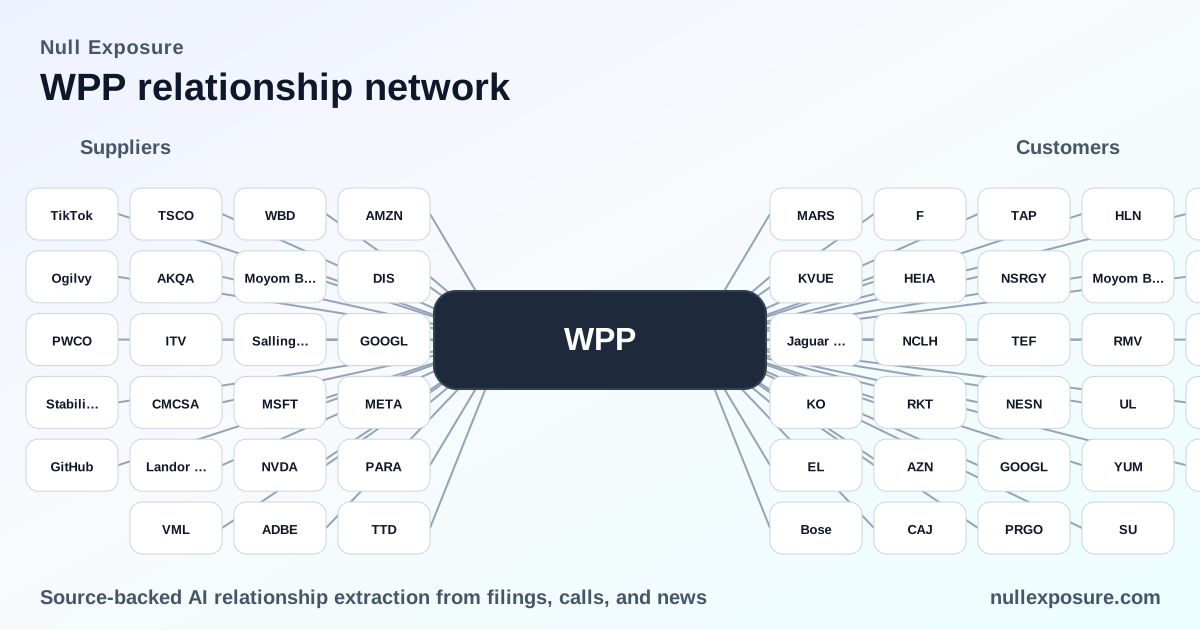
WPP’s supplier footprint: who powers the world’s largest ad group and why it matters to investors
Thesis: WPP monetizes creative, media-buying and technology services through fee-based agency work, large-scale programmatic and direct media purchases via GroupM, and by selling higher-margin technology products such as WPP Open that embed third-party AI and cloud capabilities. Revenue is driven by concentrated media spend with a small set of platform suppliers and by strategic technology partnerships that convert agency scale into recurring product revenue. For deeper supplier exposure analysis, visit https://nullexposure.com/.
Why suppliers are a financial lever for WPP, not just vendors
WPP’s operating model mixes traditional agency contracting with platform-driven product economics. Agencies sell creative and planning services under multi-year client contracts, while GroupM executes large media buys that create concentration risk with major platforms (the GroupM numbers put that concentration in plain sight). At the same time, WPP Open and cloud studio initiatives convert supplier relationships with Microsoft, Google, Adobe and AI vendors into value capture—WPP embeds those vendors’ models and cloud services into a product it controls and sells to clients. That dual posture creates a hybrid contracting stance: transactional media spend at scale plus productized, sticky technology relationships.
According to reporting in March 2026, GroupM’s platform spending in 2023 shows that Google alone accounted for $9.4 billion in spend, Meta $3.7 billion, and a set of other platforms including TikTok, Amazon and The Trade Desk each roughly $1.1 billion, which underscores the concentration profile that underpins both revenue and negotiation leverage (Digiday, March 2026). For operational readers, that means supplier disputes or regulatory scrutiny at a major platform translate quickly into revenue volatility for WPP.
For supplier-focused due diligence and relationship scoring, start from the homepage at https://nullexposure.com/.
The supplier map — every relationship named in coverage and what it means
Below I cover every company cited in the collected results, with concise takeaways and source references.
-
Google (GOOGL) — GroupM’s largest platform partner with reported global spend of $9.4 billion; Google is also embedded into WPP Open (Gemini integration) and receives strategic investment support to deepen AI integration. (Digiday, March 2026; WPP trading update April 2024; Campaignlive coverage of a $400m investment, 2026)
-
Meta (META) — Significant ad spend partner ($3.7 billion globally for GroupM) and listed among WPP’s AI/model partners for WPP Open, making Meta both an ad-execution channel and a model provider. (Digiday, March 2026; Q4 2025 earnings call transcript coverage)
-
Amazon (AMZN) — Reported GroupM platform spend of $1.1 billion and called out among technology partners; Amazon functions as both media channel and data partner for commerce-driven campaigns. (Digiday, March 2026; Q4 2025 earnings call coverage)
-
TikTok — Reported at roughly $1.1 billion in GroupM platform spend and included among the platforms WPP intends to integrate with for AI-enabled campaign workflows. (Digiday, March 2026; Q4 2025 call coverage)
-
The Trade Desk (TTD) — Identified at ~$1.1 billion of GroupM spend, representing the programmatic exchange channel exposure for WPP’s media business. (Digiday, March 2026)
-
Disney (DIS) — A material US media partner for GroupM buys (reported at about $835 million in the US), representing linear and streaming content channels that attract agency inventory. (Digiday, March 2026)
-
NBCUniversal / NBCU (CMCSA) — Reported as a $700 million US media channel in GroupM’s 2023 accounting; important for video and broadcast reach. (Digiday, March 2026)
-
Paramount (PARA) — Reported as a $540 million US media channel for GroupM, another traditional content partner with streaming reach. (Digiday, March 2026)
-
Warner Bros. Discovery (WBD) — Reported at $417 million in US spend—part of WPP’s diversified content partner set. (Digiday, March 2026)
-
Microsoft (MSFT) — Strategic cloud and AI partner: Cloud Studio was built on Azure, and Microsoft is cited as a key AI partner for WPP Open, making Microsoft a cornerstone for WPP’s cloud-native production stack. (WPP press release 2021; ad-hoc-news coverage, 2026)
-
NVIDIA (NVDA) — Identified among AI providers powering WPP’s Open platform for compute and model acceleration, positioning NVIDIA as critical infrastructure for WPP’s AI services. (ad-hoc-news, 2026)
-
Adobe (ADBE) — Expanded partnership to embed Adobe’s AI marketing suite into WPP Open and broader client operations, signaling a product-level integration rather than a mere vendor license. (InsiderMonkey Q4 2025 transcript; WPP sustainability/partnership notes)
-
Tesco (TSCO) — Worked with WPP to provide closed-loop sales measurement for a client (Heineken), enabling privacy-preserving measurement without moving customer data—a capability that supports WPP’s commerce measurement offerings. (InsiderMonkey Q4 2025 transcript)
-
ITV (ITV) — Cited as a data partner for connecting first-party audience signals with retailer data and campaign measurement. (InsiderMonkey Q4 2025 transcript)
-
Salling Group — New partnership to connect first-party retail data with WPP’s Open Intelligence for Commerce, illustrating WPP’s strategy to commercialize retailer data connections. (LBBOnline, March 2026)
-
Moyom Biotechnology — Announced a strategic branding partnership with WPP to expand international reach for a biotech brand, showing continued traditional agency work across verticals. (Laotian Times, January 2026)
-
AKQA, VML, Ogilvy — WPP will fold these existing creative agencies into a simplified WPP Creative umbrella to streamline client-facing offerings while maintaining operational continuity. (Storyboard18 summarizing Reuters, 2026)
-
VML — Included in the WPP Creative consolidation; continues to operate within WPP’s creative roster. (Storyboard18/Reuters, 2026)
-
Ogilvy — Also placed under the WPP Creative structure as part of the simplification initiative. (Storyboard18/Reuters, 2026)
-
Landor & Fitch — WPP acquisition activity (e.g., sonic branding agency AMP) highlights WPP’s ongoing investment in premium creative capabilities and client rosters. (WPP press, 2023)
-
PwC (PWCO) — Provided independent limited assurance on WPP’s sustainability report 2023, illustrating standard external audit/assurance relationships. (WPP Sustainability Report 2023)
-
GitHub — Part of the Microsoft stack cited for Cloud Studio provisioning (Azure DevOps and GitHub enable rapid provisioning of cloud studio instances). (WPP press release 2021)
-
Stability AI — Named among model providers that WPP uses to enhance its AI toolset within WPP Open. (InsiderMonkey Q4 2025 transcript)
What investors and operators should extract from the supplier list
- Concentration is a structural fact. Large portions of GroupM media spend flow to a handful of platforms—Google and Meta dominate—so platform outcomes translate directly to revenue volatility. (Digiday, March 2026)
- WPP is converting supplier relationships into product advantage. Embedding Google Gemini, Adobe marketing AI and Microsoft Azure into WPP Open turns third-party capabilities into a WPP-owned commercial asset. (WPP filings and call transcripts, 2024–2025)
- Operational criticality is high for cloud and AI partners. Microsoft, NVIDIA and Google are not interchangeable for WPP’s cloud-native production and AI workloads. (WPP press 2021; ad-hoc-news 2026)
No explicit procurement constraints or supplier-level restrictions were reported in the dataset, which is itself a company-level signal: no named contractual constraints were surfaced in the collected results, so risk assessment should focus on commercial concentration, regulatory exposure (public reporting and the Digiday whistleblower coverage), and platform dependency.
For a practical next step in mapping supplier financial exposure for portfolios, start here: https://nullexposure.com/.
Final read: investment implications and next moves
WPP’s supplier architecture presents a classic trade-off: scale gives bargaining power and product leverage, but creates concentration and operational dependency. Investors should underwrite earnings to reflect platform concentration risk and value accretion from WPP Open integrations with Adobe, Google and Microsoft. Operators should prioritize resilience—alternate measurement partners, multi-cloud portability, and negotiated commercial protections with top platforms.
If you want structured supplier exposure scoring and consolidated source evidence tailored to your coverage list, visit https://nullexposure.com/ to begin a supplier-level investigation.