Wrap Technologies (WRAP): supplier relationships that determine scalability and risk
Wrap Technologies sells non‑lethal public‑safety hardware and services—device sales (BolaWrap, WrapVision), training and software, plus licensing and manufacturing partnerships—and monetizes through product sales, recurring services/training, and limited royalty agreements. Investor returns will track the company’s ability to scale manufacturing for drone- and body‑worn systems while retaining control of critical components and U.S. supply‑chain posture. For a deeper vendor-risk read and monitoring playbook, visit https://nullexposure.com/.
What the supplier picture tells you about Wrap’s operating model
Wrap runs a hybrid hardware‑plus‑services business that is manufacturing‑dependent, geographically broad, and modest in spend scale. Public filings and press coverage show the company sources components and assemblies from third‑party manufacturers across the US, Canada, Europe and Asia, while outsourcing final assembly and cloud/camera integrations for new products. This creates a contracting posture that is typical for early‑stage hardware suppliers: reliance on external manufacturers, increasing use of strategic partners for scale, and selective licensing for IP.
Key operating signals:
- Concentration risk: the company discloses single‑supplier arrangements for certain critical subcomponents, a structural vulnerability to interruptions.
- Spend footprint: Wrap reported commitments of roughly $0.6 million for future component deliveries and contract services as of Dec 31, 2024, indicating current supplier spend is material relative to revenue but not large in absolute terms.
- Geography and supply chain: Wrap engages suppliers and logistics partners globally, while publicly pursuing a made‑in‑America roadmap for key components and cameras to address procurement requirements from U.S. government customers.
These are company‑level signals drawn from filings and corporate releases; they shape contracting leverage, time‑to‑scale, and buyer confidence.
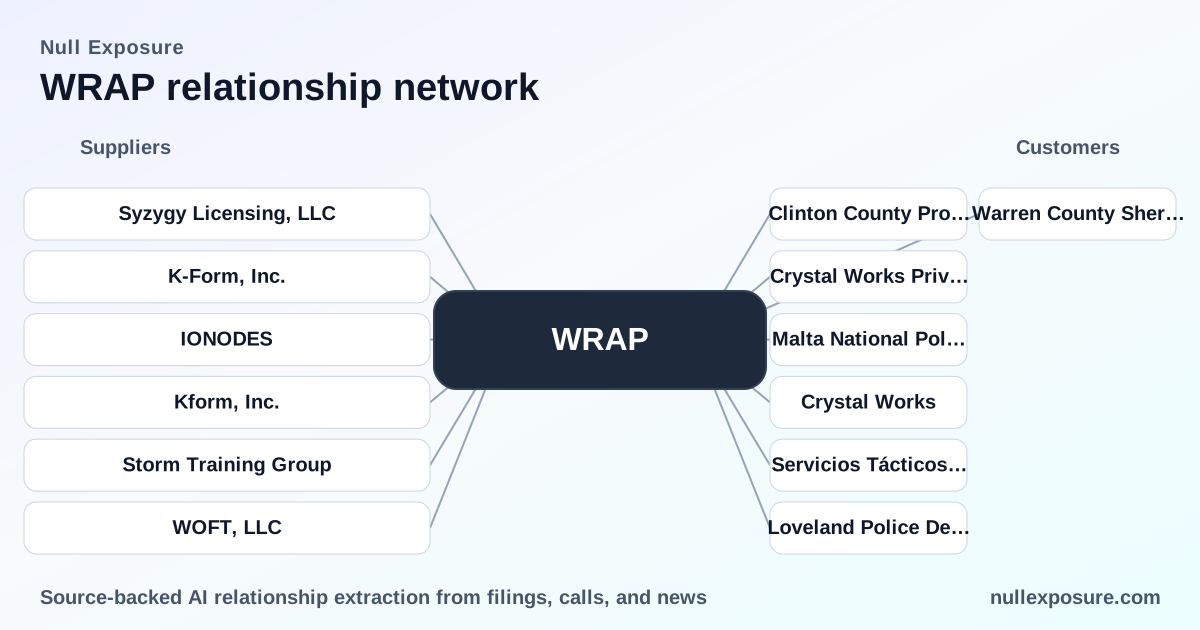
Vendor map: here’s every named supplier and what they contribute
Below I cover each supplier named in the available results, with concise, sourced descriptions.
Syzygy Licensing, LLC
Wrap’s FY2024 10‑K discloses a licensing agreement with Syzygy that carries royalty payments of 4% of revenue on products using the licensed ensnarement device technology, capped at an aggregate of $1,000 or until September 30, 2026, whichever is earlier. According to the company filing in FY2024, this is a limited, time‑bound royalty obligation that constrains long‑term royalty leakage. (Wrap 10‑K, FY2024)
K‑Form, Inc. (Kform)
Wrap has expanded a manufacturing partnership with K‑Form to accelerate development and production of its drone‑based non‑lethal MERLIN‑1 platform and DFR‑X systems; press releases note purchase orders and an enlarged scope intended to speed prototyping and production. A GlobeNewswire release in February 2026 and corroborating industry reports in March 2026 describe this strategic manufacturing relationship as central to Wrap’s drone commercialization push. (GlobeNewswire, Feb 26, 2026; Intellectia/industry reports, Mar 2026)
IONODES
IONODES powers the WrapVision body‑worn camera platform (PERCEPT BC200 integration) and supports cloud integration and final North American assembly; public announcements through 2025–2026 cite a made‑in‑America roadmap for early 2026 and position IONODES as the camera technology supplier for several deployments. Multiple press releases and financial news wires across late‑2025 and early‑2026 describe IONODES as the video solution supplier behind WrapVision. (GlobeNewswire Oct–Nov 2025; Yahoo Finance & GlobeNewswire Feb–Mar 2026; GuruFocus, Mar 2026)
Storm Training Group
Wrap has partnered with Storm Training Group to combine non‑lethal devices and real‑world training, with the objective of reducing injuries and enhancing officer outcomes during high‑risk encounters; the partnership is cited in recent company announcements around deployments of the VR training and response curriculum. (Intellectia press reports, Mar 2026)
WOFT, LLC
Wrap signed a strategic partnership with WOFT, LLC in Florida to establish an integrated drone testing and non‑lethal response training headquarters intended to support federal, state and local security agencies; the agreement is positioned as part of Wrap’s push into U.S. government and national security markets. (Intellectia/StockTwits news coverage, Mar 2026)
What these relationships mean for growth and risk
Wrap’s supplier set shows a coherent go‑to‑market: manufacturing partners for scale (K‑Form), component/camera suppliers for product capability (IONODES), and training/testing partners for field adoption (Storm, WOFT). The royalty with Syzygy is small and time‑limited per the 10‑K, so it is not a material ongoing drag under current terms.
Investment implications:
- Upside: K‑Form’s expanded role and purchase orders accelerate route‑to‑market for drone systems—a direct revenue multiplier if Wrap converts orders into deliveries and recurrent service contracts.
- Execution risk: single‑supplier notes and modest cash commitments (≈$0.6m) show supply concentration and relatively immature supplier diversification; a disruption at a critical supplier could impede deliveries.
- Procurement positioning: the made‑in‑America roadmap and training/testing hubs (WOFT) strengthen Wrap’s access to government budgets that require domestic sourcing—this is an important commercial lever for scaling defense/public‑safety sales.
Key risks and levers to monitor:
- Manufacturing concentration and supplier single points of failure.
- Speed of ramp: the company must convert partnerships into repeatable production and recurring training/service revenue to justify current valuation multiples.
- Policy and procurement cycles: U.S. government adoption depends on compliance and certifications tied to domestic sourcing and testing programs.
For portfolio teams tracking vendor risk and contract exposure, review Wrap’s 10‑K commitments and recent press on K‑Form/IONODES partnerships to model ramp scenarios; further supplier diligence is recommended via vendor calls and supply‑chain audits. Learn more about mapping supplier risk and tracking vendor signals at https://nullexposure.com/.
Bottom line and next steps for investors
Wrap’s supplier roster supports a clear commercialization path: manufacturing scale via K‑Form, product capability via IONODES, and field adoption through training partners. However, the company is in a delicate phase where manufacturing concentration and modest committed spend elevate execution risk relative to potential revenue upside.
Recommended actions:
- Validate K‑Form purchase‑order timing and delivery milestones to model revenue conversion.
- Monitor whether Wrap reduces single‑supplier exposures or secures secondary manufacturers.
- Track government procurement wins tied to the WOFT testing hub and the made‑in‑America roadmap.
For ongoing monitoring and supplier‑risk dashboards tailored to public‑safety vendors, start with a vendor map and follow the press releases cited above—more detail and continuous tracking are available at https://nullexposure.com/. Visit https://nullexposure.com/ for actionable supplier intelligence and next‑step diligence templates.