Warby Parker (WRBY): Supplier Map and Strategic Implications for Investors
Warby Parker runs a vertically integrated direct-to-consumer eyewear business that monetizes primarily through retail sales—online, in owned stores, and through select wholesale placements—while supplementing revenue with private-label products and service fees tied to optical services. The company sources frames, lenses, and logistics globally, contracts out optical-lab work, and leverages retail density and brand marketing to drive unit economics. For a focused supplier-risk briefing and ongoing monitoring, visit https://nullexposure.com/.
How Warby Parker’s supplier posture shapes its economics
Warby Parker’s operating model blends outsourced manufacturing and logistics with in‑house retail and optical services. The company does not rely on long-term supplier contracts for most inputs, creating procurement flexibility but also exposing operations to supply disruption and price volatility. At the same time, retail and distribution leases can extend substantially—Warby reports lease terms ranging up to 12 years—so the firm has a mix of short‑term supplier relationships and longer-term occupancy commitments that drive fixed-cost leverage.
Key company-level signals from filings and disclosures:
- Contracting posture: Warby states it generally does not enter into long-term supplier contracts; this is a structural posture that favors flexibility over contractual commitment.
- Global sourcing: Warby sources inputs from China, Italy, Vietnam, Japan and partners with more than 30 global suppliers across frames, lenses, cases, labs, and logistics.
- Concentration risk: The top five suppliers together account for about 18% of cost of goods sold in 2024, indicating a meaningful concentration that can affect cost and availability if a partner is lost.
- Materiality and criticality: The company acknowledges reliance on a limited number of contract manufacturers and logistics partners; loss of a partner could have a material operational impact.
- Technology and infrastructure: Warby outsources core cloud architecture to Amazon Web Services (AWS), indicating dependence on third‑party infrastructure for ecommerce and operational systems.
These structural choices—global supplier base, limited long-term procurement commitments, combined with concentrated manufacturing relationships—define both Warby’s upside on margin flexibility and its downside on supply-chain disruption.
The supplier relationships that matter now
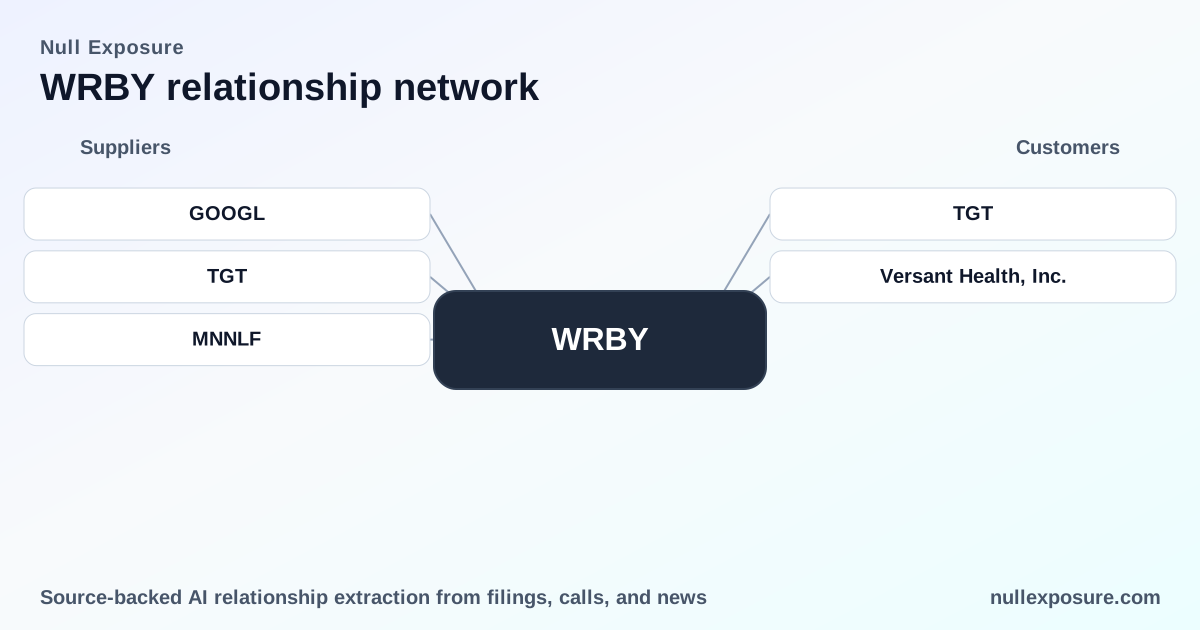
Google — strategic product partnership under review
Warby Parker has entered an AI-enabled glasses collaboration with Google that is drawing analyst attention on near-term commercial impact and execution risk. A February 2026 industry note highlighted that analyst commentary is questioning how much the Google partnership will affect Warby’s near-term business and whether it meaningfully alters growth or margin trajectories. (Source: Sahm Capital news report, Feb 3, 2026).
Target — wholesale expansion via shop‑in‑shop rollout
Warby is accelerating its physical retail footprint in 2025 and will launch shop-in-shop concepts inside Target stores, representing a deliberate wholesale/distribution channel expansion intended to increase brand exposure and lower per-store capital intensity. The plan to open 45 new stores in 2025 explicitly includes Target placements. (Source: Vision Monday / VMAIL coverage of Warby Parker 2024 annual report, reported Mar 2026).
Menicon — private‑label contact lens manufacturer
In its FY2024 Form 10‑K, Warby Parker names Menicon as the producer of its private‑label Scout by Warby Parker contact lenses, indicating a direct manufacturing relationship for a product line that extends Warby from frames and sunglasses into the contact lens category. (Source: Warby Parker FY2024 10‑K filing).
What these relationships mean for investors
Warby’s supplier map mixes brand-driven retail assets with outsourced product and service delivery, creating a set of predictable investor trade-offs:
- Growth lever via distribution partnerships: The Target shop‑in‑shop strategy accelerates reach while limiting fixed retail investment per location, which is positive for scaling revenue without proportionate increases in capital expenditure.
- Product innovation and differentiation: The Google collaboration signals an intent to pursue hardware/tech differentiation beyond commoditized eyewear, which can raise average selling price and margins if adoption proves strong.
- Concentration and operational risk: The company’s admission that a limited number of manufacturers and logistics partners are critical means that execution risk is non-trivial; investors should price in the potential for short-term supply constraints or cost shocks.
- Flexible procurement posture: Operating without long-term supplier contracts provides Warby with the ability to renegotiate or re-source when beneficial, but leaves limited contractual protection in periods of supplier stress.
- Infrastructure dependency: Outsourcing core architecture to AWS centralizes uptime and security risk with a third-party provider; this reduces capital and operational complexity but creates a dependency that investors should monitor.
Mid‑cycle volatility in sourcing costs, logistics capacity, or partner performance will disproportionately affect profitability because Warby’s retail leases and store operating cost base are less flexible than its procurement contracts. For ongoing monitoring and a structured supplier-risk view, see https://nullexposure.com/.
Operational constraints investors should track
Monitor these company-level constraints as leading indicators of margin and continuity risk:
- Supplier contract length: Predominantly short-term supplier relationships reduce contractual assurances for supply and pricing.
- Lease commitments: Long-duration retail leases create fixed-cost exposure that magnifies downside if demand decelerates.
- Top-supplier concentration (~18%): A loss or price increase from any major supplier will have material cost implications.
- Global sourcing footprint: Geographic diversification reduces single-country risk but raises exposure to trade, tariff, and freight disruptions.
- Third-party services dependence: Critical services—optical labs, logistics for Home Try‑On, and payment processing—are predominantly outsourced, concentrating operational resilience on external partners.
These constraints are company-level signals and inform both scenario analysis and downside stress testing for WRBY investments.
What to watch next — catalysts and risk triggers
Investors should watch three near-term developments:
- Product traction and margin contribution from the Google AI‑glasses collaboration—metrics to track include initial sell‑through, ASP, and incremental marketing spend.
- Execution of the Target shop‑in‑shop rollout and its impact on same-store economics and wholesale revenue recognition.
- Supplier concentration dynamics and any disclosure of alternative sourcing or contingency plans in subsequent quarterly filings.
For a deeper supplier-focused diligence package and continuous alerts on these relationship changes, visit https://nullexposure.com/.
Conclusion: Warby Parker’s supplier strategy is a deliberate trade-off—flexible procurement and global sourcing that enables fast iteration and cost management, backed by concentrated manufacturing and logistics relationships that introduce real operational risk. Investors should value Warby’s retail and brand moat while actively monitoring partner execution, supply concentration, and the commercial payoff from strategic partnerships such as Google and Target.