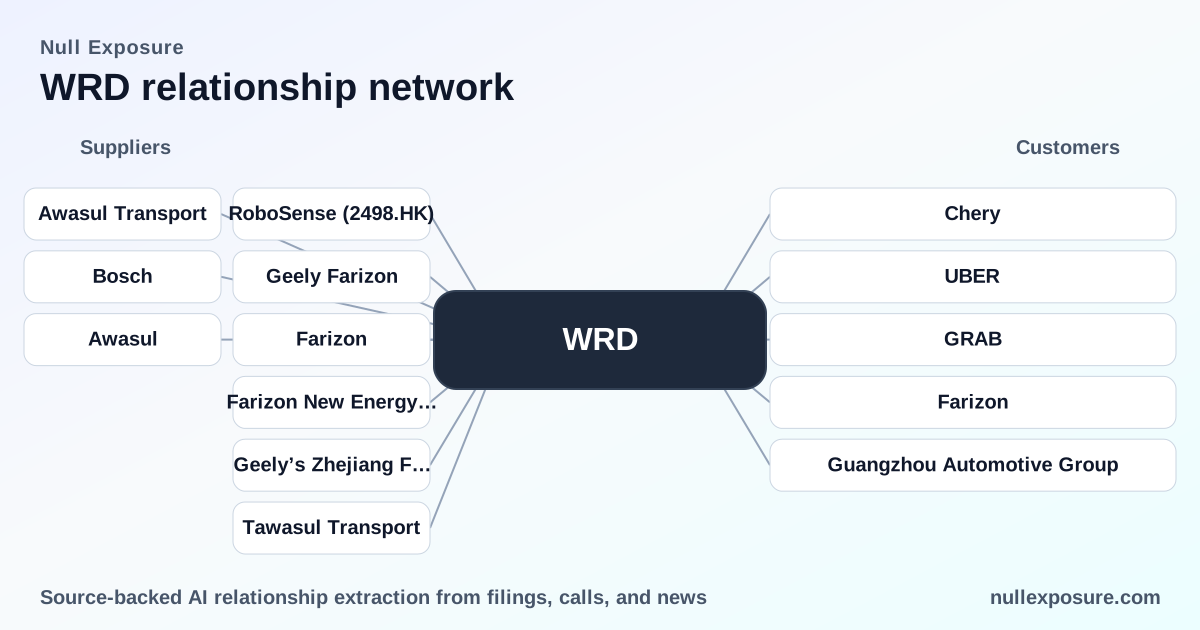
WeRide (WRD): Supplier map and what it means for commercial robotaxi rollout
WeRide builds and commercializes autonomous driving stacks and purpose‑built robotaxis, monetizing through vehicle partnerships, production orders, fleet deployments and software-for-service arrangements with platform partners and local operators. The company converts R&D into commercial scale by outsourcing vehicle manufacturing and sensor hardware to strategic partners while capturing recurring service revenue through fleet operations on platforms such as Uber. For investors, the supplier footprint is the strategic backbone that turns technology into deployable, revenue‑generating fleets.
Explore supplier intelligence and relationship due diligence at https://nullexposure.com/.
The headline view: partnerships that industrialize autonomy
WeRide’s recent public disclosures and press reporting show a concentrated, OEM‑driven supplier model: large production orders with Geely Farizon for purpose‑built Robotaxi GXRs, hardware sourcing from specialized sensor providers such as RoboSense, operational partnerships with local fleet operators (Tawasul / Awasul) to access riders and manage vehicles, and component/production integration with established automotive suppliers like Bosch. The model prioritizes scale through manufacturing partners and route-to-market through platform and fleet operators rather than owning mass production in house.
Why the supplier map matters for returns
- Scale depends on a few critical partners. Production cadence, unit economics and delivery timing hinge on execution by vehicle OEMs and tier‑one suppliers.
- Operational commercialization leans on service partners. Access to rider demand comes through Uber and local fleet managers; that determines utilization and revenue per vehicle.
- Capital intensity shifts to partners. By ordering purpose‑built units and outsourcing manufacturing, WeRide reduces capex on factories but increases reliance on contract performance and timing.
Detailed supplier relationships (each result in the record)
RoboSense (2498.HK)
RoboSense’s thousand‑beam digital LiDAR models EM4 and E1 were selected for the Robotaxi GXR platform, positioning RoboSense as a primary sensor supplier for WeRide’s next‑gen vehicles. According to PR Newswire (March 2026), factory‑installed RoboSense units are slated for global deployment on the GXR. (PR Newswire, Mar 2026)
Geely Farizon (cnevpost report)
WeRide reported that leveraging Geely Farizon’s manufacturing system will reduce per‑vehicle roll‑off time from ~1 hour to under 10 minutes, a dramatic throughput improvement tied to large‑scale manufacturing processes. (CNEVPost, Mar 9, 2026)
Farizon (Electrive)
WeRide placed an order for 2,000 upgraded Robotaxi GXR units from Farizon, formalizing a bulk procurement that underpins planned scaling of commercial services. (Electrive, Mar 9, 2026)
Farizon New Energy Commercial Vehicle Group (Just‑Auto)
The Robotaxi GXR is built on Farizon’s AI‑enabled drive‑by‑wire chassis and integrated into Farizon’s manufacturing and supply chain, signaling deep platform integration between WeRide software and Farizon hardware. (Just‑Auto, Mar 2026)
Geely Farizon (GlobeNewswire — delivery announcement)
WeRide and Geely Farizon announced a plan to deliver 2,000 purpose‑built Robotaxi GXRs by 2026, framing the agreement as central to WeRide’s large‑scale commercialization push. (GlobeNewswire, Mar 4, 2026)
Geely Farizon (FinViz coverage)
Market commentary repeated the 2,000‑unit commitment and emphasized the commercial implication: WeRide and Geely Farizon’s program advances robotaxi commercialization and underpins near‑term revenue potential from vehicle shipments. (FinViz news roundup, Mar 2026)
Geely’s Zhejiang Farizon New Energy Commercial Vehicle Group (GlobeNewswire — strategic cooperation)
WeRide signed an expanded strategic cooperation with Geely’s Zhejiang Farizon group that formalizes co‑development, production and delivery commitments for the GXR platform. (GlobeNewswire, Mar 9, 2026)
Geely Farizon (GlobeNewswire — Feb release)
A prior GlobeNewswire release reiterated the expanded strategic cooperation and the intent to deliver upgraded, purpose‑built GXRs by 2026, underscoring continuity in the program across releases. (GlobeNewswire, Feb 6, 2026)
Tawasul Transport (GlobeNewswire — Abu Dhabi deployment)
Tawasul Transport is the main fleet operator in Abu Dhabi for WeRide vehicles on the Uber platform, providing localized fleet management services required for commercial operations. (GlobeNewswire, Feb 12, 2026)
Tawasul Transport (Futunn report)
Independent coverage confirms Tawasul Transport manages fleet operations for WeRide’s robotaxi deployments on Uber in the UAE, centralizing operational responsibility for scaling services in that market. (Futunn news, Feb/Mar 2026)
Awasul Transport (SimplyWall / market write‑ups)
Reports identify Awasul (Awasul Transport) as a local fleet operator and partner that plugs WeRide into an existing rider base and fleet‑management infrastructure to accelerate ride volume and economics. (SimplyWall.St, Mar 2026)
Bosch (WeRide earnings call excerpt, 2025Q3)
WeRide and Bosch reached a production milestone with the start of production of the WePilot 3.0 stack in November, signaling collaboration with established automotive systems suppliers on production‑ready autonomy components. (WeRide 2025 Q3 earnings call, disclosed 2026)
Awasul (additional SimplyWall note)
Analysts and market briefs repeat the role of Awasul and regional partners such as the Integrated Transport Centre, highlighting the operational and regulatory layers introduced by local partners when scaling services. (SimplyWall.St, Mar 2026)
Operating model characteristics and investment constraints
WeRide’s supplier posture is partner‑centric and OEM‑dependent: the company relies on external vehicle manufacturers and sensor specialists to industrialize its technology. This creates these company‑level signals:
- Contracting posture: Strategic, long‑term co‑development and purchase agreements rather than spot contracts; WeRide is locking in volume through multi‑unit orders and expanded cooperation pacts.
- Concentration: Supplier dependence is concentrated: a limited set of OEMs and sensor suppliers carry outsized execution risk for production timing and unit economics.
- Criticality: Suppliers are mission‑critical—LiDAR and chassis integration are essential to the product; delivery slippage or hardware quality issues would directly impair service launches.
- Maturity: Partnerships range from mature automotive suppliers (Bosch, established manufacturing processes) to newer autonomy sensor vendors (RoboSense), resulting in a blended maturity profile across the supply chain.
Financial signals reinforce strategic choices: Revenue TTM roughly $511M and gross profit positive but EBITDA negative, indicating technology commercialization is progressing but profitability remains a work in progress; operational leverage will depend on supplier execution and fleet utilization.
Investment implications and near‑term catalysts
- Execution on the 2,000‑unit Farizon program is the primary operational catalyst; timely deliveries and factory integration directly translate into deployed revenue and operating data.
- Sensor supply and vehicle integration are short‑term operational risks that can affect cost and schedule; RoboSense participation reduces risk for LiDAR supply but concentrates another critical input.
- Commercial economics will be determined by fleet utilization through partners such as Uber and local operators (Tawasul/Awasul); these relationships convert vehicles into revenue.
For a deeper supplier risk assessment and relationship mapping, visit https://nullexposure.com/ to see how supplier posture affects valuation and operational risk.
Bottom line
WeRide has structured its commercial path around a small set of high‑leverage suppliers and fleet partners that convert its driving stack into revenue‑generating robotaxis. Success depends on manufacturing scale with Geely Farizon, reliable sensor supply from firms like RoboSense, and effective fleet operations through Tawasul/Awasul and platform partners. Monitor delivery cadence on the 2,000‑unit program, Bosch integration milestones, and early utilization metrics from Abu Dhabi as the immediate proof points for commercialization. For tailored supplier diligence and portfolio implications, learn more at https://nullexposure.com/.