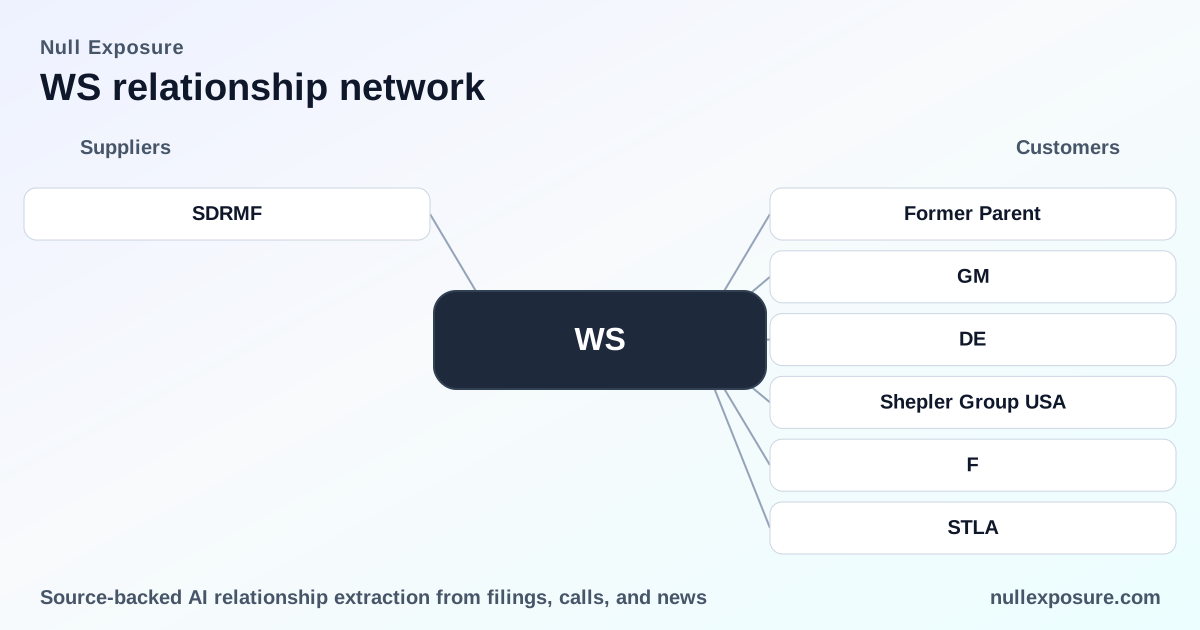
Worthington Steel (WS) — Supplier Relationships and Strategic Constraints
Worthington Steel operates as a North American steel processor that monetizes by purchasing flat-rolled steel coils from primary mills, converting those coils into customer-specified plate and sheet products, and selling finished steel with value-added processing margins and service revenue. The firm’s economics are driven by throughput, processing spreads, and selective vertical moves that add specialty capabilities — most recently a controlling stake in a European electrical-steel laminator. For a focused review of supplier exposure and implications for investors, visit https://nullexposure.com/.
What the company does and why supplier posture matters to investors
Worthington is not a primary steel producer; it is a processor and converter. The company sources coils, performs cutting, slitting, tempering and other finishing services, and sells into industrial end markets where specification and delivery matter as much as raw commodity price. Revenue (TTM ~ $3.27bn) and EBITDA (~ $245m) indicate a mid-cycle industrial with modest margins and a return profile that is typical for service-intensive steel processors. The firm trades at a mid-teens P/E and an EV/EBITDA below 10, which reflects both cyclical exposure and the stable cash generation from processing operations.
Supplier relationships are core to the operating model because input procurement flow-throughs determine gross margin and working capital. Worthington’s supplier network and any moves to vertically integrate into specialty inputs change the risk-reward profile for investors by shifting exposure from commodity price volatility to operational integration risk.
Strategic relationship disclosed: Sitem acquisition and why it matters
Worthington disclosed that it closed on a 52% ownership stake in Sitem, a European electrical steel lamination manufacturer and electric motor die-casting specialist, noting the close occurred on June 3. According to the company’s 2025 Q4 earnings call (reported March 7, 2026), the acquisition provides direct access to electrical-steel lamination and motor die-casting capabilities that extend Worthington’s addressable market into electromagnetic components and potentially EV motor supply chains. This is a deliberate capability expansion beyond domestic coil processing and positions Worthington to sell higher-value, specification-driven components. (Source: Worthington Steel 2025 Q4 earnings call, commentary reported March 7, 2026.)
All reported supplier/partner relationships (complete)
- Sitem — Worthington closed on a 52% ownership stake in Sitem, described as a European electrical steel lamination manufacturer and electric motor die-casting expert; this transaction was disclosed during the company’s 2025 Q4 earnings call. (Source: WS 2025 Q4 earnings call, reported March 7, 2026.)
Operating-model constraints and what the filings signal for investors
The filings and related excerpts articulate several company-level supplier signals that influence valuation and operational risk:
-
Counterparty type: large enterprise. Worthington purchases steel in large quantities from major domestic and foreign mills, indicating the company deals with large, established suppliers and their commercial terms. This contracting posture favors structured purchase agreements, predictable logistics, and the negotiating dynamics of scale — a signal that procurement is managed at institutional levels rather than ad-hoc spot buying.
-
Geography: North America–centric sourcing. The company explicitly sources flat-rolled coils primarily from North American mills. That concentration creates operational advantages (shorter logistics, predictable lead times) and geopolitical/market exposure to North American mill capacity cycles and trade policies.
-
Materiality: supplier relationships are largely replaceable. Management states that in nearly all market conditions steel is available from multiple suppliers and supplier contracts can be replaced with little or no significant interruption. This is a company-level signal that commodity coil supply carries limited single-supplier concentration risk and that switching costs for basic coil inputs are low.
-
Relationship role and stage: active manufacturer and seller. Worthington functions as a manufacturer (processor) and a seller of finished steel; it actively purchases coils at regular intervals. Operationally, this positions the firm as a procurement-dependent industrial with recurring commercial flows rather than one-off purchases.
Taken together, these constraints describe a steel processor whose day-to-day supplier risk is low for commodity inputs but whose strategic moves (like the Sitem acquisition) introduce different types of supplier/partner dynamics because specialty electrical steel and die-casting competencies carry higher integration importance than commodity coils.
What the Sitem tie-up changes about supplier exposure
The Sitem acquisition changes the profile in three practical ways:
-
Capability diversification: Electrical-steel lamination and die-casting are specialized inputs and processes that generate higher margin-to-risk profiles compared with commodity coil processing. That specialty capability is more strategic and less easily replaced than generic coil supply.
-
Geographic diversification: Sitem creates an operational footprint in Europe, reducing sole dependence on North American sourcing for some value-added products and opening cross-selling opportunities for global OEMs.
-
Integration risk: Moving from commodity processing into component manufacturing increases execution and integration risk — investors should watch capital allocation, margin progression at Sitem, and customer retention as leading indicators of success.
(Source for Sitem description and close disclosed during the WS 2025 Q4 earnings call, March 7, 2026.)
For more structured supplier analyses and targetable signals, see https://nullexposure.com/ which complements this market commentary with supplier-focused intelligence and tracking.
How to evaluate Worthington’s supplier exposure as an investor
Focus on a few high-impact readouts in quarterly filings and earnings calls:
- Procurement concentration metrics — percent sourced from top mills and any exclusive supply agreements.
- Specialty input dependency — volume and margin contribution from specialty products (electrical laminates, die-cast components) versus commodity processing.
- Integration performance — Sitem’s revenue trajectory, margin assimilation, and customer retention metrics post-close.
- Geopolitical and tariff exposure — changes to North American mill capacity or trade policy that affect coil availability and cost.
These metrics separate routine procurement execution from strategic supplier risk that can affect medium-term earnings.
Risks, opportunities, and final takeaways
- Risk: Commodity coil supply is largely replaceable, limiting supplier concentration risk for base processing; however, specialty capabilities (like Sitem) are strategic and require successful integration to drive accretive returns.
- Opportunity: Vertical moves into electrical steel lamination and die-casting give Worthington access to structural end-markets tied to electrification where specification-driven pricing can improve margins.
- Key investor signal: Watch management’s disclosure of supplier concentration and Sitem performance metrics; these will determine whether the company’s supplier posture shifts from low-risk commodity sourcing to strategic, higher-margin manufacturing.
If you are building a supplier-risk view for WS or benchmarking its strategic partnerships, start with secondary filings and earnings-call transcripts for explicit procurement language and follow-through on integration KPIs. For more supplier-focused, actionable intelligence and ongoing monitoring, visit https://nullexposure.com/.
Bold takeaway: Worthington is a processor whose baseline supplier risk is low for commodity coils, but the Sitem acquisition materially elevates the importance of specialty input integration — that shift is the primary driver of incremental upside or downside for equity investors. For continuous supplier-tracking and relationship-level analysis, see https://nullexposure.com/.