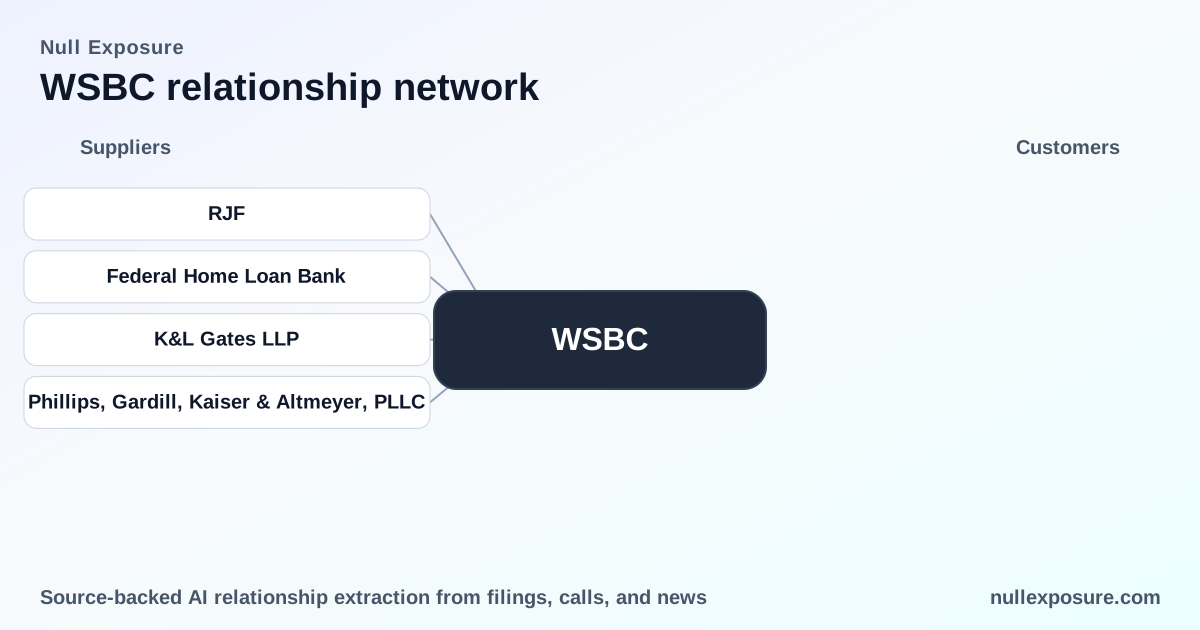
WesBanco (WSBC) — Supplier relationships, legal advisors, and operating constraints investors should price in
WesBanco is a regional bank holding company that monetizes through net interest margin on loans and securities, fee income from trust, brokerage, mortgage and deposit services, and interest-sensitive product repricing. The firm's economics are driven by customer deposit behavior, funding mix including wholesale borrowings, and predictable contractual cost lines such as long-term branch leases and core banking licensing. For investors evaluating counterparty and supplier risk, the combination of long-dated physical leases, a material core-systems licensing commitment, and active external advisors tied to an announced merger form the dominant operational contours to model into forecast scenarios.
Explore deeper supplier signals at https://nullexposure.com/ to convert these relationship reads into actionable risk views.
How to read these supplier signals in plain English
WesBanco’s supplier posture is a mix of long-dated fixed obligations and critical third-party service dependence. Leases for branches and offices have weighted-average terms measured in years and renewals that extend expense visibility, while a core-banking licensing contract through 2027 creates a clear vendor dependency and a near-term cash outflow floor (about $11.2 million annually during the contract period). The bank also holds mortgage securities issued by government or government-sponsored entities, which reduces credit-loss provisioning for that bucket but creates sensitivity to policy changes. Operationally, third-party vendors process essential functions — general ledger, payroll, loan and deposit processing, trust recordkeeping and merchant services — making continuity and cyber resilience strategic priorities. These are company-level signals rather than relationship-specific attributions.
The full roster of related counterparties you need on your model
Below are all supplier and advisor relationships surfaced in the available reporting, each with a concise, investor-ready summary and a source note.
-
Raymond James & Associates, Inc. — Raymond James served as WesBanco’s financial advisor in the announced merger transaction with Premier Financial. This involvement signals traditional investment-banking engagement and external transaction execution capacity. Source: WFIN local news release covering the merger (reported March 2026).
-
Federal Home Loan Bank — Management discussed effects of deposit growth and lower Federal Home Loan Bank borrowings on margin trajectory during the Q4 earnings call, indicating FHLB funding is an active component of WesBanco’s liquidity and margin profile. Source: Finviz coverage of WesBanco’s Q4 earnings call (March 2026).
-
K&L Gates LLP — K&L Gates is listed among legal counsel representing WesBanco in the merger transaction, indicating outside counsel engagement for M&A and regulatory work. This adds predictable billable legal spend and specialist counsel capacity during integration phases. Source: WFIN report on the WesBanco–Premier Financial announcement (March 2026).
-
Phillips, Gardill, Kaiser & Altmeyer, PLLC — This local law firm is also counsel for WesBanco on the same transaction, suggesting combined national and regional legal coverage for the deal and associated regulatory filings. Source: WFIN coverage of the merger announcement (March 2026).
What the relationships collectively reveal about operating risk and maturity
Treat these signals as complementary evidence that WesBanco runs a transaction-active balance sheet with embedded structural vendor obligations:
-
Contracting posture and maturity: The company maintains long-term physical leases for branches (some with extension options into multiple five- and ten-year terms) and carries a subordinated note due in 2032 — both points create a base of long-dated fixed-cost commitments that limit near-term operating flexibility.
-
Vendor concentration and criticality: The core banking license through 2027 and the list of third-party service providers for essential processing establish single-vendor sensitivity and operational criticality; replacement would be expensive and time-consuming, so outsourcing continuity is a material operational risk.
-
Funding and counterparty profile: Use of Federal Home Loan Bank borrowings positions the bank within typical regional-bank liquidity channels; movement away from FHLB borrowing materially shifts margin dynamics, as management has signaled on recent calls.
-
Transaction-driven cost and advisory footprint: Engagements with Raymond James and multiple law firms are consistent with an active M&A posture and mean advisory fees and integration costs are likely to be non-trivial during the transaction window.
Investor implications — what to model and where to watch
-
Model a gradual margin normalization tied to funding mix. If deposit growth persists and FHLB borrowings remain lower, net interest margin should have room to expand; conversely, renewed reliance on wholesale borrowing would compress margin.
-
Stress-test vendor disruption and license re-negotiation. The $11.2 million-per-year core-systems commitment to 2027 is a downside cash floor; scenarios that include vendor failures, accelerated capital spending to replace systems, or higher maintenance fees are relevant for multi-year earnings sensitivity.
-
Price in legal and integration costs around the merger. Advisory and counsel relationships indicate near-term transaction costs and execution risk; incorporate transaction expense and potential one-time integration charges into FY+1 forecasts.
-
Elevate cyber and operational resilience as material risk. Management’s own disclosures list information-system failures as capable of having a material effect on results, so allocate capital expenditure and operational risk buffers accordingly.
For an operationally focused supplier-risk view and to see how these relationships map into financial scenarios, visit https://nullexposure.com/ and convert relationship reads into portfolio actions.
Quick, decisive takeaways for portfolio positioning
- WesBanco runs with structural fixed-cost exposure (long leases, subordinated debt) and a material core-systems vendor commitment that sets a near-term cash obligation floor.
- Funding composition is active and moveable; management commentary about FHLB usage directly impacts margin forecasts.
- M&A activity increases advisory and legal spend in the near term, while also introducing execution risk tied to integration.
If you are refining exposure to regional banks or constructing a thesis around WSBC specifically, incorporate the supplier-contract timeline and the funding mix scenarios into both valuation and liquidity stress tests. For a workflow that ties supplier relationships to financial sensitivity analyses, start here: https://nullexposure.com/.
Bottom line
WesBanco’s supplier and advisor signals are straightforward: long-term contractual commitments, a material core-systems vendor dependency, and active external advisors tied to a merger. These factors collectively constrain upside if funding deteriorates or if integration costs escalate, while also creating predictable expense and risk vectors that can be modeled into earnings and capital projections. For investors who prioritize operational continuity and supplier concentration in regional banks, these are the inputs that should move position sizing and hedging decisions. Final operational due diligence and scenario runs are available through the supplier intelligence hub at https://nullexposure.com/.