Waterstone Financial (WSBF): Supplier relationships and operational constraints investors should price in
Waterstone Financial, the holding company for WaterStone Bank SSB, monetizes through traditional regional banking channels — net interest income from loan and deposit spreads, fee income (including mortgage origination and servicing), and selective noninterest income tied to loan sales and servicing rights. With roughly $137 million in trailing revenue and a market capitalization near $286 million, Waterstone’s economics combine steady interest income with pockets of mortgage-related fee revenue; supplier and counterparty arrangements that support mortgage origination and servicing therefore have direct impact on operating leverage and cost structure. For an investor evaluating WSBF as a borrower, partner, or portfolio position, understanding supplier criticality and the company’s contracting posture is essential. Visit the NullExposure homepage for broader counterparty intelligence: https://nullexposure.com/
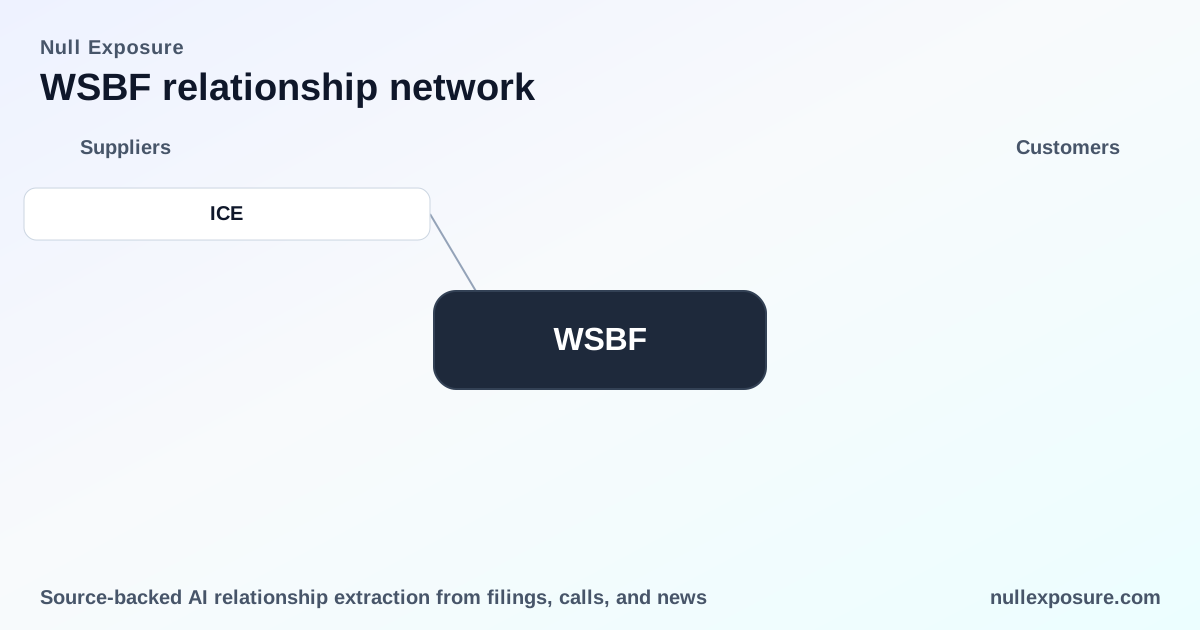
One visible supplier: ICE Mortgage Technology supports the digital mortgage channel
Waterstone’s digital mortgage platform is powered by ICE Mortgage Technology (formerly Ellie Mae), integrating third‑party loan origination capabilities into the bank’s customer workflow and improving origination efficiency. A review published on The Truth About Mortgage in March 2026 notes that Waterstone’s digital mortgage is powered by ICE Mortgage Technology, which underpins the bank’s consumer lending front end and document processing (The Truth About Mortgage, March 10, 2026). Source: The Truth About Mortgage review (2026).
Why that relationship matters to investors
ICE Mortgage Technology is a broadly adopted fintech vendor in the home-loan ecosystem; using ICE gives Waterstone access to a market-tested origination engine without the fixed costs of in‑house development. That reduces capital intensity for mortgage growth but increases operational dependence on a single third‑party platform for origination workflows and compliance updates, so vendor performance and contractual terms will influence margin volatility in the mortgage line.
What the company-level constraints reveal about operating posture
Waterstone’s disclosures and extracted constraint signals describe a firm that balances both short‑ and long‑term funding and relies materially on outsourced servicing and data processing. Treat these as company-level operational signals rather than being tied to any single supplier unless explicitly named.
- Contracting posture: Filings show both long‑term and short‑term advances with the Federal Home Loan Bank (FHLB), including a long‑term advance (example: a $10,000 advance maturing December 3, 2027) and short‑term advances totaling $293,553, indicating a mixed maturity funding posture that manages liquidity through staggered borrowings. Evidence from recent financial notes supports this long- and short-term advance mix (company filings).
- Outsourcing and service provider posture: The company discloses that it outsources a majority of data processing to third‑party providers and that Waterstone Mortgage Corporation has contracted third parties to service loans retained by the bank, signaling that third‑party vendors are operationally critical to both technology and loan servicing functions (company filings).
- Spend and leverage signals: An excerpt cites “Total borrowings $446,519,” which the model flagged within a high spend band; treat this as a pointer that borrowings and counterparty funding are meaningful line items in liquidity management rather than a trivial footnote (company filings).
Together, these constraints paint a bank that uses a hybrid funding strategy and relies on third‑party vendors for mission‑critical systems and servicing — a configuration that increases vendor concentration risk but lowers fixed cost investment in internal platforms.
How supplier relationships map to investment risks and opportunity
Waterstone’s supplier posture generates both upside and risk for investors:
- Efficiency upside: Outsourcing origination technology to ICE and third‑party servicing can compress mortgage unit economics and accelerate scale without heavy capital expenditure, supporting fee growth and margin improvement in favorable rate environments.
- Concentration and operational risk: Heavy reliance on third‑party processors and servicers concentrates operational risk; a vendor outage, contract dispute, or price increase would transmit quickly to origination volumes and servicing margins. Operational continuity of key vendors is therefore a near-term valuation lever.
- Funding flexibility: The mix of long‑term and short‑term FHLB advances demonstrates active balance‑sheet management; however, the bank’s borrowings and advance profile create refinancing and interest‑rate sensitivity that investors must monitor alongside deposit stability.
Key takeaways for investors:
- Vendor concentration is a strategic tradeoff: it lowers capex and time-to-market but raises operational dependence.
- Funding maturity mix is purposeful: the firm actively manages short- and long-term advances to match liquidity needs.
- Watch servicing arrangements: outsourced servicing arrangements affect both credit performance monitoring and potential liability if servicing fails.
For a deeper read on counterparty exposure across regional banks, see NullExposure’s intelligence tools: https://nullexposure.com/
Every supplier relationship in the public results (complete coverage)
- ICE Mortgage Technology — Waterstone’s digital mortgage platform is powered by ICE Mortgage Technology, which supplies the loan origination and digital mortgage workflow used by Waterstone Mortgage; this is documented in an industry review published March 10, 2026 (The Truth About Mortgage). Source: The Truth About Mortgage review (2026).
Practical next steps for investors and operators
- Request contract term summaries for vendor SLAs, termination rights, and pricing adjustment clauses for ICE and any other core processors; contractual protections matter more than vendor brand when continuity is at stake.
- Monitor FHLB advance maturities and short-term borrowings quarterly to assess liquidity runway and interest‑rate repricing risk.
- Stress-test mortgage processing and servicing continuity scenarios — model both volume shocks and vendor pricing shocks to quantify P&L sensitivity.
Visit NullExposure for counterparty diligence templates and to compare Waterstone’s vendor posture against peers: https://nullexposure.com/
Bottom line
Waterstone operates as a regionally focused bank that leverages third‑party mortgage technology and outsourced servicing to scale origination with limited upfront investment. That operating model drives attractive efficiency potential but elevates vendor concentration and funding‑maturity risk, both of which should be incorporated into valuation and diligence workflows. For investors and counterparties, the critical questions are contractual terms with suppliers, the maturity schedule of advances, and the operational resilience of third‑party servicers — all determinative of near‑term earnings volatility and long‑term franchise value. Explore more detailed counterparty intelligence at NullExposure: https://nullexposure.com/