Winchester Bancorp (WSBK): The lender’s supplier footprint and what it means for investors
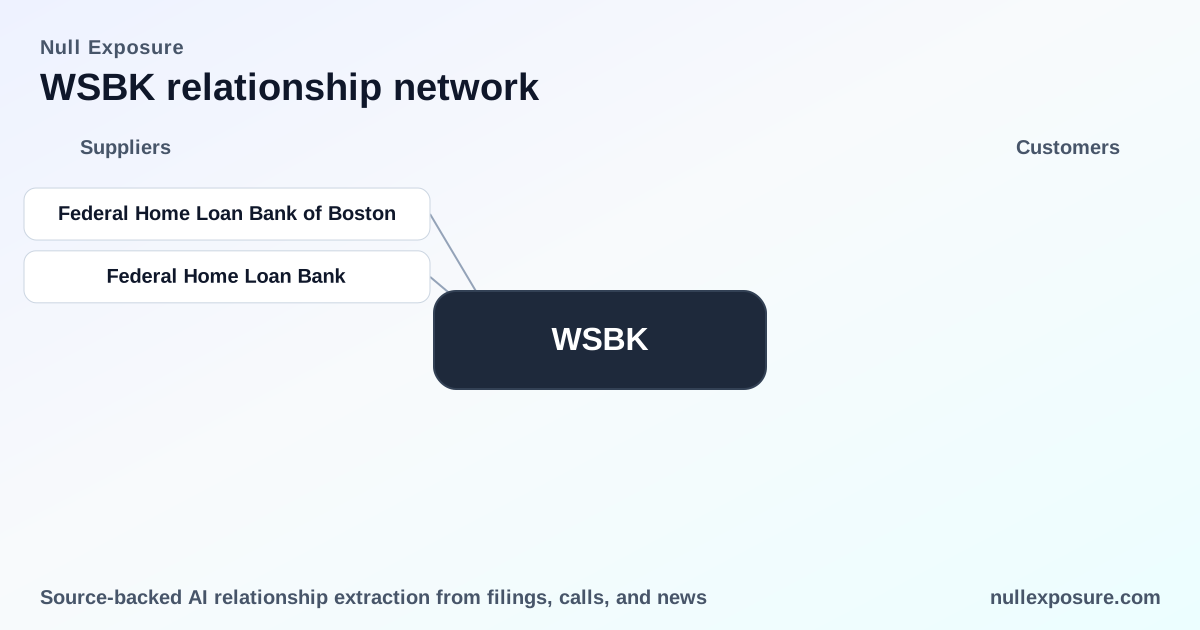
Winchester Bancorp operates as the bank holding company for Winchester Savings Bank, generating revenue from traditional community‑bank activities: net interest income on a portfolio of loans and investment securities, and fee income from deposit and service products. The company funds loan growth through customer deposits and wholesale borrowings, and monetizes the spread between loan yields and funding costs while bearing concentrated counterparty exposure in its wholesale funding relationships. For investors and operators assessing supplier risk, the dominant external relationship is with the Federal Home Loan Bank system, which functions as a core liquidity and funding partner for the institution. Learn more about supplier analysis and mapping at https://nullexposure.com/.
Why supplier relationships matter for a regional bank like Winchester
Regional banks are not just credit and deposit businesses; they are networks of counterparties that provide capital, clearing, custody, and information services. For Winchester, wholesale funding and third‑party service providers are operationally critical: funding lines determine balance‑sheet flexibility and third‑party vendors underpin data processing and back‑office continuity. Winchester’s FY2025 disclosures show material FHLB exposure and explicit vendor dependence, which elevates counterparty and concentration risk relative to peers with broader institutional funding mixes.
- Funding concentration: Large advances from the Federal Home Loan Bank system represent a structural funding lever.
- Operational concentration: Third‑party data and processing vendors are flagged as notable sources of operational and information risk.
If you want structured supplier screening and counterparty mapping, start here: https://nullexposure.com/.
Key supplier relationships you must know
Federal Home Loan Bank of Boston — funding partner with material advances
Winchester disclosed that borrowings—consisting solely of Federal Home Loan Bank of Boston advances—increased by $17.0 million to $164.0 million in FY2025, signaling active use of FHLB advances for liquidity and balance‑sheet management. This funding line is large relative to Winchester’s market capitalization and balance‑sheet scale and represents the bank’s primary wholesale counterparty. (Source: tradingview.com coverage of Winchester’s FY2025 10‑Q, reported March 2026: https://www.tradingview.com/news/tradingview:61eb663c2608b:0-winchester-bancorp-inc-md-sec-10-q-report/)
Federal Home Loan Bank — rising interest cost on advances
Winchester’s published results show interest on Federal Home Loan Bank advances increased to 6,076 from 4,545 in the comparable period, indicating higher funding cost pressure from FHLB borrowings in FY2025. The line item confirms not only usage but also the earnings impact of FHLB funding. (Source: Winchester Bancorp FY2025 results via Business Wire / The Globe and Mail, March 2026: https://www.theglobeandmail.com/investing/markets/markets-news/Business%20Wire/33755419/winchester-bancorp-inc-announces-results-for-the-year-ended-june-30-2025/)
What the constraints tell us about Winchester’s operating model
The company disclosures and the extracted constraint signals sketch a clear operating posture for Winchester:
- Long‑term contracting posture: Evidence lists multi‑year maturities for FHLB advances and lease obligations, indicating Winchester operates with long‑dated funding commitments and contracted infrastructure relationships. This supports medium‑term balance‑sheet planning but reduces short‑term funding optionality when advances are large.
- Government counterparty: The Federal Home Loan Bank of Boston is a government‑sponsored counterparty; Winchester’s use of FHLB facilities represents exposure to a highly rated, structured liquidity source, but one that creates concentration risk when it supplies a large share of wholesale funds.
- Materiality and spend concentration: Winchester reports $147.0 million outstanding in FHLB advances and additional available capacity, placing the FHLB relationship squarely in the >$100M spend band category—this is a material supplier relationship relative to Winchester’s reported revenue and market cap.
- Service provider dependence and active scope: Company statements identify third‑party vendors as active and notable sources of operational and informational risk, supplying key data processing and information services. This is a company‑level signal about vendor criticality and operational concentration rather than a specification tied to a single supplier.
Together these constraints create a profile of a small regional bank that uses long‑term, government‑sourced wholesale funding as a primary liquidity tool, while relying on external vendors for core infrastructure. That combination reduces funding cost volatility where FHLB terms are favorable, but concentrates counterparty and operational risk.
Investment implications and risk checklist
- Funding concentration is a double‑edged sword. The FHLB provides staged, reliable liquidity but $147M+ of advances constitutes a sizable funding bucket; a stress scenario that limits access to FHLB programs or raises their cost would compress net interest margin and could force balance‑sheet adjustments.
- Rising funding costs are already visible. The increase in interest on FHLB advances from 4,545 to 6,076 (FY2025) is a measurable drag on earnings — investors should track both average advance balances and the effective rate on these advances quarterly.
- Operational risk from vendors is material. Winchester’s own disclosures call out third‑party vendors as notable sources of operational and information risk; continuity and oversight of outsourced processing is a governance and resiliency concern for operators and investors alike.
- Concentration vs. capital cushion. With limited institutional ownership (≈9% institutions) and high insider ownership (~59%), strategic capital decisions and contingency liquidity planning are governed by a concentrated ownership base; monitor capital ratios and access to contingency liquidity facilities.
If your thesis depends on counterparty resilience and supplier diversification, you should model alternative funding scenarios and ask for vendor continuity plans — more on supplier risk scoring is available at https://nullexposure.com/.
What to monitor next and recommended actions
- Quarterly disclosure of FHLB advance balances and the line‑item interest expense on those advances.
- Any changes to available lines (e.g., FHLB availability, Federal Reserve BIC program access) and maturity schedules of advances.
- Third‑party vendor risk disclosures, including cyber and business‑continuity testing results and concentration metrics.
- Capital and liquidity ratios under stressed funding costs.
To get a structured supplier due‑diligence briefing and a counterparty heat map for regional banks, visit https://nullexposure.com/.
Bottom line
Winchester Bancorp’s supplier profile is defined by a material, long‑term funding relationship with the Federal Home Loan Bank system and a recognized dependence on third‑party operational providers. That structure supports liquidity and operational scale for the bank’s community lending model, but it concentrates funding and operational risk in ways investors must quantify. Active monitoring of FHLB balances, funding costs, vendor controls, and contingency liquidity is essential for any investor or operator assessing WSBK’s risk‑reward profile.