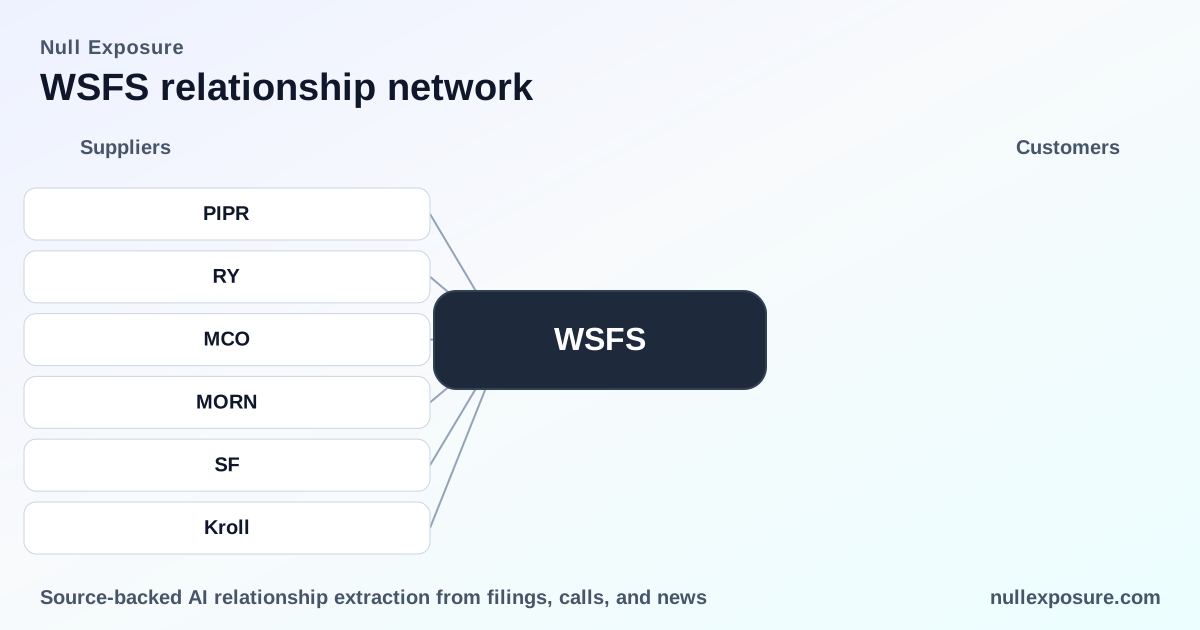
WSFS Financial: who underwrites its debt, who rates it, and what that means for investors
WSFS Financial Corporation operates as a regional bank holding company that monetizes through a combination of net interest income from lending and deposit-taking, fee income from wealth and treasury services, and occasional capital markets activity such as unsecured note issuances to optimize funding and balance-sheet composition. The company uses external investment banks as book-runners to place debt and credit rating agencies to signal credit quality to investors — both relationships are operationally important for funding cost and market access. If you want a quick consolidated reference on counterparties and implications, start at the NullExposure homepage: https://nullexposure.com/.
The recent activity that matters to suppliers and investors
WSFS executed a senior unsecured notes offering in December 2025. The transaction is informative because it exposes the company's operating model for capital formation: WSFS engages multiple book-running managers to underwrite and place notes, while independent ratings from the major agencies define investor demand and pricing. The December 9, 2025 press release on Business Wire lists the underwriting syndicate and confirms the executed pricing; a separate market bulletin summarized the ratings assigned to the notes (TradingView citing the offering announcement). Together these sources document the active supplier relationships that supported the deal.
Who’s on the roster — the counterparties named in public filings and reports
Piper Sandler
Piper Sandler acted as a joint book-running manager for the senior unsecured notes issuance. According to the WSFS press release distributed on Business Wire (Dec. 9, 2025), Piper Sandler was one of the firms leading the notes offering and allocation. (Source: Business Wire / markets.financialcontent.com, Dec 9, 2025)
RBC Capital Markets
RBC Capital Markets served as a joint book-running manager alongside Piper Sandler and Keefe, Bruyette & Woods. The same December 9, 2025 corporate announcement lists RBC as part of the underwriting syndicate supporting placement and distribution. (Source: Business Wire / markets.financialcontent.com, Dec 9, 2025)
Keefe, Bruyette & Woods (A Stifel Company)
Keefe, Bruyette & Woods, a Stifel company, was also one of the joint book-running managers for the notes offering, reflecting WSFS’s use of multiple regional and national brokers to broaden investor reach. The underwriting list appears in WSFS’s December 2025 offering notice. (Source: Business Wire / markets.financialcontent.com, Dec 9, 2025)
Moody’s
Moody’s assigned a Baa2 rating to the notes tied to this issuance, providing a mid‑investment-grade assessment that directly influences coupon level and investor appetite. The rating was reported in coverage of the proposed offering referenced by TradingView. (Source: TradingView reporting on the proposed notes offering, FY2025)
Morningstar DBRS
Morningstar DBRS provided an A(low) rating to the notes, which sits slightly higher than Moody’s in the published stack and gives WSFS access to investors with different credit thresholds. This rating is cited in public coverage of the offering. (Source: TradingView reporting on the proposed notes offering, FY2025)
Kroll
Kroll rated the notes A-, completing the multi‑agency view that investors use to price the debt and determine eligible buyer universes. Coverage of the proposed offering includes Kroll’s assessment. (Source: TradingView reporting on the proposed notes offering, FY2025)
What these relationships reveal about WSFS’s operating posture
- Contracting posture — transactional but institutionalized. WSFS engages external underwriters on a deal-by-deal basis for capital formation, but it consistently uses established investment banks and accredited ratings agencies, reflecting institutionalized capital markets workflows rather than ad hoc sourcing.
- Supplier concentration — intentionally diversified. The underwriting syndicate includes multiple firms (Piper Sandler, Keefe Bruyette & Woods / Stifel, RBC), which reduces single-counterparty execution risk and broadens distribution channels.
- Criticality — high for funding and pricing. Book-runners and rating agencies materially affect cost of funds and investor access; these suppliers are critical for timing and pricing of debt issuance.
- Maturity and stability — market-standard counterparties. The counterparties named are long‑standing capital markets players, indicating mature, market-standard relationships rather than boutique or experimental partners.
A company-level signal in WSFS’s risk disclosures reinforces this analysis: management explicitly describes reliance on third parties for certain important functions, including the operation of its core systems, and any failures by such third parties could create operational disruption — a broad warning that external suppliers are integral to both operations and capital strategy. This is a company-level constraint and does not single out any named counterparty.
Investment and operational implications for buyers and operators
- Funding resilience: Using a multi‑bank syndicate and three ratings agencies supports diversified investor access and competitive pricing. The Baa2/A(low)/A- rating mix places WSFS solidly within investment-grade investor pools while leaving room to tighten spreads if ratings improve.
- Execution risk: Underwriting execution is still a discrete risk; market conditions during issuance determine final pricing. The presence of multiple book-runners helps mitigate placement risk but does not eliminate market sensitivity.
- Vendor dependency: The corporate disclosure about third‑party reliance flags that supplier failures can have operational consequences beyond capital markets, reinforcing the need for counterparty diligence by investors and counterparties alike.
If you want a consolidated, machine-verified view of counterparty relationships and how they shift deal by deal, explore the NullExposure hub here: https://nullexposure.com/.
Quick takeaways for investors
- WSFS runs a traditional regional bank funding model augmented by periodic unsecured note issuances; underwriters and rating agencies materially shape execution and cost.
- The underwriting syndicate is diversified across national and regional banks, reducing single-name execution risk.
- Ratings are investment-grade but split across agencies (Baa2 / A(low) / A-), which expands eligible investor pools and influences coupon levels.
- Operational reliance on third-parties is explicit in company disclosures, a non-trivial governance and operational risk.
For analysts building exposure models or operational due diligence frameworks, the full counterparty list and context are available from WSFS filings and associated market releases — and you can start an organized review at the NullExposure homepage: https://nullexposure.com/.
Conclusion — what to watch next
Monitor future WSFS debt offerings and any changes in the underwriting roster or rating agency assessments. Changes in the syndicate composition, a shift in ratings, or an explicit vendor incident would be material for funding cost, liquidity, and operational stability. For ongoing tracking of WSFS supplier relationships and how they influence capital markets execution, visit https://nullexposure.com/ for consolidated coverage and alerts.