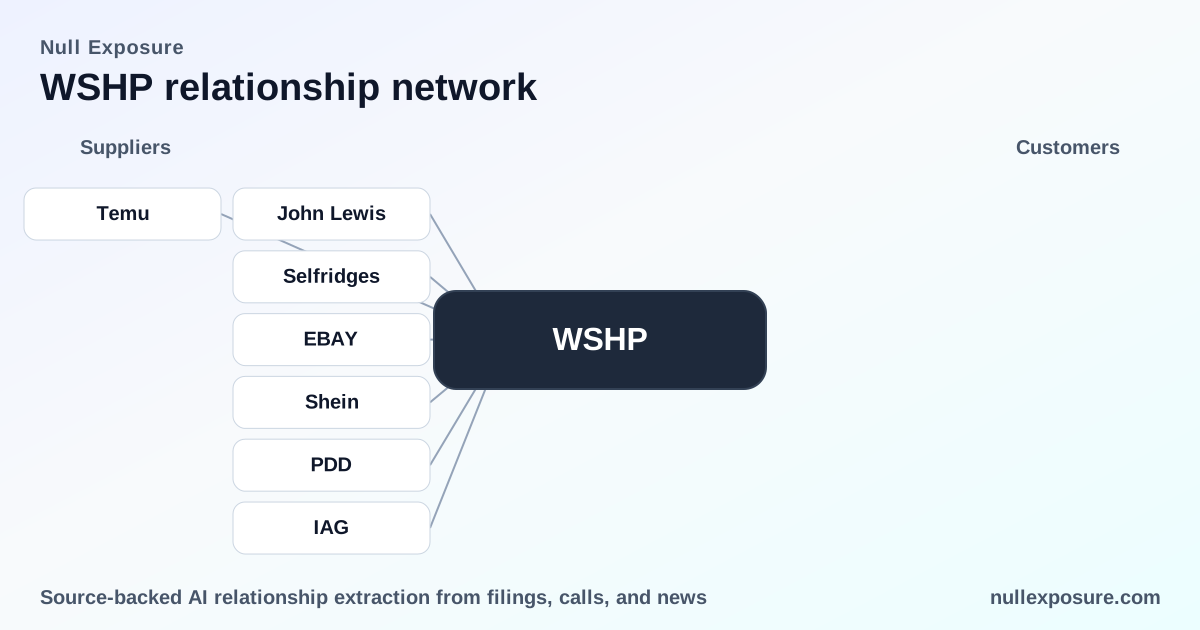
WeShop Holdings (WSHP): Partner footprint, business model, and the supplier relationships that matter to investors
WeShop operates a cross-border retail marketplace that aggregates branded inventory and routes consumer demand through partnerships with large retailers and global platforms; the company monetizes primarily through marketplace fees, merchant referral and distribution arrangements, and ancillary platform services to retailers and brands. For investors evaluating supplier and partner risk, WeShop’s strategic value hinges on distribution relationships with major UK and global retailers — these relationships drive product breadth and consumer reach while exposing WSHP to partner concentration and platform integration risk. Learn more about our supplier coverage and platform risk framework at https://nullexposure.com/.
Overview and investment thesis WeShop presents as a growth-stage marketplace with a small revenue base (Revenue TTM $810k) and negative operating profitability (Operating Margin TTM -12.33%), but its public narrative and filings emphasize integrated partnerships with large retail chains and global marketplaces to access broad product assortments. If WeShop can convert partner distribution into scalable take-rates and higher GMV, the business model offers high operating leverage; if partner access is shallow or promotional, leverage will be limited and capital costs will pressure margins. Given the company’s high insider ownership (87.75%) and minimal institutional ownership, investor scrutiny of these supplier relationships is essential.
Why the partner list matters for commercial and operational risk Partnerships with entrenched retailers bring two simultaneous effects: immediate distribution and validation, and dependency on partner commercial terms, fulfillment protocols, and marketing cooperation. For a platform at WeShop’s revenue and margin profile, partner criticality is high — losing a large retail listing or seeing unfavorable fee renegotiations would have outsized effects on growth and monetization. Contracting posture looks like a hybrid: relationships that provide product access at scale (retailer integration) alongside marketplace channel deals that monetize via referral/commission flows.
Key company-level signals for diligence
- Concentration and governance risk: 87.75% insider ownership aligns incentives with founders but limits free float and creates governance concentration.
- Commercial immaturity: Negative gross profit and small absolute revenue indicate early-stage monetization; partner agreements will need to scale to justify public valuations.
- Market valuation mismatch: Price-to-sales and EV multiples imply high expectations (P/S ~177, EV/Revenue ~141.5); these require robust partner-driven GMV growth to satisfy investors.
- No explicit contractual constraints or supplier-specific covenants are disclosed in the available relationship constraints package — treat partner claims as strategic signals to be confirmed through direct diligence (NDAs, partner confirmations).
Market-facing relationships — what the press reports and filings list Below I cover every partner mentioned in the available relationship set. Each entry is a plain-English summary of the relationship that appeared in recent trading coverage, with source citations.
-
John Lewis — WeShop is reported to partner with John Lewis in the UK to expand product access and storefront reach, giving WeShop distribution into established department-store channels. (TradingView coverage of WeShop's NASDAQ listing, March 10, 2026: https://www.tradingview.com/news/eqs:2af15b6c1094b:0-hot-rocks-investments-plc-weshop-begins-trading-on-nasdaq/ and TradingView report on a related share acquisition, March 10, 2026: https://www.tradingview.com/news/eqs:cf4406537094b:0-hot-rocks-investments-plc-agreement-to-acquire-500-000-weshop-holdings-limited-class-a-ordinary-shares/).
-
Selfridges — Press coverage lists Selfridges among WeShop’s UK retail partners, positioning the platform within premium department-store inventory feeds and marketing channels. (TradingView, March 10, 2026: https://www.tradingview.com/news/eqs:2af15b6c1094b:0-hot-rocks-investments-plc-weshop-begins-trading-on-nasdaq/; https://www.tradingview.com/news/eqs:cf4406537094b:0-hot-rocks-investments-plc-agreement-to-acquire-500-000-weshop-holdings-limited-class-a-ordinary-shares/).
-
eBay (EBAY) — Reports indicate WeShop has an integration with eBay that gives access to large multi-brand listings and secondary-market traffic, augmenting WeShop’s catalog depth and search distribution. (TradingView coverage, March 10, 2026: https://www.tradingview.com/news/eqs:cf4406537094b:0-hot-rocks-investments-plc-agreement-to-acquire-500-000-weshop-holdings-limited-class-a-ordinary-shares/; https://www.tradingview.com/news/eqs:2af15b6c1094b:0-hot-rocks-investments-plc-weshop-begins-trading-on-nasdaq/).
-
British Airways (IAG) — The firm’s partner list includes British Airways, implying WeShop has retail or loyalty-distribution arrangements that place products to travelers or convert loyalty channels into commerce flows. This extends WeShop’s addressable audience beyond traditional retail. (TradingView, March 10, 2026: https://www.tradingview.com/news/eqs:2af15b6c1094b:0-hot-rocks-investments-plc-weshop-begins-trading-on-nasdaq/; https://www.tradingview.com/news/eqs:cf4406537094b:0-hot-rocks-investments-plc-agreement-to-acquire-500-000-weshop-holdings-limited-class-a-ordinary-shares/).
-
Temu (PDD) — Trade press names Temu among partner platforms, indicating WeShop’s willingness to integrate with fast-fashion, high-volume marketplaces for broader SKU reach and potentially price-competitive segments. (TradingView, March 10, 2026: https://www.tradingview.com/news/eqs:2af15b6c1094b:0-hot-rocks-investments-plc-weshop-begins-trading-on-nasdaq/; https://www.tradingview.com/news/eqs:cf4406537094b:0-hot-rocks-investments-plc-agreement-to-acquire-500-000-weshop-holdings-limited-class-a-ordinary-shares/).
-
Shein — Coverage includes Shein as a commercial partner, which gives WeShop access to high-velocity apparel assortments and a global customer base focused on low-cost fashion. (TradingView, March 10, 2026: https://www.tradingview.com/news/eqs:2af15b6c1094b:0-hot-rocks-investments-plc-weshop-begins-trading-on-nasdaq/; https://www.tradingview.com/news/eqs:cf4406537094b:0-hot-rocks-investments-plc-agreement-to-acquire-500-000-weshop-holdings-limited-class-a-ordinary-shares/).
Commercial analysis and risk framing These partner names collectively demonstrate two strategic priorities: product breadth through large assortments and channel amplification via established retail brands. For investors, the value chain question is whether these are deeply integrated commercial partnerships (revenue-share, API/catalog sync, co-marketing) or shallower distribution relationships (affiliate listings or branding partnerships). Given WSHP’s limited reported revenue and negative gross profit, the current partner set reads as strategic validation rather than proven monetization.
Operationally, partners like John Lewis and Selfridges increase customer trust and pricing power; partners like Temu and Shein increase SKU velocity but lower average unit economics. That mix creates both opportunity and balancing risk — high-growth GMV from fast-fashion versus profitability pressure from low take-rates. Mid-deal diligence should request partner agreements, take-rate schedules, and co-marketing commitments.
A practical next step for investors
- Review partner contracts, minimum performance commitments, and termination clauses to assess commercial durability.
- Validate GMV flow and reconciliation processes between WeShop and each named partner.
- Monitor ownership dynamics and free float — high insider control amplifies operational discretion and raises the bar for public-market accountability.
If you want a concise supplier risk briefing or tailored diligence questions for management and partners, find more resources and request a scoped review at https://nullexposure.com/.
Final assessment and action points WeShop’s publicly reported partner list provides meaningful distribution upside but also concentrated execution risk given the company’s early-stage revenue profile and negative gross profit. For investors, the central diligence questions are the depth of commercial integration, take-rate sustainability, and contractual protections. Confirm these through partner documentation and direct GMV reporting before assuming the headline partnerships translate into durable cash flow.
For a deeper supplier-network risk assessment and model-linked sensitivity analysis, start a tailored review at https://nullexposure.com/.