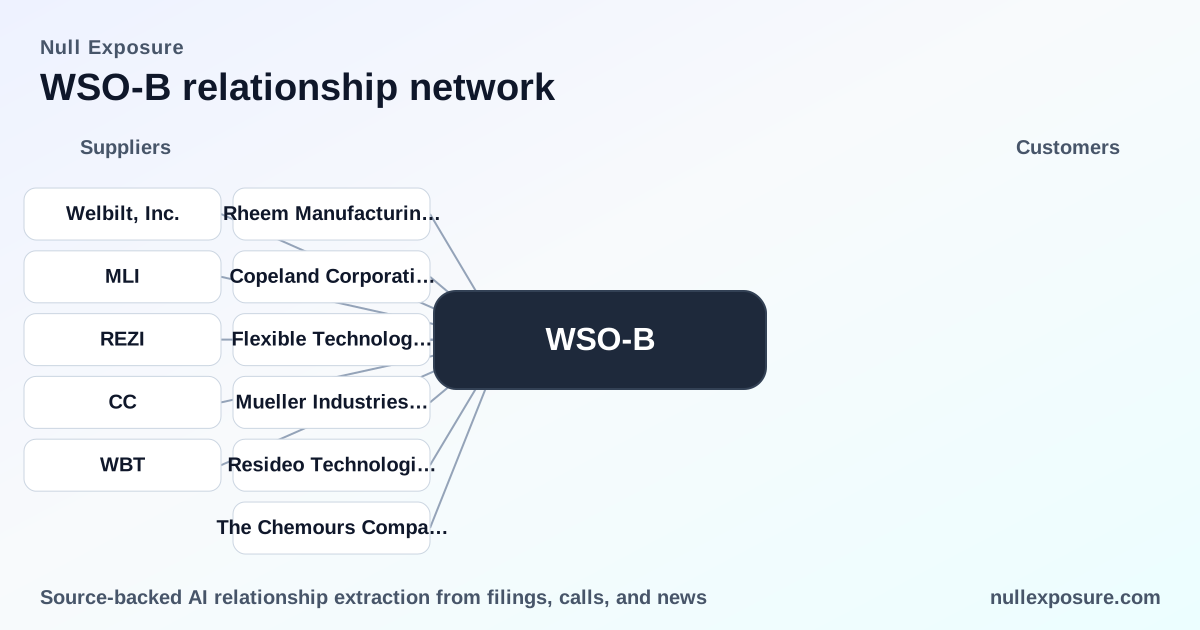
Watsco (WSO-B): supplier map and why concentrated OEM relationships drive both margin and risk
Watsco monetizes by distributing HVACR equipment and parts through a broad North American network of branches and affiliated service channels, buying product from OEMs and realizing margin through inventory turnover, value-added services and scale logistics. Watsco’s economics are driven by distribution scale, supplier access to branded products, and the company’s ability to convert inventory into high-margin aftermarket sales. Investors should evaluate supplier concentration and contract posture as first-order drivers of revenue stability and margin durability.
For a consolidated view of supplier linkages, visit https://nullexposure.com/.
The business model in one picture: distribution plus brand access
Watsco is a classic industrial distributor that captures value by aggregating demand across installers and contractors, holding inventory close to customers, and selling a mix of new equipment and replacement parts. The company reported Revenue TTM of $7.24 billion and EBITDA of $737.9 million, showing that scale and procurement terms are central to profitability. Distribution monetization is therefore twofold: (1) capture supplier rebates and price differentials on OEM product flows, and (2) extract higher margins on aftermarket parts and services that benefit from local availability and technical support.
This operating model makes Watsco structurally dependent on OEM supplier relationships for product assortment and pricing power; changes in those relationships will propagate quickly to sales mix and working capital. Learn more about how supplier exposures affect public companies at https://nullexposure.com/.
Supplier concentration is a company-level constraint you must weigh
Watsco’s filings disclose a stark concentration signal: the top ten suppliers accounted for 85% of purchases in 2024, which is classified as a material and critical supplier concentration. That fact is a company-level indicator of procurement risk rather than an attribute of any single supplier unless explicitly named in source material. The implications are direct:
- High concentration raises bargaining asymmetry—Watsco gets scale benefits but is exposed if one large OEM changes terms or faces production disruptions.
- Operational criticality is elevated—inventory planning, lead times and rebate structures are tightly coupled with a small set of manufacturers.
- Maturity of the supplier set is generally high, reflecting long-established OEMs in HVACR, which moderates but does not eliminate disruption risk.
Relationship roster: the supplier partners referenced in filings and press
Below are every supplier relationship surfaced in the source materials, each summarized in plain language with the supporting citation.
- Rheem Manufacturing Company — Watsco’s FY2024 10‑K identifies Rheem as “one of the Company’s principal suppliers,” noting senior management provenance that ties to the supplier relationship and highlighting Rheem’s strategic role in Watsco’s supply chain. (Watsco FY2024 Form 10‑K).
- Copeland Corporation, LLC — Watsco’s March 2026 press coverage lists Copeland among the manufacturers whose products Watsco distributes, indicating Copeland is a current product supplier to Watsco’s distribution network. (MarketScreener, March 10, 2026).
- Flexible Technologies, Inc. — Market commentary in March 2026 cites Flexible Technologies as a manufacturer whose products are distributed by Watsco, signaling this supplier is part of Watsco’s equipment and components mix. (MarketScreener, March 10, 2026).
- Resideo Technologies, Inc. — Watsco’s March 2026 communications name Resideo as a manufacturer whose products are in Watsco’s catalog, confirming Resideo as a channel supplier. (MarketScreener, March 10, 2026).
- The Chemours Company — The same March 2026 release lists Chemours among manufacturers whose products Watsco distributes, indicating input or component supply relationships relevant to HVACR products. (MarketScreener, March 10, 2026).
- Mueller Industries, Inc. (MLI) — MarketScreener’s March 2026 item includes Mueller as one of the manufacturers whose products Watsco handles, marking Mueller as part of Watsco’s supply base. (MarketScreener, March 10, 2026).
- Welbilt, Inc. (WBT) — The March 2026 press mentions Welbilt among manufacturers distributed by Watsco, demonstrating Welbilt’s inclusion in Watsco’s product lineup. (MarketScreener, March 10, 2026).
These entries reflect every relationship discovered in the source payload; each citation is drawn from either Watsco’s FY2024 10‑K or MarketScreener distribution notices published in March 2026.
What the supplier map tells operators and investors about contracting posture
Watsco’s model and the source evidence together indicate a contracting posture that blends long-term commercial distribution agreements with transactional purchasing tied to product cycles:
- Concentration and criticality imply negotiation leverage is two-sided. Watsco’s scale creates purchasing clout, but OEM brands are differentiated and essential to contractor demand, which limits Watsco’s ability to replace key suppliers quickly.
- Maturity of the supplier pool reduces novelty risk—these are established HVACR manufacturers with stable product lines—yet product-specific disruptions (compressors, refrigerants, key fittings) transmit quickly to branch inventories.
- Operational controls matter more than ever—inventory management, dual-sourcing where possible, and clear rebate/return terms are primary tools to manage concentration risk.
If you are assessing counterparty risk or supplier negotiations, these are the signals you should prioritize. For further supplier analytics and relationship intelligence, see https://nullexposure.com/.
Investment and operational implications: what to look for next
For investors and operators assessing Watsco, focus on three pragmatic areas:
- Monitor supplier financial health and capacity: Given 85% purchasing concentration across ten suppliers, an OEM production hiccup would have a magnified impact on Watsco’s sales and inventory turns.
- Track contract terms and exclusivity language: Changes to rebate schemes, minimum purchase commitments, or exclusivity with key OEMs will alter gross margins more quickly than market-wide demand shifts.
- Assess diversification levers: Product mix adjustments toward aftermarket parts, acquisitions of local distributors, or wider geographic sourcing reduce single‑supplier exposure and protect cash flow.
Key takeaway: supplier concentration is a structural feature of Watsco’s economics — it simultaneously enables margin through scale and creates a non-trivial single‑point risk that investors must price.
For subscribers who evaluate supplier risk across industrial distributors, our platform compiles filing- and press‑level supplier signals at scale — learn more at https://nullexposure.com/.
Bottom line
Watsco’s distribution franchise monetizes scale and branded OEM access, but its purchasing profile—top ten suppliers representing 85% of purchases in 2024—makes supplier relationships a central risk and value driver. Investors should treat OEM counterparty health, contract terms and inventory resilience as primary inputs into valuation and operational stress testing. For deeper supplier intelligence aligned to capital allocation decisions, visit https://nullexposure.com/.