Wintrust Financial (WTFC): What its custody and trust relationships reveal for investors
Wintrust Financial Corporation operates as a diversified regional bank holding company headquartered in Rosemont, Illinois, monetizing through traditional banking channels — net interest income from lending and securities, deposit-based funding, and fee income tied to trust, depositary and capital markets services. The company’s balance sheet and capital actions rely on a small set of institutional service providers for custody, depositary and redemption mechanics; understanding those suppliers and Wintrust’s counterparty profile clarifies execution risk around capital transactions and funding flows. For further supplier intelligence, visit https://nullexposure.com/.
How the recent redemption action exposes Wintrust’s service chain
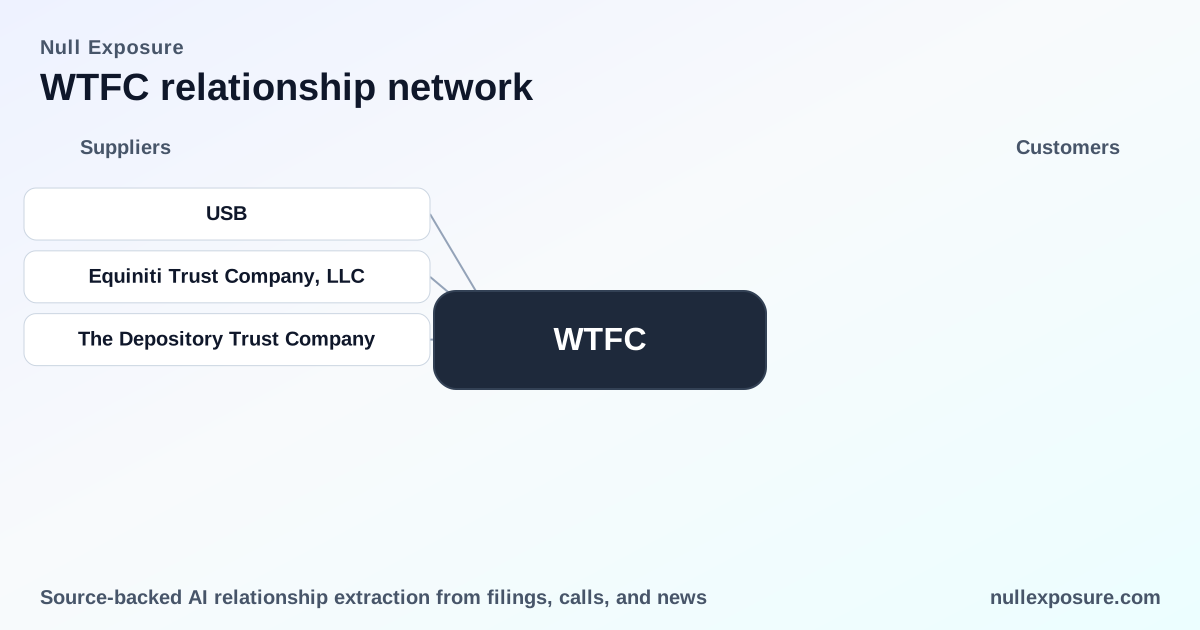
Wintrust’s public notice of preferred stock redemptions in mid‑2025 required coordination with multiple custody and trust intermediaries. These relationships are operationally simple but functionally critical for capital management — they move cash, support DTC book‑entry mechanics and act as the formal redemption agents that execute the shareholder-level transactions.
U.S. Bank Trust Company, National Association
U.S. Bank Trust acted as the Depositary for Wintrust’s depositary shares; payment to DTC for the depositary shares was routed through U.S. Bank Trust in the redemption process. According to a GlobeNewswire release dated June 13, 2025, U.S. Bank Trust executed payment arrangements as the depositary in connection with the redemption notice (GlobeNewswire, June 2025).
Equiniti Trust Company, LLC
Equiniti Trust Company served as the Redemption Agent for Wintrust’s Series D preferred stock and processed payment instructions to DTC as part of the redemption. The GlobeNewswire release describing the redemption explicitly names Equiniti Trust Company as the agent handling the Series D payments (GlobeNewswire, June 2025).
The Depository Trust Company (DTC)
Wintrust’s Series D preferred shares and related depositary shares are held only in book‑entry form through DTC, and the redemption was to be executed under DTC procedures. The GlobeNewswire notice confirms DTC as the book‑entry platform governing the mechanics of the redemption (GlobeNewswire, June 2025).
Company‑level constraints that shape counterparty strategy
Beyond the redemption event, Wintrust’s public disclosures and filings reveal several company‑level operational constraints that shape how management selects and manages suppliers:
-
Long‑term contracting posture: Filings note required early repayment and staged put/call dates on Federal Home Loan Bank (FHLB) advances, implying Wintrust engages in funding arrangements with multi‑period maturity profiles and embedded call/put features that influence liquidity management. This indicates an operational focus on managing long‑dated funding and interest‑rate optionality rather than purely short-term transactional relationships.
-
Government counterparties and agency exposure: Wintrust holds municipal securities and U.S. government agency securities (FHLB, Fannie Mae, etc.), flagging significant interaction with government and quasi‑government issuers for asset holdings and funding lines. That positions Wintrust in a set of counterparties with high structural credit quality but also sector‑specific concentration risk.
-
Large financial institutions as hedge counterparties: The company hedges derivative market risk by entering offsetting trades with large, highly rated financial institutions, signaling dependence on the operational and credit capacity of major banks to manage market exposures.
-
Geographic concentration: Municipal securities are concentrated in the Chicago metropolitan area and southern Wisconsin, indicating regional exposure that links credit and market risk to local economic conditions.
-
Buyer role in secured funding: The characterization of FHLB advances as collateralized obligations shows Wintrust operates as a buyer/issuer of secured funding rather than relying solely on uninsured wholesale deposits; collateral mechanics and counterparty enforcement matter for liquidity and funding continuity.
These constraints are company‑level signals derived from Wintrust’s regulatory and investor disclosures for year‑end periods, and they materially affect supplier selection, contract tenor and contingency planning.
For more detailed supplier mappings and systemic relationship views, see https://nullexposure.com/.
What investors should read into the supplier list
The three named suppliers in the redemption notice — U.S. Bank Trust, Equiniti Trust and DTC — are standard for a bank executing preferred share redemptions. That normality is important: these are execution providers, not credit providers, and their role is to ensure proper settlement and transfer of funds and ownership records under regulated market infrastructure.
-
The reliance on DTC for book‑entry custody means operational settlement risk is concentrated in a single, systemically critical infrastructure provider; this is standard across U.S. financial institutions but remains a single point where process failure would be highly visible.
-
Using established trust and redemption agents such as U.S. Bank Trust and Equiniti reduces transactional operational risk, shifting the primary risk set back to Wintrust’s funding mix and asset composition rather than to exotic or unvetted suppliers.
Investment implications: risk, concentration and valuation context
Wintrust’s business model — monetizing through interest spread, fee income and securities activities — is supported by these supplier relationships but is more directly exposed to funding profile and asset concentration. Key investment considerations:
-
Funding and maturity execution risk: The company’s reference to repaying FHLB advances and managing put/call schedules means liquidity is actively managed across maturities; disruptions in secured funding markets would stress the balance sheet, particularly given regional economic ties.
-
Counterparty concentration: Government and large financial institutions show up repeatedly in filings as counterparties for securities holdings and derivatives hedging, producing credit reliability but sectoral concentration, especially geographically in the Chicago/southern Wisconsin corridor.
-
Operational execution is routine but critical: The named suppliers perform well‑understood custody and redemption functions that support capital decisions; investor focus should remain on Wintrust’s underlying credit, interest‑rate exposure and capital ratios rather than on these third‑party service providers.
Valuation context: Wintrust trades at a Price/Book of ~1.28 and a trailing P/E around 11.5, with an analyst target price materially above current levels; these metrics reflect both durable earnings and a banking model sensitive to interest rates and credit cycles.
Final read for investors
The supplier relationships disclosed in the June 2025 redemption notice are operational enablers — not exotic dependencies — and they validate that Wintrust uses established custodians and redemption agents to execute capital actions. The more consequential investor signals are the company‑level constraints: long‑term funding posture, government and large‑bank counterparty reliance, and regional asset concentration. Monitor maturity schedules on secured funding, municipal credit quality in the Chicago region, and derivative counterparty composition as the triage points for event risk.
If you’re mapping counterparties and operational dependencies for WTFC, start with these confirmed providers and then layer in the funding and concentration signals from company filings. For a consolidated supplier view and deeper relationship tracing, explore https://nullexposure.com/.
For direct supplier intelligence and continuous monitoring of WTFC counterparties, visit https://nullexposure.com/ to review service provider records and disclosure excerpts.