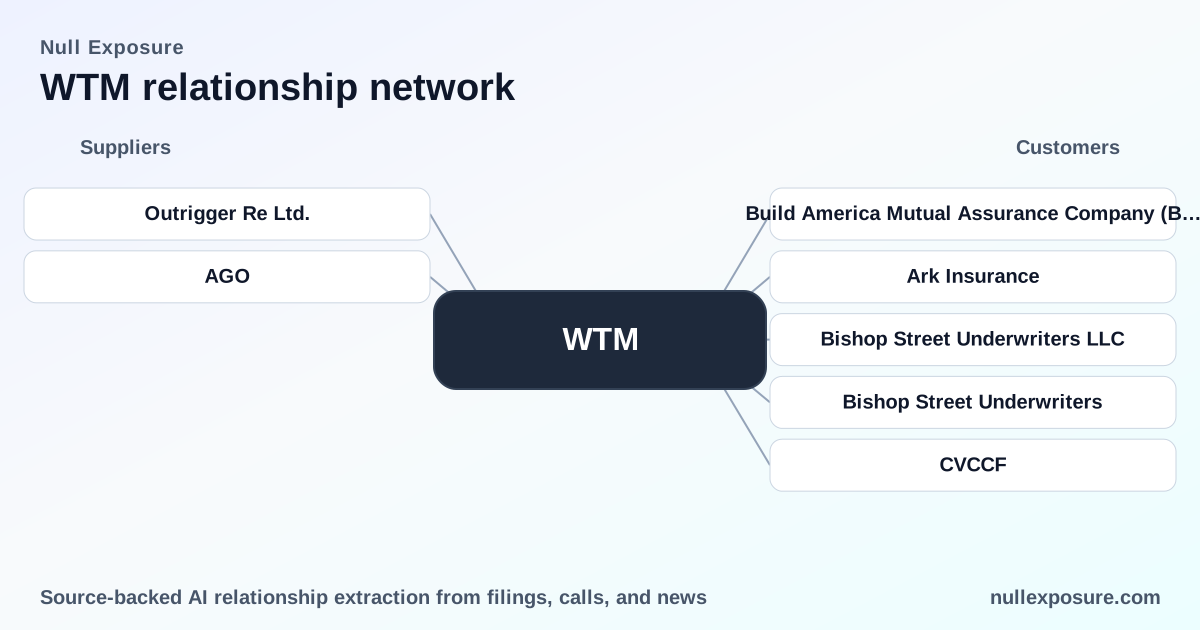
White Mountains (WTM) — Supplier relationships, counterparty map, and investor takeaways
White Mountains operates as a diversified insurance holding company that monetizes through underwriting margins, investment income and structured capital solutions, including reinsurance vehicles and sidecars that deploy third‑party capital alongside balance‑sheet risk. Its operating model relies on a mix of direct underwriting (through subsidiaries such as Ark Insurance Holdings), third‑party distribution channels (brokers, MGAs) and capital markets arrangements (reinsurance sidecars and credit facilities) to scale risk transfer while preserving capital efficiency. For investors, the supplier and counterparty set of relationships is central to assessing distribution concentration, capital utility and reinsurance execution.
Explore further on the NullExposure homepage: https://nullexposure.com/
What the relationship signals say about how White Mountains runs the business
White Mountains runs a hybrid, capital‑efficient underwriting franchise. Key operating model characteristics emerge from the supplier relationships and public disclosures:
- Contracting posture — long dated funding and capital partnerships. Company disclosures show long‑term financing in place that supports underwriting and capital markets activity; the Kudu Credit Facility, for example, matures in 2036, signaling long‑horizon financing commitments.
- Concentration — underwriting flows depend on a narrow set of intermediaries. Ark received a significant portion of its gross written premiums from four insurance and reinsurance intermediaries during recent years, which creates concentrated distribution risk and negotiating leverage for those intermediaries.
- Role diversity — distributor, seller and service provider in one ecosystem. White Mountains uses independent brokers and MGAs as primary sales channels (a distributor posture), reinsures risks to limit losses (a seller of risk), and purchases reinsurance as a risk‑management service (a service‑provider posture). The company’s public filings frame these roles as integral to how products reach policyholders and how capital is managed.
- Maturity and criticality — established vehicles with repeat renewals. Reinsurance sidecars and repeat renewals (see Outrigger Re renewal) indicate matured partner arrangements that are operationally important rather than one‑off transactions.
These are company‑level operational signals drawn from filings and recent market reporting; they inform counterparty risk, volatility of earnings and the sensitivity of underwriting growth to third‑party capital availability.
The relationships you need to know (concise map)
Below I cover every named relationship surfaced in the public signals for WTM and give a plain‑English investor summary with source citations.
Outrigger Re Ltd.
White Mountains’ Ark Insurance Holdings renewed the Outrigger Re Ltd. reinsurance sidecar for the 2026 underwriting year, deploying US$70 million of third‑party capital on terms similar to 2025, which indicates continuity in sidecar economics and ongoing reliance on third‑party capital deployment to scale underwriting. According to Simply Wall St (news item reported March 10, 2026) and a TradingView notice dated January 7, 2026, the renewal was announced as a firm commercial action for 2026.
Assured (inferred symbol: AGO)
White Mountains’ filing identifies Assured as a primary competitor to BAM in the structured finance and financial guarantee segment; Assured provides financial guarantees on non‑municipal debt, positioning it as a direct market peer in certain specialty guarantee lines. This competitive placement is documented in White Mountains’ FY2024 Form 10‑K (filed information cited in public disclosures).
How these relationships translate into investment risk and opportunity
White Mountains’ supplier and counterparty set creates a mix of structural advantages and concentrated exposures:
- Advantage — scalable capital without diluting equity. The recurrent use of sidecars like Outrigger Re allows White Mountains to underwrite scalable volumes while sharing risk and return with third‑party investors, preserving the holding company’s capital and enabling higher ROE on retained capital. The company’s financials show strong operating margin and high return on equity, which align with efficient capital deployment strategies.
- Risk — distribution concentration and contractual stickiness. The company‑level disclosure that a significant portion of Ark’s premiums come from four intermediaries is a clear concentration risk: loss or repricing of one large intermediary relationship would materially affect premium flows and underwriting leverage. This is a counterparty concentration risk that investors must quantify.
- Operational exposure — renewal and market terms. Sidecar renewals on similar terms (Outrigger Re 2026 renewal) reduce near‑term economic uncertainty, but sidecar economics are cyclical and depend on third‑party capital appetite, which is sensitive to market claims, interest rates and competitors’ pricing.
- Balance sheet durability — long‑dated financing. The existence of long‑term facilities (the Kudu Credit Facility matures in 2036) provides funding stability for multi‑year underwriting programs; long‑dated debt reduces rollover risk but creates fixed obligations during periods of balance‑sheet stress.
Mid‑analysis next step: if you want a full supplier risk scorecard for WTM, begin with the NullExposure supplier overview: https://nullexposure.com/
Practical checklist for due diligence
Use this checklist to convert the relationship map into valuation and operational actions:
- Verify latest sidecar economics and the amount of third‑party capital committed each underwriting year. Renewals like Outrigger Re’s 2026 engagement are a good forward indicator of capital availability.
- Quantify premium concentration by counterparty and model scenarios for loss of each top intermediary. The FY2024 disclosures flag concentrated flows from four intermediaries that warrant stress testing.
- Reconcile funding maturity profile (including the Kudu facility) with projected underwriting cash flows and investment liquidity under adverse claims scenarios.
- Monitor competitor moves in guarantee and structured finance lines (Assured/AGO) to assess pricing pressure and potential margin compression.
Bottom line: where the signal converges
White Mountains executes a deliberate capital‑efficient underwriting strategy that leverages third‑party capital and broker distribution to expand scale while protecting balance‑sheet capital. The renewal of sidecars like Outrigger Re for 2026 demonstrates operational continuity in that strategy, while the 10‑K competitive notes on Assured highlight the competitive set that constrains pricing in specific specialty lines. The principal investor tradeoff is attractive operating returns and low beta on the one hand, versus distribution concentration and third‑party capital cyclicality on the other.
For an in‑depth supplier profile and a downloadable counterparty risk brief on White Mountains, visit: https://nullexposure.com/
Key sources referenced: company filings (White Mountains FY2024 Form 10‑K), Simply Wall St news coverage (March 2026) and TradingView reporting (January 7, 2026) on the Outrigger Re renewal.