Watts Water Technologies (WTS) — Supplier Relationships and Strategic Implications
Watts Water Technologies designs, manufactures and sells fluid- and energy-management products across commercial and residential markets worldwide, generating revenue through product sales, aftermarket service and systems integration. The company monetizes scale in manufacturing, global distribution and recurring aftermarket demand, while directing capital toward digital and operational upgrades that reduce cost and improve installation / service economics. For investors, supplier relationships are a direct lever on margins, working capital and execution risk; Watts’ recent vendor disclosures highlight a strategic IT modernization alongside ongoing supply-chain exposure. Learn more at NullExposure.
How Watts buys and why it matters for margins and continuity
Watts operates as a capital- and supplier-intensive industrial manufacturer with a broad geographic footprint across the Americas, EMEA and APAC. That operating model generates three structural procurement characteristics that investors and operators must treat as primary drivers of performance:
- Contracting posture: Procurement is dominated by long-lead, multi-year sourcing for components, tooling and enterprise software; Watts’ capex and transformation programs indicate vendor relationships that are strategic and durable rather than transactional.
- Concentration risk: Manufacturing scale reduces per-unit cost but concentrates exposure to a smaller set of critical component and systems vendors; any disruption to those vendors will transmit quickly to margins and delivery.
- Criticality and maturity: Enterprise systems and key equipment are mission-critical for inventory management, production planning and field service profitability; multi-year modernization initiatives show management prioritizing resilience and scalability.
These characteristics line up with Watts’ financial profile — $2.44B in trailing revenue, ~18% operating margin and $528.6M EBITDA — where supplier efficiency and uptime materially affect free cash flow and return on capital. If you track supplier risk for position sizing or operational due diligence, start from these structural points. Visit NullExposure for deeper supplier intelligence.
What the disclosed relationships show
Below I cover every supplier relationship captured in the sourced material and provide concise, sourced takeaways for investor diligence.
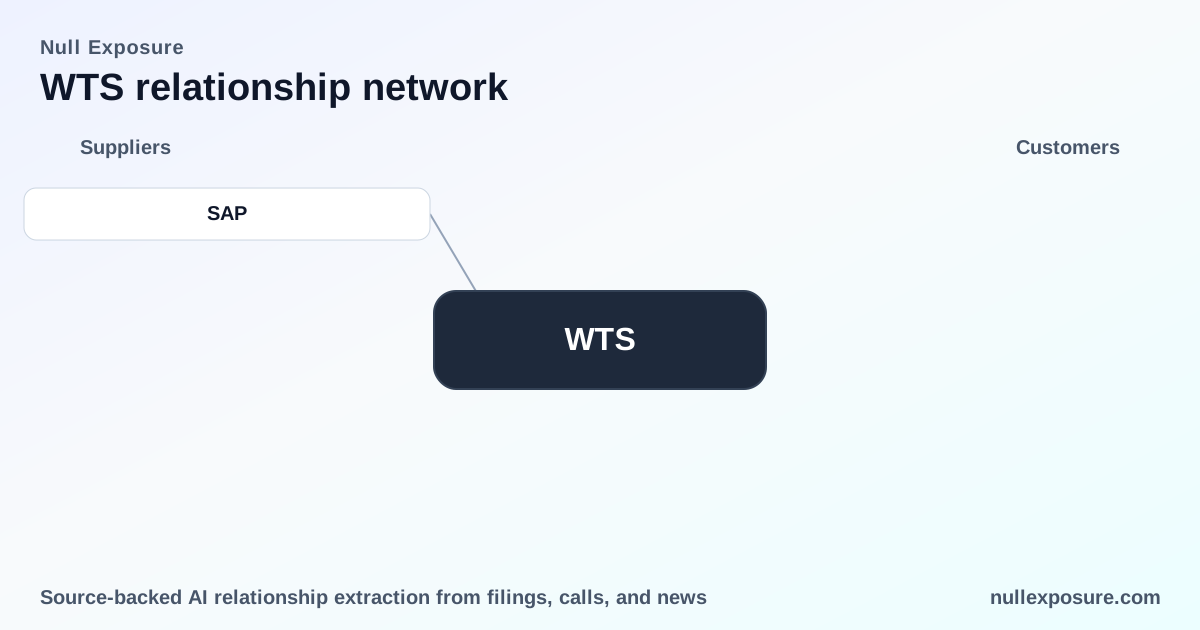
SAP — enterprise software partner for a multi-year ERP rollout
Watts is implementing a multi-year SAP ERP program across its Americas and APMEA regions to improve productivity and support its smart and connected product strategy. This positions SAP as a strategic software vendor underpinning inventory, supply-chain planning and aftermarket service integration. According to a TradingView report referencing Watts’ FY2026 SEC 10‑K filing (reported March 10, 2026), the ERP implementation is a multi-year effort designed to standardize processes and support growth.
How to interpret the SAP relationship for investment decisions
The SAP engagement is not a peripheral IT refresh; it is a strategic, multi-year transformation that changes operational control points — order-to-cash, procurement, manufacturing scheduling and field service. For investors:
- Positive read: Standardized ERP reduces fragmentation, compresses working capital cycles and improves gross-to-net visibility, supporting sustainable margin expansion.
- Execution risk: Multi-year ERP projects carry implementation timing and cost risks that can temporarily pressure operating margins and distract management from commercial priorities.
Monitor milestone disclosures and any incremental IT-related capex or consulting spend in quarterly filings; those line items will be early indicators of pacing and cost realization.
Company-level constraints and signals
There are no explicit supplier-contract constraints captured in the source material. Treat that absence as a company-level signal: Watts has not disclosed supplier-imposed contractual restrictions in the referenced filings, but its global manufacturing footprint and modernization programs imply strategic vendor commitments and multi-year procurement relationships. In practice, this means:
- Contractual obligations likely extend beyond annual purchase orders to include service-level agreements, implementation schedules and long-term licensing for enterprise systems.
- The lack of disclosed constraints does not eliminate concentration or criticality risk; transparency on vendor terms is limited in public filings and requires monitoring of subsequent filings or vendor-level disclosures.
Risk checklist for investors and operators
Focus diligence on the following items to align supplier risk with valuation assumptions:
- Monitor ERP implementation disclosures for timing, cost overruns and any one-time charges that affect EBITDA in the near term.
- Track working capital trends and inventory turns; ERP benefits should materialize as improved turns and reduced obsolescence if implemented on schedule.
- Validate supplier diversification for critical components — single-source parts or regional suppliers create outsized disruption risk.
- Ensure contingency plans for field-service continuity: aftermarket revenue depends on parts availability and service scheduling, which are directly impacted by supplier performance.
Key actions for teams and portfolio managers:
- Demand project-level KPIs from management (go-live dates, module deployments, expected savings) and incorporate into near-term financial models.
- Require procurement to publish a supplier concentration heat map for high-value components and contractual dependencies.
- Stress-test cash flow under scenarios of ERP delay or supplier outage to quantify downside.
What this means for valuation and positioning
ERP modernization and supplier governance are actionable value levers for Watts. If ERP execution reduces working capital and supports higher aftermarket margins, consensus estimates should be adjusted upward for improving free-cash-flow conversion. Conversely, protracted implementation or supplier disruptions will compress margins and increase capital intensity in the near term. Given Watts’ current multiples (trailing PE ~29.6, EV/EBITDA ~18.9), execution on these fronts is the primary path to multiple expansion.
For ongoing monitoring and supplier-focused research, start with consolidated vendor reporting and timeline milestones that management provides in earnings calls and 10‑K/10‑Q disclosures. For more supplier intelligence and relationship mapping, visit NullExposure.
Bottom line and next steps
Watts’ supplier landscape — anchored by a large-scale SAP ERP rollout and an inherently global manufacturing supply chain — is strategically critical and will be a determinative factor for near-term margin trajectory and long-term free cash flow. Investors should hold management accountable for implementation milestones and procurement transparency while operators should prioritize contingency planning and supplier diversification.
Ready to translate supplier relationships into investment signals? Explore supplier intelligence at NullExposure.