Willis Towers Watson (WTW): supplier relationships, risk posture, and what investors should know
Willis Towers Watson (WTW) is a global advisory, broking and human capital solutions firm that monetizes through advisory fees, insurance placement commissions, and recurring technology and consulting contracts. Its business model combines high-margin consulting and analytics with transactional broking activity that carries episodic counterparty and contingent liability exposure. Investors should view WTW as a fee-oriented services operator with diversified carrier relationships, meaningful fixed obligations tied to property leases, and exposure where the firm acts as broker or guarantor on large placements. Learn more at https://nullexposure.com/.
How WTW actually operates with suppliers and carriers
WTW functions as both a broker and service provider to clients, and as a purchaser/contracting party with landlords, insurers and technology vendors. The firm places insurance with a broad roster of carriers and earns commissions and placement fees, while also running long-term consulting and platform contracts that generate recurring revenue. Key business drivers are advisory fee mix, broking volumes, and the margin profile of recurring software and consulting services. Financials show substantial scale — roughly $9.7 billion in revenue (TTM) and an operating margin in the mid-30s — which amplifies the importance of stable supplier and carrier relationships to both top-line and margin resilience.
The Chubb relationship: a concise, verifiable point
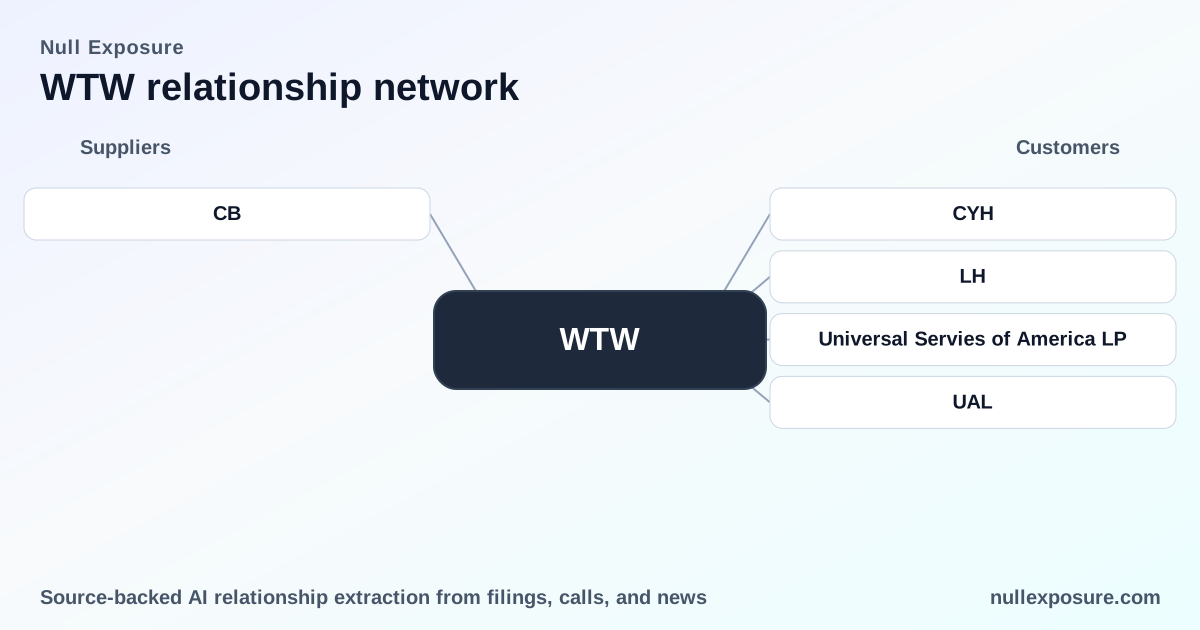
Willis Towers Watson served as the broker on the insurance policy that covered Baltimore’s Francis Scott Key Bridge; Chubb is the carrier expected to pay $350 million to the state of Maryland in connection with the bridge collapse, and WTW confirmed its role as broker. This placement highlights WTW’s involvement on very large casualty and infrastructure risks where broker confirmations and placement documentation have real financial and reputational consequences. The reporting on this matter was published in Insurance Journal (May 2, 2024).
Source: Insurance Journal, May 2, 2024 — reporting that Chubb is preparing to remit $350 million and that a WTW spokesperson confirmed the firm’s brokerage role.
What the company-level constraints tell investors about supplier risk
WTW’s public disclosures produce several company-level signals that inform supplier and counterparty risk:
- Long-term contracting posture: WTW’s weighted-average term for operating leases is reported at 6.1 years, indicating a tendency toward multi-year real estate commitments rather than short-term occupancy. This drives predictable fixed costs and operational footprint risk if revenue or margins shift.
- Low carrier concentration: The company places business with approximately 2,500 insurance carriers, and no single carrier accounted for a significant concentration of premiums in 2024–2022, which signals diversified counterparty exposure and limited single-carrier dependency for broking volumes.
- Service-provider obligations and contingent guarantees: WTW’s subsidiaries have provided landlord guarantees for leased properties, showing the company holds contractual guarantees that create contingent liabilities beyond standard lease payments.
- Material fixed commitments: Operating lease obligations subject to guarantees were $301 million at December 31, 2024 (and $350 million in 2023), which places WTW in a >$100 million spend band for property-related commitments and underlines tangible fixed-cost leverage.
These are company-level constraints, not relationship-specific claims. They collectively portray an operator that balances diversified broking across many carriers with meaningful fixed commitments and occasional contingent guarantees—an operating model that delivers recurring margin but requires careful management of fixed obligations and reputational exposure.
Why the Chubb episode matters for investors and operators
The Chubb payout tied to the bridge collapse is a vivid example of how WTW’s role as broker intersects with carrier claims and public scrutiny. When WTW confirms placements in large infrastructure or casualty programs, the firm becomes a focal point for regulators, clients, and media, even though carriers carry underwriting risk. For investors this implies:
- Revenue is durable but reputation-sensitive. High-margin consulting and platform revenue supports earnings, but broking activity generates headline risk that can influence client renewals and regulatory oversight.
- Counterparty diversification reduces single-vendor shocks but does not eliminate the impact of major claims where WTW’s confirmation is part of the public record.
- Contingent liabilities are real. Landlord guarantees and long lease terms increase operational leverage.
A pragmatic takeaway: monitor large-case placements and public claim events for potential short-term volatility in client sentiment and reputational exposure. More detailed supplier analytics are available at https://nullexposure.com/.
Practical recommendations for procurement, investors, and operator teams
- Require explicit documentation of placement confirmations and indemnities for large infrastructure or casualty risks; ensure contractual clarity on broker obligations and any post-placement support.
- Monitor lease and guarantee schedules as part of liquidity planning; $300M+ of lease obligations creates a floor on cash requirements and affects leverage capacity.
- Maintain counterparty scorecards that emphasize carrier diversity and carrier claims history, not just premium share.
Investment implications: how this maps to valuation and risk
WTW’s mix of recurring advisory fees and transactional broking yields attractive operating margins and predictable cash generation, supporting its current valuation multiple metrics and dividend policy. However, investors should price in two structural risks: reputational volatility from large claims or high-profile placements, and fixed-cost leverage from multi-year leases and guarantees. The firm’s diversification across thousands of carriers materially reduces single-counterparty underwriting concentration, which supports downside protection on placement-dependent revenues.
Final read and next steps
WTW is a mature, fee-driven professional services firm whose supplier and carrier relationships are broad and diversified, but whose operating model includes meaningful fixed lease commitments and occasional contingent guarantees. For investors and operators evaluating WTW, the combination of strong margins, a high degree of carrier diversification, and tangible fixed obligations leads to a balanced risk-reward profile where execution and reputational management matter as much as top-line growth. For a deeper look into supplier dynamics and to track similar brokerage relationships, visit https://nullexposure.com/.
If you want an operational brief or a tailored supplier-risk snapshot for WTW or peers, start here: https://nullexposure.com/ — we provide focused, investor-grade supplier intelligence.