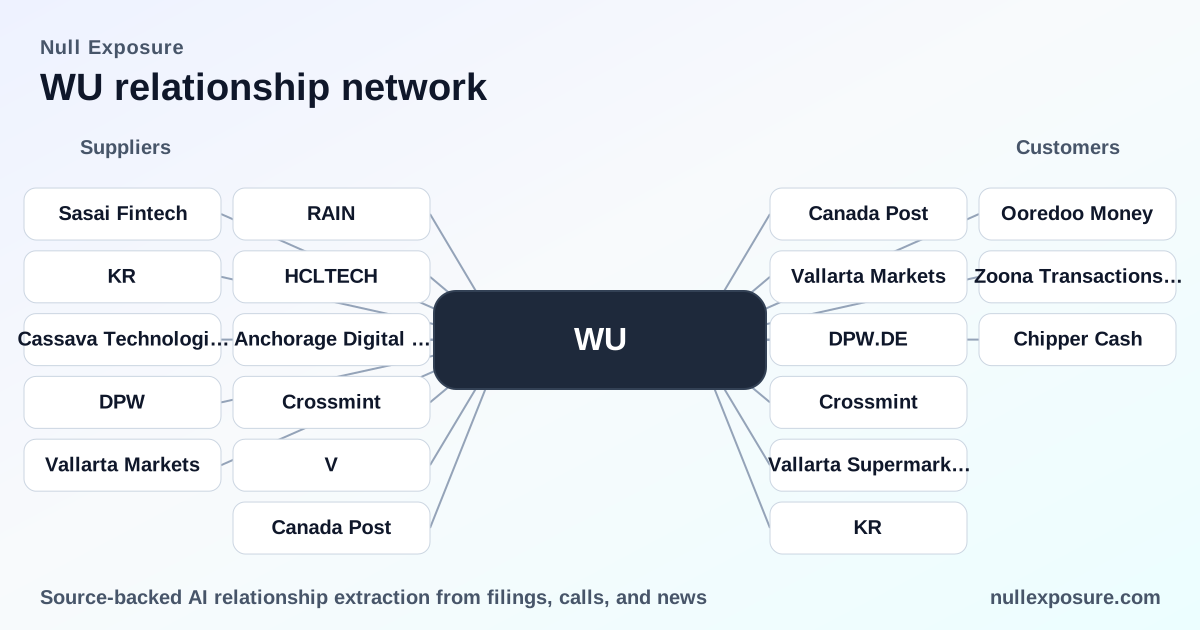
Western Union (WU): Supplier and partner map for investors evaluating counterparty exposure
Western Union operates a global payments and payouts network and monetizes by collecting transaction fees, foreign-exchange spreads and settlement fees across retail agents, digital rails, and institutional channels. With roughly $4.05 billion in TTM revenue and a market capitalization near $3.0 billion, Western Union is shifting capital from legacy retail to digital asset rails and platform partnerships to expand margins and reach. For deeper supplier and counterparty intelligence, visit https://nullexposure.com/.
Why these supplier relationships matter to investors
Western Union’s revenue and operating leverage depend on two distinct supplier classes: retail distribution partners and digital/technology providers. Distribution partnerships drive cash collection and payout density; technology and digital-asset partners determine product innovation and access to growth markets. Together they shape growth optionality, cost structure and regulatory complexity.
- Balance sheet context: Revenue TTM $4.05B, EBITDA $933.6M, and a forward P/E near 5.3 signal strong cash generation that funds strategic experiments while supporting a high dividend yield (~9.9%).
- Strategic pivot: Management is explicitly investing in a Digital Asset Network and AI-led platform modernization to link digital dollars to 360,000+ global collection points.
For a holistic supplier risk view and to compare counterparties by concentration and criticality, explore https://nullexposure.com/.
Trading partners, tech partners and retail anchors — relationship snapshots
Below are the relationships identified in recent public reporting and press coverage; each line gives a plain-English summary and the reporting source.
-
RAIN — Western Union is partnering with RAIN and Visa to introduce stable-card products and to bring a U.S. stable card to market, with an initial rollout targeted for more than a dozen countries in 2026. Source: Q4 2025 earnings commentary reported by InsiderMonkey and The Globe and Mail (FY2026; March 2026).
https://www.insidermonkey.com/blog/the-western-union-company-nysewu-q4-2025-earnings-call-transcript-1700321/ and https://www.theglobeandmail.com/investing/markets/stocks/WU/pressreleases/349362/western-union-earnings-call-growth-bets-vs-headwinds/ -
Visa — Visa is a co‑partner on the stable‑card initiative, providing payments network access and programmatic card rails for the planned multi-country launch in 2026. Source: Q4 2025 earnings reporting via InsiderMonkey and The Globe and Mail (FY2026; March 2026).
https://www.insidermonkey.com/blog/the-western-union-company-nysewu-q4-2025-earnings-call-transcript-1700321/ and https://www.theglobeandmail.com/investing/markets/stocks/WU/pressreleases/349362/western-union-earnings-call-growth-bets-vs-headwinds/ -
HCLTech — Western Union launched a Global Capability Center in Hyderabad in collaboration with HCLTech to drive AI-led innovation, platform modernization and engineering across payments and digital operations. Source: SimplyWall.St, Deccan Chronicle and other press (FY2026; January–March 2026).
https://simplywall.st/stocks/us/diversified-financials/nyse-wu/western-union/news/does-western-unions-new-ai-hub-in-hyderabad-deepen-its-digit and https://www.deccanchronicle.com/business/companies/western-union-hcltech-expand-global-capability-center-to-hyderabad-1933291 -
Anchorage Digital Bank — Anchorage is the issuing bank partner for Western Union’s USD‑pegged stablecoin (USDPT), enabling regulatory issuance and bank-grade custody for markets with dollarization demand. Source: Cryptobriefing and FinancialContent reporting on the USDPT initiative (FY2026; March 2026).
https://cryptobriefing.com/western-union-stablecoin-solana/ and https://markets.financialcontent.com/stocks/article/finterra-2026-2-20-the-digital-transformation-of-a-legacy-giant-a-deep-dive-into-western-union-nyse-wu -
Crossmint — Crossmint will enable access to USDPT through wallet and payment APIs so fintechs can settle on Solana and route converted fiat via Western Union’s payout infrastructure. Source: Crossmint partnership announcements covered by Finviz and SimplyWall.St (FY2026; March 2026).
https://finviz.com/news/332488/western-union-partners-wu-with-crossmint-to-launch-usd-stablecoin-on-solana and https://simplywall.st/stocks/us/diversified-financials/nyse-wu/western-union/news/is-western-unions-usdpt-stablecoin-rollout-reshaping-the-inv -
Canada Post — Western Union secured an exclusive five‑year retail contract with Canada Post covering roughly 5,600 locations, reinforcing payout and retail presence in Canada. Source: Earnings call press release coverage by The Globe and Mail (FY2026; March 2026).
https://www.theglobeandmail.com/investing/markets/stocks/WU/pressreleases/349362/western-union-earnings-call-growth-bets-vs-headwinds/ -
Kroger — Western Union renewed exclusivity arrangements with Kroger, preserving a high-frequency retail footprint within a major U.S. grocery operator. Source: The Globe and Mail earnings coverage (FY2026; March 2026).
https://www.theglobeandmail.com/investing/markets/stocks/WU/pressreleases/349362/western-union-earnings-call-growth-bets-vs-headwinds/ -
Deutsche Post — Western Union renewed a retail partnership with Deutsche Post, maintaining post‑office doorways for cash remittance and payouts in key European markets. Source: The Globe and Mail earnings coverage (FY2026; March 2026).
https://www.theglobeandmail.com/investing/markets/stocks/WU/pressreleases/349362/western-union-earnings-call-growth-bets-vs-headwinds/ -
Vallarta Markets — Western Union added Vallarta Markets in California as a retail partner, strengthening targeted in‑market distribution channels in high-remittance corridors. Source: The Globe and Mail earnings coverage (FY2026; March 2026).
https://www.theglobeandmail.com/investing/markets/stocks/WU/pressreleases/349362/western-union-earnings-call-growth-bets-vs-headwinds/ -
Sasai Fintech — Sasai’s Payments‑as‑a‑Service stack powers a South Africa-focused remittance app in collaboration with Western Union, combining Western Union’s global network with local PaaS licensing. Source: The Fintech Times and ConnectingAfrica (FY2026; March 2026).
https://thefintechtimes.com/western-union-and-sasai-fintech-launch-international-money-transfer-app-for-south-africa/ and https://www.connectingafrica.com/fintech/western-union-sasai-launch-money-transfer-mobile-app -
Cassava Technologies — Cassava Technologies partners with Western Union to accelerate financial inclusion in Africa by integrating Cassava’s fintech platforms with Western Union’s network. Source: ConnectingAfrica coverage of the Sasai announcement featuring Cassava comments (FY2026; March 2026).
https://www.connectingafrica.com/fintech/western-union-sasai-launch-money-transfer-mobile-app
What the supplier map implies about Western Union’s operating model
Western Union’s disclosures and recent announcements provide clear operating signals that shape supplier risk.
-
Contracting posture: The company uses a mix of long‑term and short‑term contractual instruments—longer-duration financial hedges and leases alongside short-term FX derivatives for daily settlement needs—creating a layered counterparty exposure profile rather than a single tenure risk. (Company filings cited in FY2024–FY2025 disclosures.)
-
Geographic scale and concentration: Western Union operates in roughly 45 countries for facilities and maintains an extensive retail footprint (360,000+ collection points referenced in press), indicating global dispersion that reduces single-market concentration but raises regulatory and operational complexity.
-
Role mix and criticality: Suppliers fall into two functional buckets: distributors (agents and retail partners) that are revenue-critical for cash flow and service providers (tech, capability centers, issuing banks) that are critical for product innovation and settlement integrity. Company text confirms agents are paid commissions and that some agents function as master agents with subagents.
-
Maturity and materiality: Short-term and variable lease costs are disclosed as immaterial to financials, suggesting supplier cost volatility is not currently a major margin driver; conversely, digital partnerships represent higher strategic importance for future growth.
Investment implications and risk focus
- Upside: The stablecoin and stable‑card initiatives broaden product set and create new revenue channels tying on‑chain liquidity to traditional cash rails; partnerships with Visa, Anchorage and Crossmint accelerate distribution and custody credibility. These moves increase optionality without immediate large capital outlays.
- Risk: Digital-asset initiatives introduce regulatory, counterparty and operational risks (issuer banks, exchange listings, on-chain settlement) that differ from retail agent risk. Retail exclusivity deals (Canada Post, Kroger, Deutsche Post) protect cash flows but concentrate dependency on large partners in certain corridors.
- Operational signal: The HCLTech-backed Global Capability Center signals a longer-term investment in tech and AI, shifting cost toward platform modernization and away from purely commission-driven growth.
For rigorous counterparty scoring and scenario analysis, review supplier-level exposure and concentration tools at https://nullexposure.com/.
Bottom line
Western Union is executing a deliberate transition from a predominantly retail commission model to a hybrid model combining retail distribution strength with digital-asset and platform partnerships. The company’s partner set—ranging from HCLTech and Visa to Anchorage, Crossmint and national posts—reflects a strategy to pair global footprint with fintech rails. Investors should track integration milestones, regulatory progress for USDPT, and the performance of retail exclusivity agreements to measure whether this transition translates to durable margin expansion and higher cash returns.
For a complete, investor-grade supplier exposure report and monitoring alerts, visit https://nullexposure.com/.