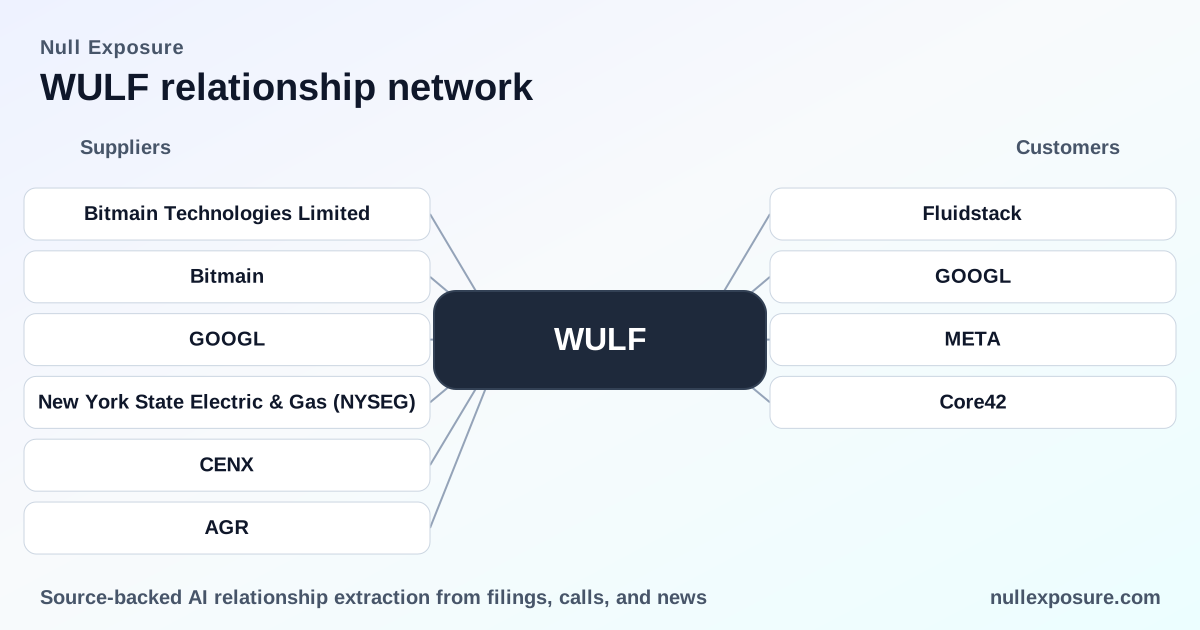
Terawulf (WULF): Supplier relationships that shape a capital‑intensive pivot
Terawulf operates large‑scale bitcoin mining and digital infrastructure sites and monetizes through hosted mining revenue, asset-backed power arbitrage, and the sale of computing capacity. The company sources high‑performance miners and site power, contracts services for construction and operations, and increasingly leverages strategic capital partners to underwrite expansion into AI and HPC hosting. Investors should evaluate supplier concentration, long‑term service contracts, and strategic capital backstops as the primary drivers of operational continuity and growth optionality.
For primary research and supplier signals, see https://nullexposure.com/.
How Terawulf makes money and why suppliers matter
Terawulf generates operating cash by deploying computing hardware to mine bitcoin at owned and hosted facilities and by offering colocation and HPC hosting at scale. Revenue depends on three supplier vectors: (1) hardware vendors that supply miners, (2) energy providers and site developers that secure low‑cost, renewable power, and (3) services and capital partners that enable construction and ongoing operations. The balance among these relationships defines both margin volatility and the company’s ability to pivot into adjacent revenue streams such as AI infrastructure.
Visit https://nullexposure.com/ for a consolidated view of supplier disclosure and risk.
Supplier and partner references from public filings and press
Below are every relationship referenced in the public results pulled for WULF. Each entry is a plain‑English summary followed by a concise source reference.
Bitmain Technologies Limited
Terawulf (via Lake Mariner Data LLC) sources high‑performance bitcoin miners primarily from Bitmain, which supply the core hardware used to validate Bitcoin transactions. According to Terawulf’s FY2024 10‑K, Bitmain is the primary hardware supplier noted for the Lake Mariner fleet.
Source: Terawulf FY2024 10‑K (filed covering year ended Dec 31, 2024).
Bitmain (competition context cited in filing)
The FY2024 10‑K also references Bitmain in the broader competitive landscape: Terawulf competes with data center REITs, hyperscalers and other miners for high‑power sites and capital required to scale HPC hosting. This situates Bitmain both as a vendor and as a participant in the competitive ecosystem for infrastructure and compute demand.
Source: Terawulf FY2024 10‑K (competitive landscape discussion).
Google (backstop and equity)
Google has committed a large credit backstop and an equity stake to support Terawulf’s strategic expansion, providing a $3.2 billion credit backstop and taking an ownership position to underwrite Lake Mariner and other capacity conversion initiatives. A report from SahmCapital (Mar 5, 2026) documents the credit backstop and equity arrangement.
Source: SahmCapital report (Mar 5, 2026).
Google (additional reporting on funding for Lake Mariner)
Independent coverage reiterates Google’s funding role, noting the company’s backstop funding is targeted at expansion of Terawulf’s Lake Mariner data center capacity in support of a shift from pure bitcoin mining toward AI and HPC workloads.
Source: Simply Wall St coverage (Mar 2026).
New York State Electric & Gas (NYSEG) — Project Nautilus (MarketBeat)
Terawulf’s Project Nautilus in Tompkins County, NY, draws hydroelectric power from the NYSEG grid, anchoring the site with renewable energy for mining and hosting operations. MarketBeat reporting (Mar 9, 2026) highlights NYSEG as the source of hydroelectric power for Nautilus.
Source: MarketBeat instant alert (Mar 9, 2026).
New York State Electric & Gas (NYSEG) — duplicate reference (AGR inferred)
A second MarketBeat instant alert repeats that Project Nautilus harnesses hydroelectric power sourced via NYSEG, reinforcing the linkage between the Nautilus site and the New York grid for low‑carbon energy supply.
Source: MarketBeat instant alert (Mar 9, 2026).
Century Aluminum (Hawesville site deal)
Terawulf closed a Kentucky site acquisition in Hawesville that involved Century Aluminum’s local unit selling ~750 acres for $200 million, with Century receiving a 6.8% non‑dilutive minority equity stake in Terawulf’s development arm (Raylan Data Holdings) and a put‑back right exercisable after the data center goes live; the Hawesville deal closed Feb. 2 per public filings cited in news coverage.
Source: TS2.tech summary of Century Aluminum filings and Terawulf 8‑K disclosures (Mar 2026).
Operating‑model constraints and what they signal
The public constraints and excerpts reveal predictable structural characteristics of Terawulf’s supplier posture:
- Long‑term contracting posture: The Services Agreement cited in filings carries an initial five‑year term, indicating multi‑year service commitments for construction and operations. This length supports continuity but locks in service costs and counterparty exposure.
- Service provider reliance and related‑party concentration: Terawulf uses a Services Agreement with Beowulf Electricity & Data Inc. (a related party) to provide construction, technical, procurement, IT and administrative services; annual payments under this agreement totaled $15.8M in 2024, reflecting meaningful recurring outflows to a single provider and related‑party dynamics documented in the FY2024 filing.
- Active, material spend band: Historical payments to Beowulf E&D fall in the $10M–$100M band annually, signaling material operating dependence rather than immaterial vendor ties.
- Revenue segment concentration: The services segment is core to building and operating facilities; the Services Agreement language confirms that operations and construction services are centralized under that arrangement.
These are company‑level signals drawn from the FY2024 filing and associated public disclosure; they highlight concentration in service delivery and the financial scale of vendor commitments.
For a deep dive into supplier exposure and third‑party risk scoring, visit https://nullexposure.com/.
Investment implications and risk checklist
Terawulf’s supplier map creates a clear risk/reward profile for investors:
- Upside: The Google backstop and equity stake de‑risk large capital projects and accelerate the company’s pivot into higher‑value AI/HPC hosting revenue streams.
- Operational fragility: Heavy reliance on Bitmain for miners and a related‑party services provider for construction and operations creates vendor concentration and governance questions.
- Energy security: Long‑term access to low‑carbon grid power (NYSEG, hydroelectric) is an advantage for pricing and ESG positioning; the Hawesville transaction and project links establish geographic and power‑source diversification but introduce counterparty and real‑estate complexity.
Key tactical checklist for investors: validate the terms of the Google backstop in SEC filings, review the Beowulf Services Agreement schedule and related‑party disclosures, and monitor hardware supply agreements with Bitmain for delivery timing and warranty/maintenance terms.
Conclusion and next steps
Terawulf’s operating model rests on a concentrated set of suppliers and a handful of strategic capital partners that collectively determine ability to scale beyond bitcoin mining. Google’s capital backing materially alters growth optionality, but supplier concentration and related‑party service flows remain principal governance and execution risks.
Explore supplier risk profiles and cross‑company supplier exposure at https://nullexposure.com/. For research access and notifications about supplier events that affect capital allocation, check https://nullexposure.com/ and subscribe for updates.