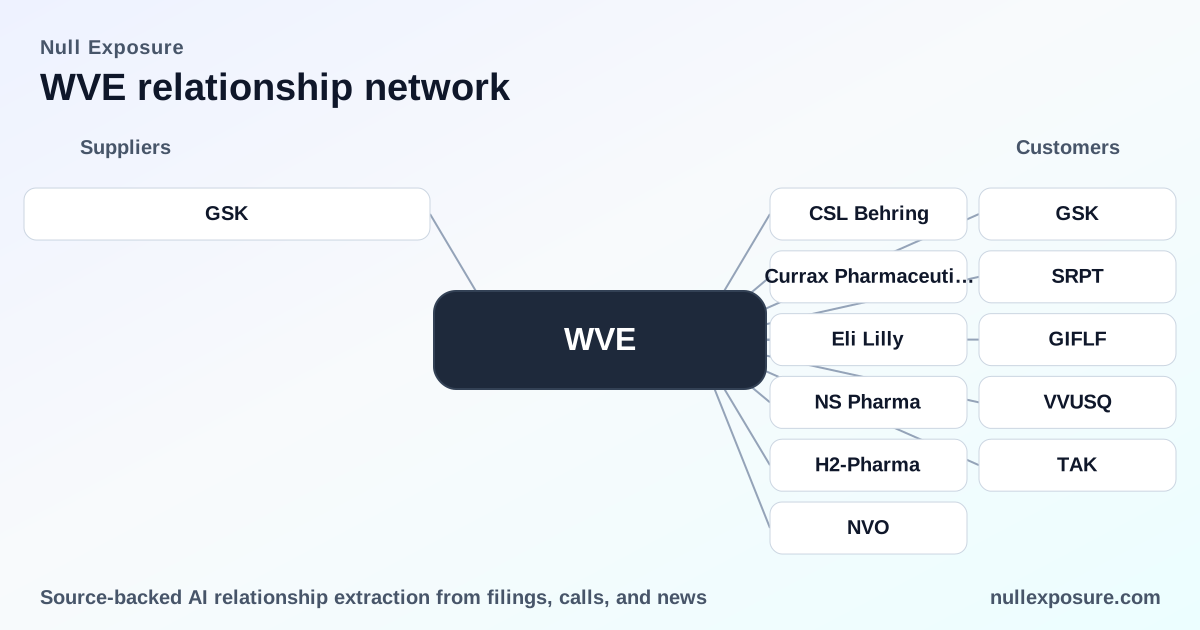
Wave Life Sciences (WVE) — supplier relationships and what they mean for investors
Wave Life Sciences is a clinical-stage genetic medicine company that designs and develops stereopure oligonucleotides and monetizes through licensing, milestone-driven partnerships, and eventual product commercialization. Revenue is currently driven by partnered asset transfers and milestone potential rather than product sales, while core R&D and clinical manufacturing are outsourced to third parties. For investors evaluating Wave as a supplier counterparty or a buy-side exposure, focus on outsourced manufacturing risk, partner licensing dynamics, and the operational implications of recent asset transfers. Learn more and track supplier signals at https://nullexposure.com/.
How Wave runs its supply base — an operator’s view
Wave’s operating model is outsourced by design. The company relies on contract research organizations (CROs) for study execution and contract manufacturing organizations (CMOs) for the production of oligonucleotides used in preclinical and clinical work. This structure delivers capital efficiency and scalable clinical throughput but shifts execution risk to vendors. Company disclosures around staffing, CRO/CMO expenses, and supply agreements position third parties as mission-critical suppliers rather than interchangeable vendors.
Key characteristics that define Wave’s supplier posture:
- Contracting posture — partner-heavy and transactional. Wave structures much of its discovery and clinical execution through third-party agreements rather than in-house manufacturing capacity, concentrating negotiation on service-level and supply agreements.
- Concentration and capacity sensitivity. Wave monitors available manufacturing capacity and maintains supply agreements intended to secure lead times for clinical supplies, which makes a small number of CMOs operationally critical.
- Criticality to timelines. Clinical-stage timelines depend directly on third-party performance for formulation, manufacturing and clinical data management; delays translate into program risk and milestone slippage.
- Maturity profile. As a clinical-stage biotech, Wave’s supplier relationships skew toward service providers for development-stage activities rather than large-volume commercial suppliers.
These are company-level signals described in Wave’s filings and risk disclosures through the latest reported quarter (2025-12-31).
The material relationship in the public record: GlaxoSmithKline (GSK)
GlaxoSmithKline (GSK) transferred rights to WVE-006 (an alpha-1 antitrypsin deficiency program) to Wave, a transaction that creates direct ownership and upstream responsibilities for Wave in that program. This transfer increases Wave’s program-level ownership and thereby its reliance on third-party manufacturing and clinical partners for development and potential commercialization. (Source: Finviz news report, March 10, 2026.)
What the filings and disclosures say about supplier roles
Wave’s public disclosures clearly identify three supplier roles as persistent operational realities:
- Manufacturer: Wave uses CMOs to manufacture oligonucleotides for preclinical and clinical use and monitors capacity to secure supply lines. The company frames manufacturing partners as essential to maintaining development cadence.
- Service provider: CROs, clinical data managers, and consultants run and manage Wave’s trials and data collection, making operational delivery contingent on third-party performance.
- Licensor: Wave licenses external patent rights and likewise transfers or accepts licensed rights with partners; licensing is both a lever and a dependency for program freedom-to-operate.
These roles are stated as company-level constraints in Wave’s risk disclosures and expense descriptions through FY2025 and the latest quarter ending 2025-12-31.
Why the GSK transfer matters to supplier risk and investor returns
The GSK-to-Wave transfer of WVE-006 reshapes both the upside and the vendor roadmap:
- Upside concentration increases: Direct ownership of WVE-006 means Wave captures a larger slice of potential downstream value, but also assumes execution risk that was previously shared.
- Supplier load increases: Program ownership converts a previously partner-managed obligation into one that requires Wave to expand or intensify CMO/CRO relationships to meet clinical milestones and regulatory expectations.
- Negotiation leverage shifts: With greater program ownership, Wave’s bargaining position with vendors changes — vendors negotiate with a company that owns the asset rather than a licensee; this affects pricing, exclusivity and lead times.
Investors should treat the GSK transfer as both a catalytic event for value capture and a signal to re-evaluate Wave’s supplier commitments and contingency plans. (Source: Finviz, March 10, 2026.)
For a centralized view of supplier signals and to monitor changes to Wave’s partner relationships, visit https://nullexposure.com/.
Operational and financial implications for investors
The supplier model yields a trade-off between capital efficiency and execution risk:
- Cost structure: Outsourcing reduces fixed capital but increases variable expense and program-level operating leverage tied to third-party rates and deliverables.
- Timeline risk: Clinical progress and milestone realizations are directly linked to third-party performance; delays result in deferred revenue and potential valuation compressions.
- Supply concentration risk: A small number of specialized CMOs produce stereopure oligonucleotides, making supplier disruption a near-term program-stopper.
- Intellectual property dependency: Licensing arrangements underpin freedom-to-operate; weak control over patent prosecution by licensors would degrade competitive positioning.
These implications are visible across Wave’s operating metrics and public disclosures through FY2025 and the latest quarter.
Tactical checklist for investors and operators
- Validate CMO/CRO capacity and contractual protections (lead times, penalty clauses, backup suppliers). Operational continuity is the critical counterparty risk for Wave.
- Monitor milestone schedule sensitivity for programs like WVE-006 now that Wave holds transferred rights from GSK.
- Review licensing footprints to understand patent prosecution responsibilities and the scope of licensed rights.
- Assess concentration among service providers and the robustness of contingency plans for manufacturing scale-up.
These actions convert qualitative supplier signals into actionable monitoring and diligence items.
For a full supplier relationship audit and continuous monitoring of Wave and peer firms, check resources and analytic products at https://nullexposure.com/.
Final verdict — what investors should price in
Wave’s commercial profile is partner-dependent and execution-sensitive: the company captures upside via asset ownership and licensing events while relying on a tight roster of specialized service providers for delivery. The GSK transfer of WVE-006 enhances potential upside but escalates supply-side exposure and program execution risk. Investors should price Wave for clinical execution risk, supplier concentration, and milestone uncertainty, while recognizing that successful vendor performance can unlock material valuation upside.
Stay current on supplier developments and partner movements at https://nullexposure.com/ — supplier relationships will drive Wave’s near-term value realization.