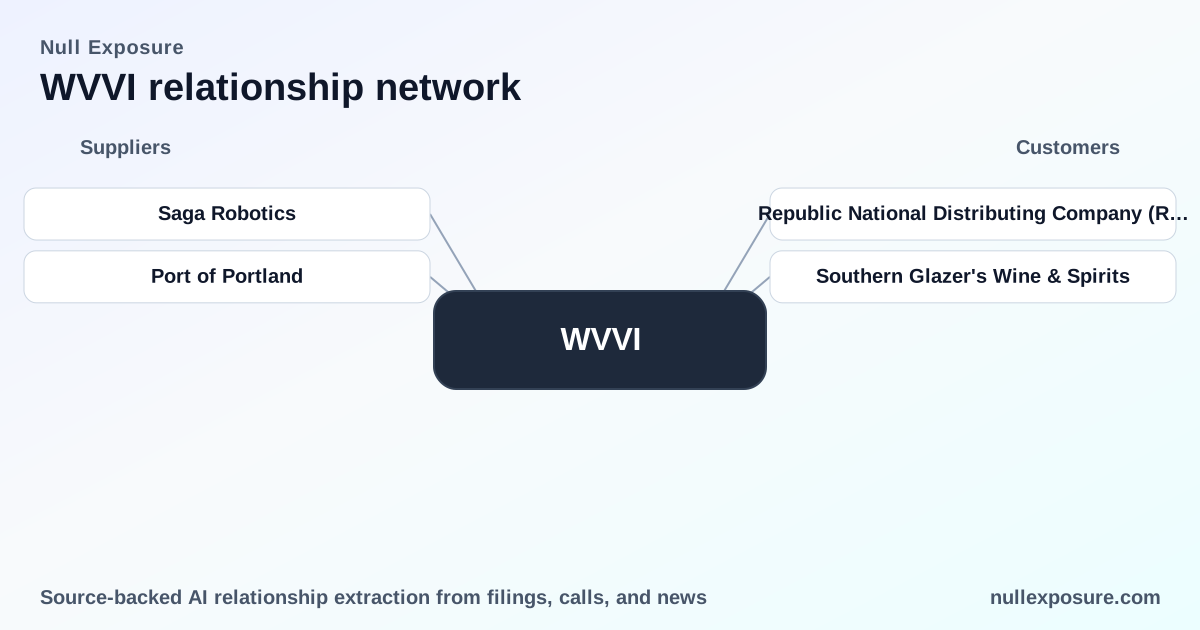
Willamette Valley Vineyards (WVVI): supplier profile and what buyers and investors need to know
Willamette Valley Vineyards operates as an integrated wine producer and retailer: it purchases grapes from growers under a mix of long‑term and short‑term contracts, vinifies and bottles wine at company facilities, and monetizes through wholesale, direct‑to‑consumer and international sales. Revenue drivers are grape supply stability, vintage quality, and the company’s control of production and distribution, while margin pressure is driven by input costs and modest scale. For a concise supplier-risk view and connectivity mapping, visit https://nullexposure.com/.
How WVVI’s supply choices translate into economics
Willamette Valley Vineyards reports roughly $38.4 million in trailing revenue and a gross profit of about $23.4 million, reflecting a business that generates meaningful top‑line dollars from wine production but operates with tight overall profitability (TTM diluted EPS of -$0.55 and a marginal negative profit margin). The company balances contracted grape purchases and spot buying to protect vintage supply while managing cost flexibility. Financially, this results in moderate capital intensity—low market capitalization (~$13.7 million) and a high EV/EBITDA multiple (~34.9x) driven by low absolute EBITDA.
Operationally, WVVI’s supplier posture is not transactional only: a material share of grapes are sourced under multi‑vintage agreements, reducing acquisition volatility at the cost of committing cash flow to fixed purchase obligations. That contracting posture shapes negotiating leverage, inventory planning, and exposure to vintage variation.
Visit https://nullexposure.com/ for a supplier‑focused due diligence checklist tailored to wine and beverage supply chains.
Supplier relationships reported in public coverage
Saga Robotics — introducing robotics to the vineyard
Willamette Valley Vineyards partnered to deploy Saga Robotics’ Thorvald vineyard robot as part of a U.S. commercial pilot; Saga’s leadership framed WVVI as a forward‑looking partner committed to sustainable production. Source: TheDrinksBusiness.com coverage of the Thorvald deployment (May 2021), quoting Saga Robotics executives.
Port of Portland — design materials repurposed in visitor facilities
Willamette Valley Vineyards used materials repurposed from the Port of Portland—specifically pallet wood—for interior finishing and cozy design elements in its hospitality spaces, indicating local sourcing and reuse in its retail/hospitality buildouts. Source: Oregon Wine Press feature on visitor experience (circa 2015).
What the documented constraints tell investors about WVVI’s operating model
The public disclosures on grape procurement provide direct signals about WVVI’s supplier strategy and operational maturity:
-
Contracting posture: WVVI purchases grapes under both long‑term and short‑term arrangements. In 2024 and 2023, 11% and 18% of harvested grapes were purchased under short‑term contracts, while 29% and 40% were purchased under long‑term contracts, respectively. The company defines short‑term as single‑vintage and long‑term as multi‑vintage agreements. This mix indicates a deliberate strategy to lock in core supply while retaining flexibility for vintage‑by‑vintage sourcing.
-
Spend scale and concentration: Reported grape purchases totaled approximately $2.96 million in 2024 and $5.26 million in 2023, with long‑term contract receipts of $2.28 million (2024) and $3.31 million (2023) and short‑term receipts of $681,705 (2024) and $1.94 million (2023). These figures place grape spend squarely in the $1M–$10M band, implying suppliers of grapes deliver material but not dominant revenue to WVVI.
-
Supplier role and sourcing mix: Disclosures note remaining grapes are purchased from other growers, signaling WVVI operates a hybrid model of contracted growers plus spot purchases—a manufacturer‑centric sourcing posture where the firm controls production but sources agricultural inputs externally (confidence lower on categorical role labeling).
-
Maturity and commitment: The presence of multi‑vintage contracts denotes operational maturity and ongoing relationships with growers, reducing short‑term supply shocks but creating fixed cost commitments that can compress margins during weak demand or poor vintages.
These characteristics combine into a supplier risk profile that favors continuity of supply with some embedded cost inflexibility. For a deeper supplier exposure map and risk scoring, see https://nullexposure.com/.
Investment implications: risk, opportunity, and monitoring priorities
Willamette Valley Vineyards’ supplier disclosures create a compact but actionable view for investors and procurement operators:
-
Risk — price/cost stickiness: Long‑term contracts reduce input price volatility but create exposure if grape costs rise relative to wine pricing or if demand deteriorates. Given thin net profitability, cost overruns in grape procurement can move the company into deeper losses.
-
Opportunity — operational differentiation: Partnerships like Saga Robotics demonstrate WVVI’s willingness to pilot innovation to reduce labor costs and improve sustainability—a potential long‑term margin lever if adoption scales.
-
Concentration and negotiating leverage: With grape spend in the $1M–$10M band and a mix of contract tenors, WVVI has enough purchasing scale to negotiate but lacks the size to dictate market terms. Supplier relationships are strategically important but not overwhelmingly concentrated, lowering single‑counterparty dependency.
-
Valuation context: Small market cap and a high EV/EBITDA multiple suggest the market prices limited near‑term upside absent meaningful operational improvement or a change in earnings trajectory.
What to monitor (operational and financial):
- Changes in the percentage of grapes under long‑term vs. short‑term contracts and the dollar value of those contracts.
- Supplier innovations and capital investments (e.g., robotics trials) that impact labor cost structure.
- Year‑over‑year gross margin and inventory turns through vintage cycles.
- Any disclosure of material supplier concentration or single‑supplier dependence.
Bottom line — where supplier dynamics intersect with value
Willamette Valley Vineyards runs a blended sourcing model that balances long‑term security and short‑term flexibility. The company’s supplier spend is material but not dominant, and its willingness to trial technology and repurpose local materials points to an operational mindset focused on sustainability and cost control. Key investor focus should be on contract tenor shifts, grape cost trajectories, and the realization of automation benefits—these factors will drive whether WVVI converts gross profitability into consistent positive net income.
For a structured walkthrough of WVVI’s partner map and supplier risk scoring, start at https://nullexposure.com/.