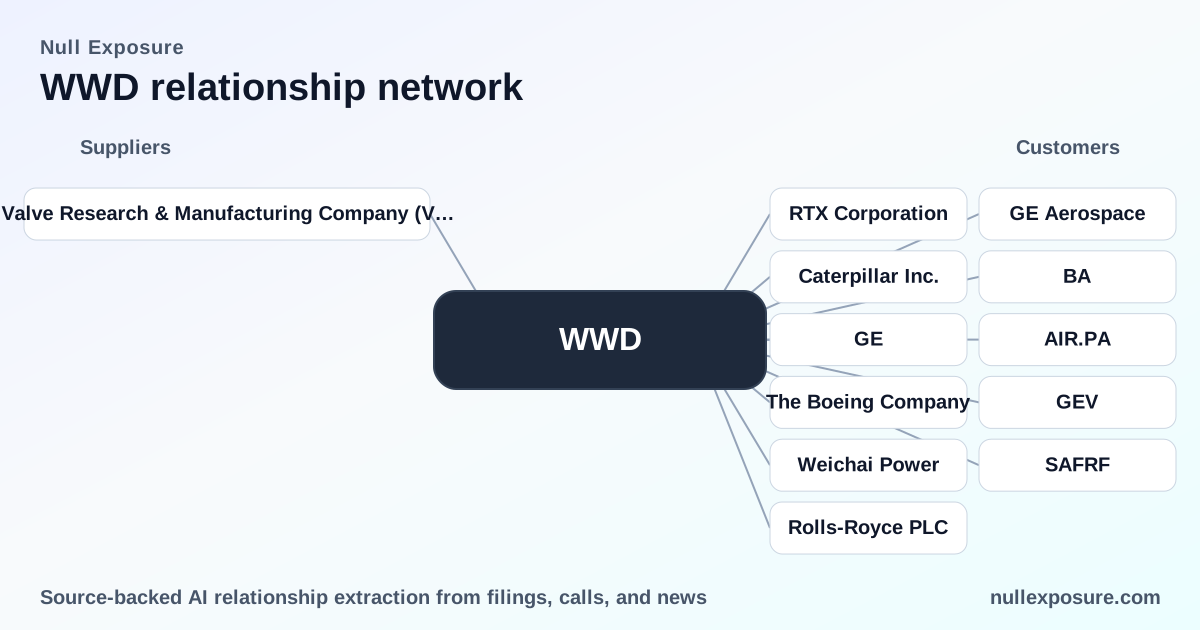
Woodward Inc (WWD): Supplier relationships, strategic posture, and what the VRM deal signals to investors
Woodward designs, manufactures and services control systems for aerospace and industrial customers and monetizes through product sales, aftermarket service contracts, and selective M&A that secures critical component capacity. The business generates roughly $3.79 billion of revenue with healthy gross and operating margins while trading at a premium multiple (TTM EV/EBITDA ~29.1 and trailing P/E ~46.3), reflecting a combination of stable aerospace demand and premium engineering content. For investors evaluating supplier exposure and counterparty risk, Woodward combines long-term purchasing commitments, global sourcing, and targeted tuck-in acquisitions to convert supplier relationships into durable operational advantages. Learn more about supplier intelligence and supplier-driven risk with NullExposure: https://nullexposure.com/
Operational posture and what the supplier signals mean for investors Woodward’s public disclosures and recent transactions reveal a buyer-first, integration-oriented supply strategy. Company filings show explicit future minimum unconditional purchase obligations through fiscal years (Year Ending September 30: 2026 $640,763; 2027 $89,718; 2028 $3,302; 2029 $171; 2030 $64,620; Thereafter $2; Total $798,576), which indicate material, multi-year procurement commitments that underpin production planning and supplier spend forecasting. Those same filings note a global sourcing model intended to support worldwide facilities and long-term supplier relationships, signaling broad supplier dispersion rather than single-source concentration in procurement design.
- Contracting posture: Long-duration purchase obligations and formal commitments create predictability in supply but lock in spend and potential structural exposure to supplier delivery performance.
- Geography and resiliency: A global sourcing model reduces single-region concentration but raises geopolitical and logistics considerations that scale with aerospace cycles.
- Role and capability: Woodward operates primarily as the buyer of components and as an outsourcer of certain services; the company also uses professional firms to manage financial assets and plans, pointing to mature governance of outsourced functions.
These company-level signals are drawn directly from public filings and company statements and should be treated as operating facts rather than speculative inferences.
Supplier relationship that requires active monitoring: Valve Research & Manufacturing (VRM) A recent GlobeNewswire press release announced Woodward’s agreement to acquire Valve Research & Manufacturing Company (VRM) in FY2026. VRM has a long history of working with Woodward, and the deal reflects a strategy of bringing critical valve manufacturing capabilities under direct control to secure supply and rationalize production. (GlobeNewswire, March 9, 2026: https://www.globenewswire.com/news-release/2026/03/09/3251611/32326/en/Woodward-Announces-Agreement-to-Acquire-Valve-Research-Manufacturing.html)
- Valve Research & Manufacturing Company (VRM): Woodward announced an agreement to acquire VRM; the seller highlighted that “we’ve worked with Woodward for decades and know the caliber of their organization,” underscoring an established supplier-customer relationship that is being internalized through acquisition. (GlobeNewswire press release, March 9, 2026.)
What the VRM transaction concretely changes for investors Bringing a long-term supplier into the corporate fold is a strategic lever to reduce supply fragility and capture margin in a high-value subcomponent. For investors this has three practical implications:
- Supply continuity and margin capture. Owning VRM’s valve manufacturing capacity converts supplier spend into internalized gross margin, improving control over lead times and quality on mission-critical components.
- Integration and execution risk. The financial benefit hinges on successful operational integration and realization of cost synergies; the market’s premium multiple already prices high expectations of execution and growth (Forward P/E ~43.7).
- Capital allocation trade-offs. M&A to secure suppliers competes with dividends and R&D; Woodward pays modest dividends (Dividend per share $1.12) while maintaining investment in engineering—a balance that shareholders must watch.
Mid-deal due diligence priorities for operators and buy-side analysts When evaluating the transaction and whether to adjust exposure, focus on the operational levers and contractual realities Woodward disclosed:
- Validate the magnitude and timing of future minimum purchase obligations in the filings to understand near-term cash flow commitments and the extent to which they will be internalized post-acquisition.
- Assess the company’s global sourcing footprint to determine whether integration of VRM reduces reliance on any single geography or simply replaces external supply with owned capacity that is still globally distributed.
- Monitor working capital and capex implications—tuck-ins that add manufacturing capacity can require immediate capital and change the maturity profile of the supplier base.
If you want structured supplier analytics and scenario modeling for Woodward, see NullExposure’s supplier intelligence hub: https://nullexposure.com/
Valuation and risk context, compressed Woodward combines premium valuation with solid fundamental performance: return on equity ~20.4%, operating margin ~16.1%, and quarterly earnings growth +52.8% YOY are consistent with a high-quality industrial/defense supplier profile. That profile justifies strategic M&A to secure differentiated capabilities, but it also means that disappointing integration or persistent supply interruptions would have magnified earnings and multiple downside. The company’s FY2026 disclosures on long-term obligations and global sourcing are a reminder that supplier commitments are not static—they transmit directly into working capital, capex, and operating leverage.
Final takeaway and action points for investors and procurement leaders Woodward’s acquisition of VRM and its public disclosures together show a deliberate move from external dependency toward selective vertical integration, supported by long-term purchase commitments and global supplier management. For investors, that means balancing the upside of more predictable supply and potential margin expansion against the downside of integration risk and a richly valued stock.
- Key takeaway: Woodward is converting supplier relationships into owned capability to secure critical valves and capture margin—this is strategic but execution-sensitive.
- Watch list: integration milestones, realized cost synergies, and any changes to disclosed purchase obligations or sourcing geography.
For a deeper read on supplier-level exposures and to benchmark Woodward against peer supplier networks, visit NullExposure: https://nullexposure.com/