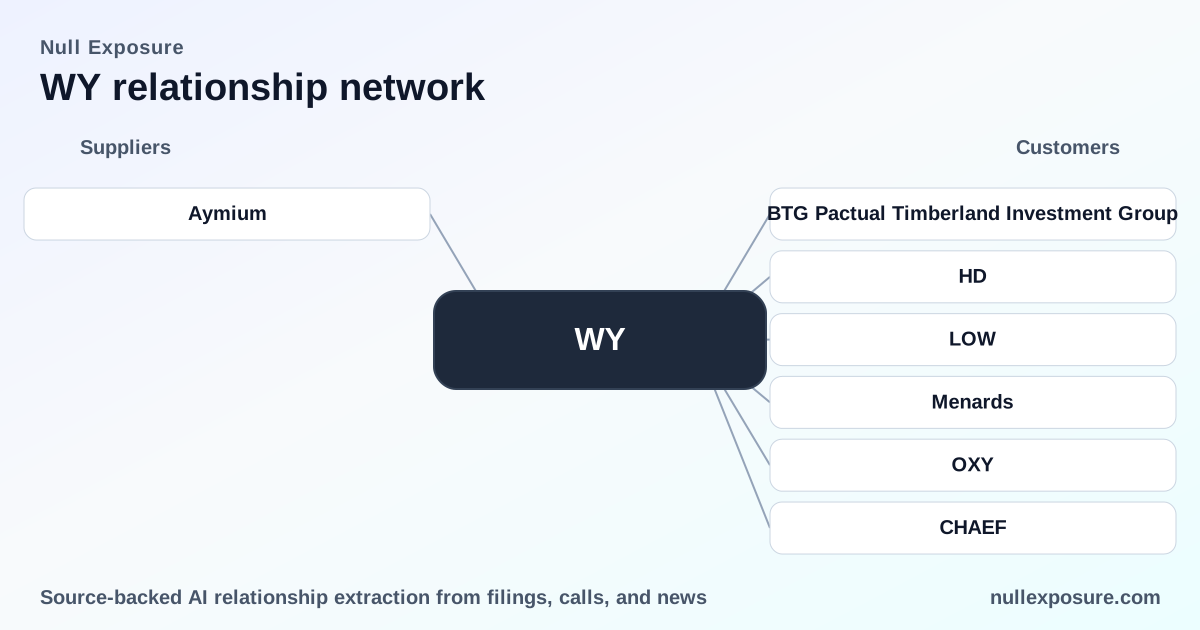
Weyerhaeuser (WY): supplier posture, strategic suppliers, and what investors should price in
Weyerhaeuser operates as a timberland-focused REIT that owns approximately 12.4 million acres of U.S. timberlands and manages another ~14 million acres under long‑term Canadian licenses, and it monetizes those assets through timber harvest sales, wood‑products manufacturing and the controlled disposal or re-leasing of real estate rights. Its supplier relationships are a mix of long‑duration, government‑mediated licenses and high‑volume third‑party service contracts for logging, transportation and processing; incremental strategic partnerships — like the recent biocarbon deal — are intended to create new monetization channels from existing assets. For more supplier intelligence and counterparty analytics, visit https://nullexposure.com/.
What the supplier picture looks like for an asset-heavy REIT
Weyerhaeuser’s operating model creates a supplier profile that is asset‑specific, concentrated in services, and governed by long contracts rather than spot-market purchasing. Company disclosures state the Canadian timberlands are managed under licenses “granted for initial periods of 15 to 25 years and renewable provided we meet reforestation, operating and management guidelines,” which makes Weyerhaeuser a long‑tenor licensee of provincial governments and creates durability in land access (company filings covering Canadian operations). That contracting posture reduces short‑term counterparty risk for timber supply but increases exposure to regulatory and compliance risk tied to government counterparties.
At the same time, Weyerhaeuser “depends heavily on third parties for logging and transportation services,” creating operational criticality and supplier concentration around service providers whose disruption or cost inflation would materially affect results (company risk disclosures). The company’s M&A activity — for example, the July 25, 2024 acquisition of 84,000 acres in Alabama for $244 million — also signals meaningful procurement and capital spend levels that require large counterparties and logistics networks to scale operations (company acquisition disclosure).
The Aymium partnership: a new supplier/customer axis for biocarbon
Weyerhaeuser disclosed in its 2025 Q4 earnings call that it is partnering with Aymium, a global biocarbon technology company, to produce and sell up to 1.5 million tons of biocarbon annually by 2030. This arrangement broadens Weyerhaeuser’s monetization beyond raw timber and finished wood products into higher‑value, carbon‑related commodities sold to industrial and energy markets. According to the Q4 2025 earnings call (recorded March 7, 2026), the Aymium collaboration targets scaled biocarbon production using Weyerhaeuser feedstock and land access.
- Strategic takeaway: Aymium is both a supplier and revenue partner — it converts Weyerhaeuser feedstock into a marketable product, creating a vertically integrated revenue stream that leverages land and operations.
- Source: 2025 Q4 earnings call disclosure (first reported March 7, 2026).
Third‑party services: the operational backbone and a concentration risk
Weyerhaeuser’s model outsources heavy operational activities — logging, hauling, and certain processing steps — to third parties. The company’s risk notes that reliance on these contractors means cost escalations or service interruptions can be materially adverse to operations and financial results. This is a classic supplier concentration risk for timber and forestry firms where a small number of skilled contractors control harvest capacity and seasonal logistics.
- Implication for investors: Factor in service provider counterparty reviews (contract terms, geographic footprint, financial health) when modeling harvest volumes or margin volatility. Evidence: company risk disclosures regarding dependence on third‑party logging and transportation services.
Long‑term government licenses: stability with conditionality
Weyerhaeuser’s Canadian footprint is secured through long‑term provincial licenses (15–25 years, renewable) that require compliance with reforestation and management standards. That structure gives Weyerhaeuser predictable land access and a planning horizon suitable for forestry capital investments, but it also embeds regulatory performance obligations.
- Risk/return balance: Licenses lower tenure risk but raise regulatory and compliance exposure; renewal depends on meeting explicit stewardship obligations (company filings on Canadian timberland management).
Spend profile and capitalization signals
The company’s acquisition activity — for example, the $244 million purchase of 84,000 acres in Alabama announced July 25, 2024 — signals that Weyerhaeuser operates in a high‑spend band for land and asset investments. That scale of capital deployment indicates significant counterparty engagement across land vendors, closed‑deal advisors, and large logistics suppliers.
- Investment implication: Large, episodic capital outlays create procurement concentration and short‑term counterparty negotiation leverage for sellers and contractors; they also increase the need for reliable counterparties for integration and operations (company acquisition disclosure).
How these supplier dynamics change the investment thesis
- Durable asset base: Long‑tenor licenses and large owned acreage make Weyerhaeuser’s timber supply predictable and support long‑cycle investments.
- Service concentration risk: Heavy reliance on logging and transport contractors represents an operational vulnerability that can compress margins under cost pressure.
- New commercial channels: Partnerships like Aymium introduce revenue diversification into carbon and bio‑energy markets, improving upside optionality if commercialization scales.
- Capital intensity: Frequent large acquisitions and asset investments imply counterparty networks that must scale alongside operations; procurement discipline will matter for margin resilience.
For a targeted supplier risk review and counterparty scoring for Weyerhaeuser, explore detailed profiles and relationship signals at https://nullexposure.com/.
Checklist for investors evaluating WY supplier exposure
- Confirm the geographic distribution and renewal timelines of provincial licenses and any performance conditions.
- Review contracts and counterparty financials for the largest logging and transport providers in key operating regions.
- Monitor commercialization milestones and off‑take frameworks for the Aymium biocarbon program to assess revenue timing and margin capture.
- Model acquisition cadence and integration costs to estimate near‑term capital needs and supplier onboarding risks.
Closing assessment and action steps
Weyerhaeuser’s supplier network is a mix of stable, long‑dated government licenses that secure feedstock and concentrated third‑party service relationships that create operational fragility. The Aymium partnership is a material strategic development that converts existing feedstock into a higher‑value product and alters the supplier/customer dynamic. Investors should underwrite both the compliance demands of government licenses and the service concentration risks inherent to logging and transportation when assessing WY’s mid‑cycle earnings volatility.
For deeper counterparty analysis and tailored supplier exposure reports, visit https://nullexposure.com/ and request a supplier‑level briefing. Build a disciplined supplier due diligence process now; the next large land acquisition or strategic partnership can change the supplier map quickly — stay ahead at https://nullexposure.com/.