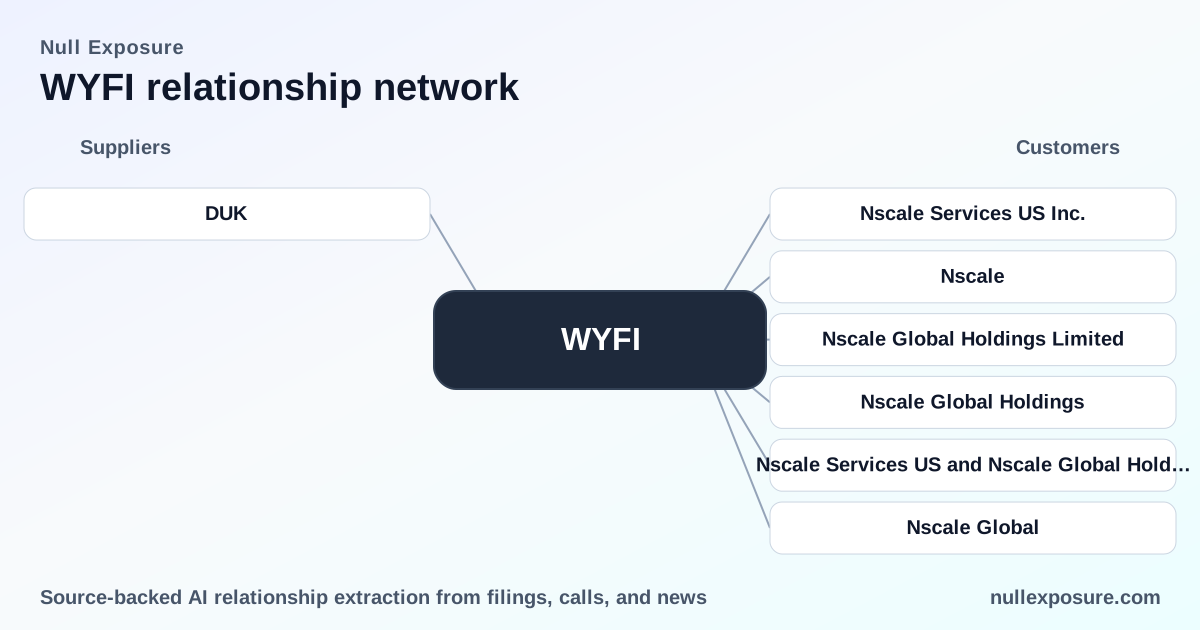
WYFI: WhiteFiber’s Power Link with Duke Energy and the Strategic Implications for AI Data Center Economics
WhiteFiber builds and operates AI-focused data center campuses and monetizes through long-term colocation contracts and capacity sales to hyperscalers and AI operators. The company’s economics depend on securing large, long-duration power and infrastructure agreements that enable multi-megawatt deployments; its business model converts real estate and electrical capacity into predictable, multi-year revenue streams tied to anchor tenants. Investors should value WhiteFiber as an infrastructure roll-up play with concentration risks tied to a small number of large contracts and upside from scalable power capacity. For a closer look at supplier exposures and how they affect valuation and operational risk, visit https://nullexposure.com/.
Operating snapshot: WhiteFiber reports roughly $62.3M in trailing revenue, $39.2M gross profit, and a market capitalization near $720M, while retaining negative EPS and an operating margin under pressure — a profile consistent with growth-stage infrastructure providers investing to scale capacity.
The Duke Energy relationship — what the market reported
WhiteFiber’s North Carolina AI campus is supported by a 99 MW capacity agreement with Duke Energy, and company management projects that the site can support up to 200 MW of total electrical supply over time, conditional on infrastructure upgrades and permitting. Multiple press releases and market reports reference this power arrangement as the backbone enabling a large 10‑year, 40 MW colocation commitment announced by WhiteFiber and nScale (reported contract value ~ $865M), with Duke providing the foundational grid capacity for the campus (PR Newswire; CoinDesk, Dec 2025; Yahoo Finance). These reports indicate the power agreement is a critical enabler of WhiteFiber’s ability to host multi‑MW AI loads.
Why a power supplier matters for investors and operators
Power is the single most important supplier relationship for AI-focused colocation providers. A 99 MW capacity agreement with a regulated utility like Duke Energy represents both a growth enabler and a concentration point: it supplies the electrical headroom necessary to sign anchor leases and to scale modular builds, while also creating a dependency on third‑party grid upgrades, interconnection timelines, and regulatory pathways. The market has priced this dependency into WhiteFiber’s expansion narrative: anchor deals that follow this supply backbone convert into long-duration revenue but require capital to realize.
All reported supplier relationships (complete list)
-
Duke Energy — WhiteFiber’s campus is supported by a 99 MW capacity agreement with Duke Energy, and management states the site can be expanded to 200 MW with additional infrastructure upgrades and conditions; this arrangement underpins the campus’ ability to host large AI colocation commitments (PR Newswire; CoinDesk, Dec 2025; Yahoo Finance).
Sources: PR Newswire release on WhiteFiber’s NC‑1 campus (FY2025 reporting); CoinDesk coverage of the WhiteFiber–nScale 10‑year, 40 MW colocation agreement (Dec 18, 2025); Yahoo Finance bulletin summarizing the same capacity details (reported FY2025).
Company-level operating signals and constraints
The raw constraints feed for supplier relationships is empty, so interpret the following as company-level signals derived from public disclosures and announced commercial deals:
- Contracting posture — long-duration, anchor-tenant centric. WhiteFiber structures the business around multi-year colocation agreements and capacity reservations that convert capital-intensive builds into contracted revenue streams.
- Concentration — high at the contract level. A small number of large tenants or one utility agreement providing most of a campus’ power creates revenue and operational concentration. That concentration accelerates revenue recognition when deals land but amplifies counterparty and execution risk if interconnection or permitting stalls.
- Criticality — power is mission-critical. Electrical supply agreements are the gating factor for ramping AI racks; success depends on timely utility delivery and feasible grid upgrades.
- Maturity — growth-stage infrastructure economics. Financials show meaningful gross margins but negative EPS and operating losses consistent with heavy upfront capex and scaling costs; operational maturity depends on converting announced capacity into occupied, revenue-generating deployments.
These signals together frame WhiteFiber as an asset‑heavy operator where supplier relationships — and especially utility agreements — determine the pace of revenue realization.
Commercial and execution risks to watch
- Interconnection and upgrade timelines. Management’s expectation of moving from 99 MW to 200 MW is contingent on grid upgrades and permitting; delayed upgrades slow revenue ramp and increase capital intensity.
- Counterparty concentration. Heavy reliance on a small number of anchor tenants and a single utility for power represents both a value accelerator and a single-point-of-failure if negotiations or delivery slip.
- Capital intensity and margin profile. With roughly $62M revenue and negative EPS, WhiteFiber requires continued capital access to fund buildouts before long-term contractual cash flows fully mature.
What this means for valuation and strategy
Investors should value WhiteFiber not as a pure software name but as an infrastructure growth company where the premium or discount to peers depends on proven execution converting contracted capacity into occupied racks. The existence of a 99 MW utility agreement materially de-risks the firm’s ability to host large AI loads relative to speculative land play, but the upside is binary: either the company executes on expansion and tenancy, or the capital spend yields delayed returns.
For operators and buyers evaluating supplier relationships, the Duke Energy agreement signals that WhiteFiber’s campus is grid‑anchored and potentially scaleable, but operational readiness will be demonstrated only when expansions and tenant rollouts follow according to announced timelines.
Learn more about how supplier relationships affect capital allocation and counterparty risk at https://nullexposure.com/.
Actionable takeaways
- Proof of power matters as much as customer contracts. A utility capacity agreement validates the campus’ technical feasibility and underwriting assumptions for multi‑MW AI deployments.
- Monitor upgrade milestones. Track permitting, interconnection agreements, and physical grid upgrades as leading indicators of revenue ramp.
- Price for execution risk. Given small revenue today and high headline contract values, assign valuation multiples that reflect both contract backlog and execution risk on power and buildout timelines.
For additional, supplier‑focused analysis and to model counterparty exposures across data center operators and utilities, visit https://nullexposure.com/.
WhiteFiber’s relationship with Duke Energy is a clear example of how a single supplier agreement can determine the timeline and scale of growth for AI infrastructure players — a decisive factor that investors and operators must treat as central to due diligence.