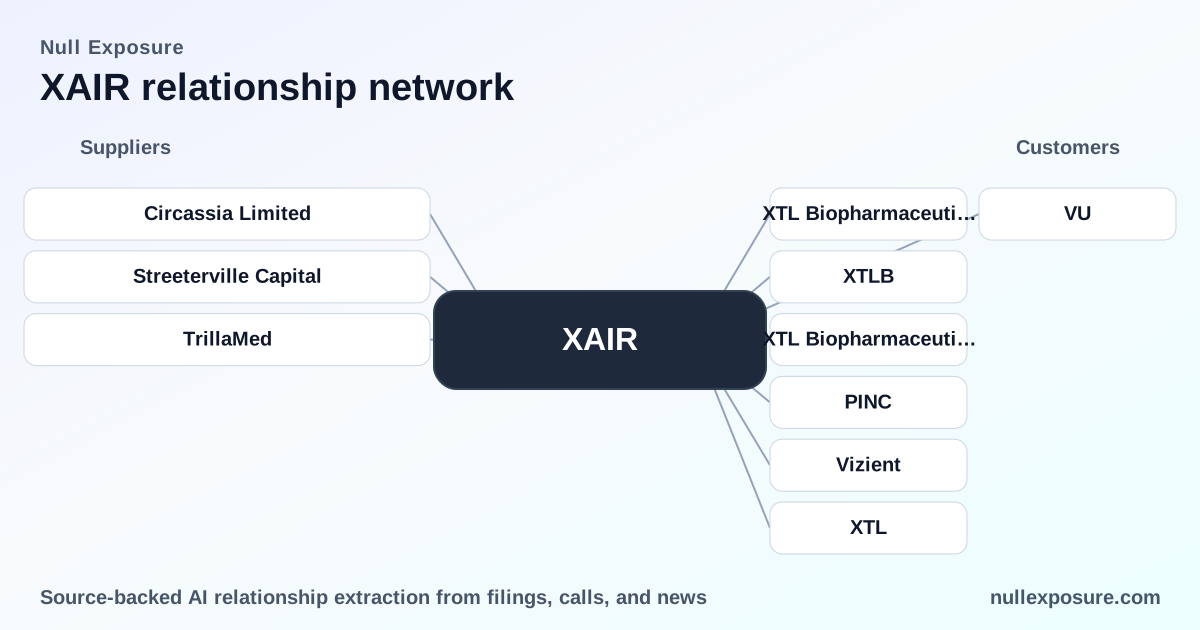
Beyond Air (XAIR): Supplier relationships that determine commercial runway
Beyond Air commercializes and plans to scale LungFit PH, a nitric oxide generator and delivery system, by selling capital equipment plus recurring consumables and services; the company currently relies on third-party manufacturers and service providers for production, logistics and clinical execution, and monetizes through device sales, consumable replacement and contract-related revenue while financing operations with short‑term capital lines. Revenue remains modest ($6.9M TTM) and losses are material, so supplier continuity and financing flexibility are core determinants of valuation and commercial viability. For a concise supplier-risk brief and monitoring checklist, visit https://nullexposure.com/.
How Beyond Air runs its supply base — a practical investor view
Beyond Air is contractually dependent on outside specialists for the manufacture and distribution of its LungFit PH system and for clinical/regulatory services. Its filings and public commentary flag four operational realities that drive business risk and valuation:
- High supplier concentration is a live strategic constraint. The company reported purchasing roughly 85–87% of materials from a single vendor in the fiscal year ended March 31, 2025, which creates a single-point-of-failure risk for commercial scale-up (Beyond Air Form 10‑K, FY2025).
- Manufacturing and quality are mission-critical. Beyond Air outsources production of the NO generator and delivery system to contract manufacturers and states that failure by those manufacturers to meet demand or quality standards would have a material adverse effect (company 10‑K, FY2025).
- Services are outsourced and embedded in operations. Beyond Air relies on third‑party logistics, CROs, and clinical vendors to manage warehouses, field service locations (FSLs), and trials — a mature but externally driven operating posture that requires active vendor governance (company 10‑K, FY2025).
- The company acts as the buyer and integrator. Beyond Air’s role is to procure components and finished goods, integrate them into a regulated medical product, and sell equipment plus consumables; this buyer/manufacturer/service-provider mix shapes contract terms and contingency needs (company filings).
Taken together, the operating model is commercially scalable but operationally fragile until secondary suppliers, longer-term manufacturing agreements, and stronger working-capital lines reduce concentration and execution risk.
Relationship-by-relationship: what investors need to know
Circassia Limited — legal settlement and termination
Beyond Air disclosed that it entered into a settlement agreement with Circassia on May 25, 2021 that resolved prior claims and mutually terminated the preexisting agreement referenced in its financial statement notes for the year ended March 31, 2025; the termination is documented in the company’s FY2025 Form 10‑K. According to the 10‑K (FY2025), the Settlement Agreement closed outstanding disputes and ended that commercial arrangement.
Streeterville Capital — financing partner for commercialization
Beyond Air completed a $5 million financing in January 2026 and previously announced a promissory note and equity line of credit with Streeterville Capital of up to $32 million (announced November 2025) to support commercial execution and readiness for the second‑generation LungFit PH system, according to a Q3 FY2026 earnings transcript published on InsiderMonkey. Streeterville provides liquidity tied directly to commercialization, which de‑risks near‑term capital but raises dilution and covenant considerations.
TrillaMed — federal health‑system engagement support
Beyond Air has been working with TrillaMed to support its engagements with federal health care systems, reflecting a vendor relationship focused on market access and government channel execution, per the Q3 FY2026 earnings-call transcript reported on InsiderMonkey. TrillaMed serves as a commercial/market-access service provider to help penetrate U.S. federal buying channels.
Commercial and financial implications for investors
Beyond Air’s supplier posture and financing choices drive three investment-grade implications:
- Supply concentration is the principal execution risk. With the company reporting ~85–87% of materials sourced from a single vendor in FY2025, a disruption would materially affect revenue and delivery timelines (Beyond Air 10‑K, FY2025). Addressing this requires validated back‑up suppliers, dual sourcing clauses, and inventory cushions.
- Outsourced manufacturing increases quality and timing exposure but reduces fixed capital intensity. Contract manufacturing allows capital-light scale-up, but it places quality control and capacity planning in third parties’ hands — a tradeoff investors must price into upside timing and downside risk.
- Financing relationships are strategic operational levers. The Streeterville Capital facilities provide runway for second‑generation product launches, shifting some execution risk from capital constraints to partner negotiation and dilution outcomes (InsiderMonkey, Q3 FY2026). Monitor draw schedules, warrants, and covenants for implications on shareholder value.
For ongoing monitoring, prioritize supplier audit results, change‑of‑control or termination clauses with manufacturers, and the cadence of capital draws under the Streeterville arrangements. Learn how to track these signals at https://nullexposure.com/.
Practical actions for operators and portfolio managers
Operationally and for diligence, focus on these mitigations:
- Establish and verify dual‑source readiness for critical BOM items and confirm lead times under stress scenarios.
- Demand SLAs and penalty clauses from contract manufacturers and logistics vendors tied to quality and delivery milestones.
- Stress‑test working‑capital and financing plans against slower adoption curves and elevated warranty/return rates given medical device rollout risk.
- Validate that CRO and federal‑engagement vendors (e.g., TrillaMed) have direct experience converting pilot sites into repeat purchasers in federal systems.
These steps convert qualitative supplier risk into measurable remediation milestones for board and investment committees.
Bottom line: supply relationships define the runway
Beyond Air’s upside — adoption of LungFit PH and recurring consumable revenue — is real but contingent: scaling requires uninterrupted supply, tight vendor governance, and the financing to bridge regulatory and commercial milestones. Key risks are supplier concentration and outsourced manufacturing quality, while the Streeterville facility and TrillaMed engagements are positive tactical moves to secure runway and market access. Investors should place a premium on supplier diversification progress and the terms and execution of financing draws when assessing valuation and timing. For a tailored supplier-risk scorecard and monitoring playbook, visit https://nullexposure.com/.