XBiotech (XBIT): Supplier relationships and what they mean for investors
XBiotech operates as a discovery-to-commercialization biopharma that discovers, develops and markets True Human monoclonal antibodies, monetizing through product sales and partnership/licensing arrangements tied to clinical progress. The company runs a lean balance sheet (Market Cap ~$70.1M) and a low revenue base (Revenue TTM $300k), while funding R&D and trials through operating capital and vendor relationships—therefore supplier posture directly affects clinical timelines and value realization. For a focused supplier-risk read on XBiotech, visit https://nullexposure.com/ to see full supplier mapping and signals.
How suppliers fit into XBiotech’s operating model
XBiotech outsources core operational activities that are critical to advancing its pipeline. Company filings disclose that disposal services, clinical trial management and other specialized manufacturing inputs are sourced from third parties, and the firm accrues expenses based on actual services rendered. Those disclosures produce several actionable operating signals:
- Contracting posture — outsourced and active. XBiotech contracts clinical trial service providers and disposal contractors and recognizes accruals based on vendor activity, indicating ongoing and active contractual relationships as fundamental to operation.
- Concentration risk — limited alternate sources for components. Filings state that some manufacturing components have few alternative suppliers, creating a heightened vendor concentration and substitution risk for specific inputs.
- Criticality — supplier inputs are mission-critical. Clinical samples, specialized waste disposal and trial services are central to R&D progress; interruptions would delay development milestones and revenue timelines.
- Spend magnitude and maturity — mid-size, recurring vendor spend. Procurement signals place XBiotech in a $1M–$10M vendor spend band for clinical activities, and accrued trial expenses recorded in filings confirm active third-party execution.
These company-level signals come directly from regulatory disclosures and periodic reporting and should frame any counterparty diligence.
What we found: every supplier relationship in the record
Below is a complete review of supplier relationships surfaced in available public sources.
BioBridge Global — clinical sample provider
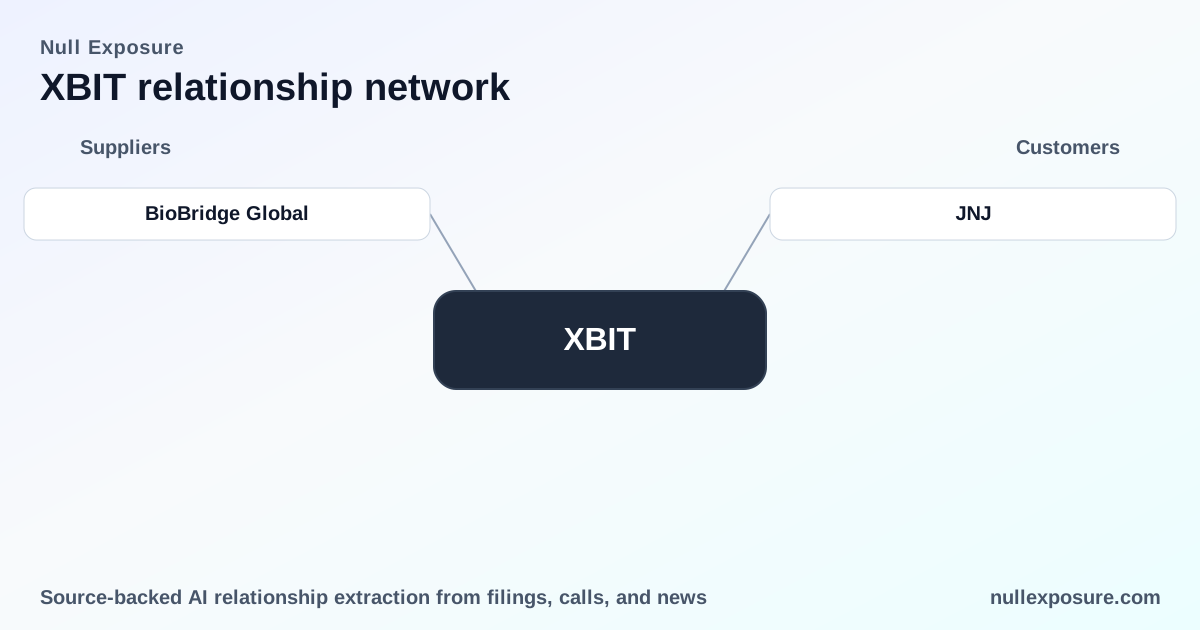
An RTTNews article (March 10, 2026) reported that BioBridge Global provided XBiotech with blood samples from patients infected with COVID‑19, which the company used to identify a candidate therapy. This sample-sourcing relationship supports antibody discovery activities and demonstrates XBiotech’s reliance on external biological material suppliers for target selection and validation (RTTNews, March 10, 2026: https://www.rttnews.com/amp/3121907/xbiotech-discovers-covid-19-candidate-therapy-stock-surges.aspx).
Contracting posture, concentration and maturity — interpreting the constraints
The company-disclosed excerpts produce a coherent vendor-risk profile for investors:
- Filings state that crucial manufacturing components are acquired from vendors with few alternate sources, signaling supplier concentration and potential single‑source dependencies. This is a company-level supply risk; no single supplier is named in that excerpt.
- XBiotech explicitly contracts third parties for disposal of materials and for clinical trial conduct and management, indicating reliance on specialized service providers and clinical CROs for trial execution and regulatory compliance.
- Expense recognition language shows that XBiotech accrues clinical trial costs based on vendor-reported effort and enrollments, which implies active, measurable contracts rather than ad hoc arrangements.
- The constraints classification places clinical vendor spend within a $1M–$10M band, supported by an excerpt of accrued clinical trial expenses in filings, reinforcing that vendor payments are material to ongoing operations.
Collectively, those signals describe a company that is operationally dependent on third-party clinical and laboratory services, with focused supplier concentration for some manufacturing inputs and recurring, measurable spend.
Financial and strategic implications for investors
XBiotech’s supplier profile creates clear investment implications:
- Upside tied to operational continuity. With a small revenue base and a pipeline-driven valuation, timely access to samples, CRO capacity and disposal/manufacturing inputs is a direct determinant of milestone achievement and cash burn.
- Supplier concentration is a tactical risk to factor into valuation scenarios. Loss or disruption of a specialized vendor would disproportionately affect timelines; investors should price contingency and alternative sourcing costs into models.
- Active contract accounting improves visibility but also creates fixed-cost exposures. Accrual-based expense recognition provides transparency into ongoing vendor commitments, which investors can project into near-term cash needs.
- Capital structure and scale amplify supplier risk. Market capitalization (~$70M) and negative EBITDA indicate limited buffer against protracted supplier disruption or trial delays.
Key financial context: Market capitalization is approximately $70.1M, Revenue TTM $300k, and EBITDA is negative (~$54.0M), which frames how supplier interruptions translate quickly into financing and timeline pressures.
For a deeper supplier-risk profile and to compare XBiotech’s vendor posture against peers, see our platform: https://nullexposure.com/.
Rapid diligence checklist for operators and investors
Use this list as a compact action plan before increasing exposure:
- Verify existence and term length of CRO and disposal contracts, and confirm single-source clauses or break‑fees.
- Confirm alternative suppliers for any components identified as having few alternate sources in filings.
- Obtain vendor-level spend run-rates and milestone‑tied payment schedules to reconcile with accruals in filings.
- Request documented sample provenance and chain-of-custody procedures for biologic inputs (as with BioBridge Global).
- Stress-test timelines under a 30–90 day vendor disruption to quantify cash and clinical impact.
Conclusion — where this drives valuation and next steps
XBiotech operates a supplier-dependent development model: third-party clinical services and biological sample suppliers are integral to value creation, while supplier concentration and modest financial scale are clear risk multipliers. The BioBridge Global relationship illustrates the functional role of external sample providers in discovery work; company filings confirm active contracts and measurable spend with specialized vendors. For investors and operators, the priority is vendor due diligence that converts qualitative supplier signals into quantifiable timeline and cash-flow sensitivity.
Take the next step: review XBiotech’s supplier map and constraint analysis at https://nullexposure.com/ to prioritize vendors for contract review and scenario modeling.