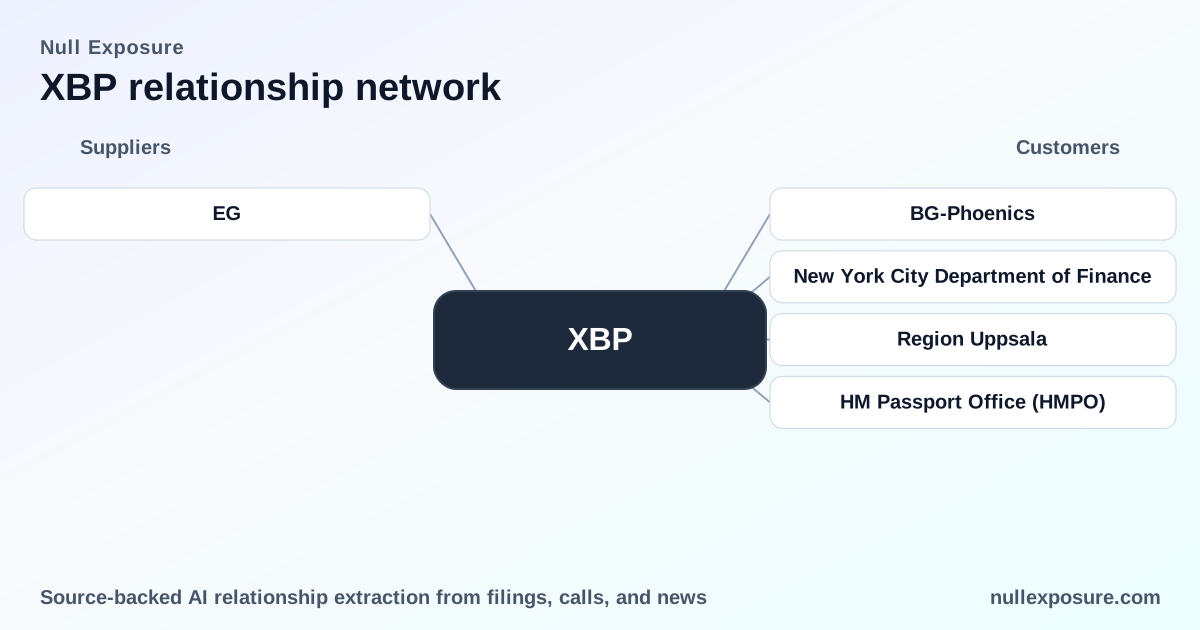
XBP Europe Holdings: supplier footprint, related-party signals, and what investors should price in
XBP Europe Holdings operates cross-border bills, payments, and workflow automation businesses across France, Germany, the U.K., Sweden and internationally, monetizing through recurring software and payment processing fees, professional services for digital transformation, and transactional hardware and equipment sales where relevant. The company combines payments flows and automation software with implementation services; supplier relationships therefore influence both cost of goods sold and delivery of client-facing services. For an investor, the question is whether supplier arrangements—and related-party linkages—represent routine operating leverage or a structural concentration that changes execution risk. Visit Null Exposure for additional supplier diligence resources: https://nullexposure.com/
How XBP’s supplier posture fits the business model
XBP is a software-infrastructure company that earns revenue from platform usage and service delivery; gross profit and operating leverage are driven by client volumes and the cost of enabling infrastructure. Supplier relationships matter at two levels: (1) recurring third-party services and managed support that affect operating margins and scalability, and (2) one-off hardware or equipment purchases that affect capital intensity and working capital. The company’s public financials show $62.8M revenue TTM with a gross profit of $19.4M and a reported operating margin effectively near break-even, so supplier cost control is a lever to convert incremental revenue into meaningful profit.
Company-level disclosures also flag material related-party activity and modest but non-trivial hardware procurement in recent years, which should be factored into any valuation or operational due diligence. For more structured supplier analysis and monitoring resources, see Null Exposure: https://nullexposure.com/
What we found in XBP’s supplier relationships
The open-source and public record returned a single, material relationship reference in our review.
Everest Group — research sponsorship / content partnership
XBP supported a report from Everest Group focused on intelligent document processing and public-sector modernization, with the press release published via GlobeNewswire in February 2026. This indicates XBP uses third-party analyst validation and thought-leadership to position its workflow automation and agentic AI capabilities with prospects and clients. (Source: GlobeNewswire release syndicated through The Manila Times TMT Newswire, Feb 18, 2026.)
What the constraints and disclosures reveal about supplier concentration and governance
The company disclosures and constraint excerpts provide three actionable signals about XBP’s supplier posture and governance:
-
Related-party service provider activity is present. Company disclosures state that subsidiaries of ETI provided management services to XBP in exchange for a management fee during the historical periods presented. That signals an ongoing governance and operational linkage to ETI-affiliated service providers, which is important for assessing independence of operations and potential routing of costs. (Source: company historical disclosures.)
-
Hardware procurement is modest but visible. XBP reported purchases of high-speed scanners and related products from non-XBP Europe subsidiaries of ETI, with purchases totaling $0.1 million and $1.0 million for the years ended December 31, 2024 and 2023, respectively. That pattern shows periodic capital purchases tied to document capture and processing infrastructure rather than large-scale hardware programs. (Source: company filings for the years ended Dec 31, 2023–2024.)
-
Related-party expense lines are measurable. The filings show total related-party expense reported as $5,101 and $4,633 for the historical periods presented, which is a line-item that investors should reconcile to operating expense trends and margins to understand persistence and disclosure quality. (Source: company disclosures.)
Taken together, these signals indicate a contracting posture that includes managed service relationships with related parties and low-to-moderate capital procurement, rather than heavy third-party vendor fragmentation. That implies moderate supplier concentration and a level of operational centralization that is likely manageable for revenue growth but material for governance and audit scrutiny.
Detailed relationship summary: Everest Group
XBP supported an Everest Group report highlighting intelligent document processing as a modernization vector for public-sector service delivery; the press release was issued Feb 18, 2026 through GlobeNewswire. This is a commercial or marketing-level partnership that enhances XBP’s product positioning rather than a core procurement relationship. (Source: GlobeNewswire release via The Manila Times, Feb 18, 2026.)
Investment implications — what active investors and operators should prioritize
- Governance and related-party transparency: Related-party management services and purchases tied to ETI subsidiaries are disclosed; investors should demand clear breakouts and documentation on the nature, pricing, and competitive tendering of those arrangements.
- Operational concentration: The presence of related-party services plus measured capital buys (scanners) implies concentration around a small set of service providers, which reduces vendor diversity but can speed execution; price this into scenarios for margin improvement and vendor replacement cost.
- Commercial credibility vs. supplier risk: Sponsorships and analyst partnerships (Everest Group) amplify go-to-market traction; however, they do not substitute for resilient supply chains for hardware or managed services. Investors should balance marketing momentum with supplier continuity plans.
- Quantify the economics: With $62.8M revenue TTM and razor-thin operating margins, even modest supplier cost reductions or a change in related-party terms can swing profitability; model scenarios where related-party fees scale with revenue versus fixed-fee contracts.
If you are running supplier diligence as part of a buy-side thesis or an operational improvement plan, Null Exposure maintains templates and supplier scoring tools that align with these priorities: https://nullexposure.com/
Bottom line and next steps for investors
XBP’s supplier footprint is characterized by measured related-party engagement, targeted hardware procurement, and marketing partnerships that build product credibility. These elements are not disqualifying, but they are material. The valuation and operational upside hinge on converting topline automation demand into higher operating margins while ensuring related-party arrangements are commercially competitive and well-documented.
Next steps for investors: request detailed schedules of related-party fees and capacity commitments, examine the tendering process for hardware and managed services, and validate the commercial terms of third-party research or marketing sponsorships that produce sales pipeline momentum. For a structured supplier audit playbook and ongoing monitoring, visit Null Exposure: https://nullexposure.com/
Key takeaway: supplier arrangements are modest in absolute spend but uneven in governance impact—investors should demand clarity on related-party economics and contingency plans for service continuity.