XBP Europe Holdings (XBPEW) — supplier relationships and what they signal for investors
XBP Europe Holdings operates bill-payment and related payments solutions across Europe and monetizes primarily through transaction and service fees tied to billing, payments processing, and value-added services for utility and enterprise clients. Revenue is driven by recurring payments flows and cross-border settlement services, while margins depend on scale in each market and the degree to which the company internalizes technology and operations versus buying services from related parties. For direct access to supplier analytics and filings, visit https://nullexposure.com/ for sourcing and document context.
How XBP Europe generates cash and why suppliers matter
XBP Europe presents itself as a Europe-focused billing and payments operator with reported trailing revenue of $62.8 million and gross profit of $19.4 million (TTM), yielding an overall profit margin near 19.4% on the profiles available. The commercial model centers on recurring billing contracts and payment-processing relationships; those flows both drive revenue and create supplier dependency for back-office services, hardware, and intellectual property. Supplier relationships are therefore a direct determinant of operating leverage and execution risk — both because of discrete procurement spend and because certain services are delivered by affiliates or under licensing arrangements.
For a deeper look at how supplier relationships are disclosed and sourced, see the primary filings linked at https://nullexposure.com/.
What the 10‑K disclosures reveal about contracting posture and concentration
The company’s FY2024 10‑K frames supplier exposure in three practical dimensions: licensing, shared services, and discrete procurement spend.
-
Licensing posture: XBP Europe holds a “worldwide, non‑exclusive, fully paid perpetual irrevocable intellectual property license” from ETI for assets in existence as of a stated date, with exclusive usage rights in the EMEA region. That structure signals long-dated access to core IP and lower renewal risk, but it also centralizes strategic dependence on the licensor’s legacy IP estate.
-
Shared services and related‑party delivery: The company continues to receive accounting, finance, IT, and business process operations from non‑XBP Europe subsidiaries of its parent, reported as related‑party shared services. These services are operationally critical — they support billing and payments execution — and they show up as a steady line in related‑party expense.
-
Spend concentration: Discrete purchases (for example, high‑speed scanners) are modest in isolation — $0.1 million in 2024 and $1.0 million in 2023 — but aggregated related‑party fees totaled $5.101 million in 2024 (including shared services, service fees, and royalties). That places XBP Europe in a mid‑level spend band where outsourcing (and especially related‑party outsourcing) is both material and visible in the P&L.
These points are company‑level signals derived from the filing language in the FY2024 10‑K; they frame operating constraints on renewal flexibility, vendor concentration, and the practical criticality of supplier outputs. If you evaluate supplier risk as part of counterparty analysis, these contract and spend characteristics are primary inputs. For more document-level sourcing and supplier context, visit https://nullexposure.com/.
What the filings list as named supplier or acquired entities
Below are the specific counterparties and acquisitions the 10‑K identifies. Each item is summarized in plain English with the original filing cited.
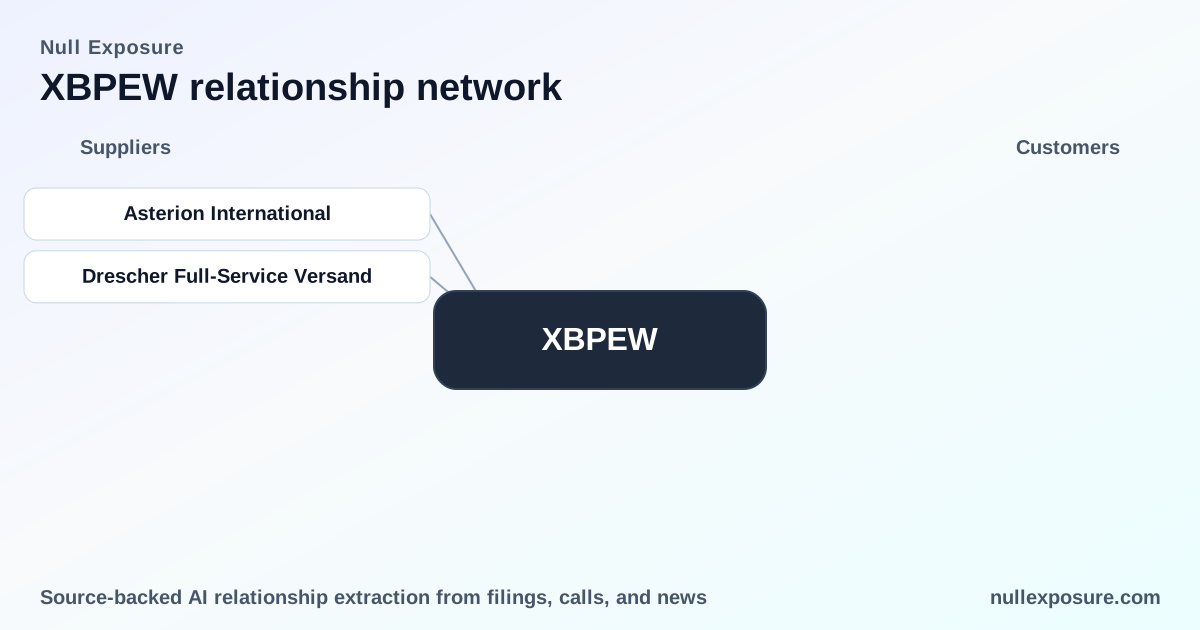
Asterion International
In its FY2024 10‑K, XBP Europe discloses that Asterion International was acquired in 2018 as part of a push to expand geographic and client reach across Europe, contributing to the company’s European footprint. According to the company’s 10‑K for the year ended December 31, 2024, this acquisition was grouped with other deals that extended ETI’s and XBP Europe’s presence in European markets.
Drescher Full‑Service Versand
The FY2024 10‑K likewise records the acquisition of Drescher Full‑Service Versand in 2018, cited alongside Asterion as a transaction that broadened the company’s market reach in Europe and supplemented its service capabilities. The filing notes both entities as part of ETI’s historical consolidation strategy to grow client coverage.
(Both disclosure items are drawn from XBP Europe Holdings’ annual 10‑K filing for FY2024 and are presented in the company’s corporate history and acquisition summary.)
Constraints, maturity and what they mean for operators and investors
The filing excerpts that underpin XBP Europe’s supplier picture convey four operational characteristics you should weigh when modeling the company:
-
Contracting maturity: The IP license is perpetual and irrevocable, indicating a mature, long‑dated contractual posture that de‑risks short‑term renewal exposure to core IP. This reduces headline risk around losing technology rights but locks the company into the pre‑existing IP estate.
-
Operational criticality: Shared services (accounting, IT, finance) are delivered by related parties and recorded as material recurring expense. These functions are critical to day‑to‑day billing and settlements; disruption would be operationally impactful.
-
Concentration of spend: Related‑party expense aggregated to $5.101 million in 2024, with discrete purchases in the $0.1m–$1.0m range for certain hardware items. This profile indicates moderate vendor concentration with financial materiality relative to reported revenue.
-
Contract type and exclusivity: While the IP license is described as non‑exclusive worldwide, the filing grants exclusive rights for EMEA use of the existing IP, which creates a regional exclusivity benefit for XBP Europe and reflects a governance choice that favors market protection in the company’s primary operating geography.
These attributes drive both upside (protected IP access, established service delivery channels) and downside (related‑party dependence, limited diversification of service providers).
Investor implications and a quick risk checklist
- Positive: Perpetual IP license and established shared services support steady operations and reduce near‑term execution risk.
- Watchlist: Related‑party expense is material enough to affect margins; any change in affiliate arrangements or service pricing would have a direct P&L impact.
- Liquidity note: Public profile fields show limited market data (market capitalization reported as "None" and zero shares outstanding in the summary), which signals potentially thin liquidity or reporting nuance—tread carefully when sizing positions.
- Acquisitions: The 2018 acquisitions expand reach but also increase integration complexity and legacy systems exposure.
Next steps for due diligence
- Pull the FY2024 10‑K and the referenced Services, Tax Sharing, and License agreements to quantify termination provisions, service‑level obligations, and change‑of‑control triggers. For access to filings and supplier mapping resources, go to https://nullexposure.com/.
- Validate related‑party cost trends across quarterly filings and test sensitivity to a 10–20% increase in service fees as a margin stress case.
- Engage with management (or review conference call transcripts) about plans to reduce related‑party dependence and onshore or diversify critical back‑office services.
For document access and faster supplier relationship mapping, start with the XBP Europe holdings page and related filings at https://nullexposure.com/.
In sum, XBP Europe is a payments operator whose operating leverage and execution hinge on a mix of perpetual IP licensing and materially outsourced related‑party services; investors should value the security of long‑dated IP access against the governance and concentration risks implicit in related‑party service delivery.