XCHG Supplier Landscape: Who Matters, What They Do, and What Investors Should Price In
XCHG functions as a sponsor/issuer platform that monetizes through advisory and distribution arrangements tied to product launches and ongoing fund administration. The company’s economics are driven by advisory fees and issuer/distributor fee splits rather than proprietary asset-gathering; strategic dependence on established institutional partners concentrates execution risk but accelerates market access. Investors should evaluate counterparty strength, fee capture, and distribution reach as primary drivers of XCHG’s revenue durability. For a full view of supplier exposures and disclosures, visit https://nullexposure.com/.
What the partner list reveals about XCHG’s operating model
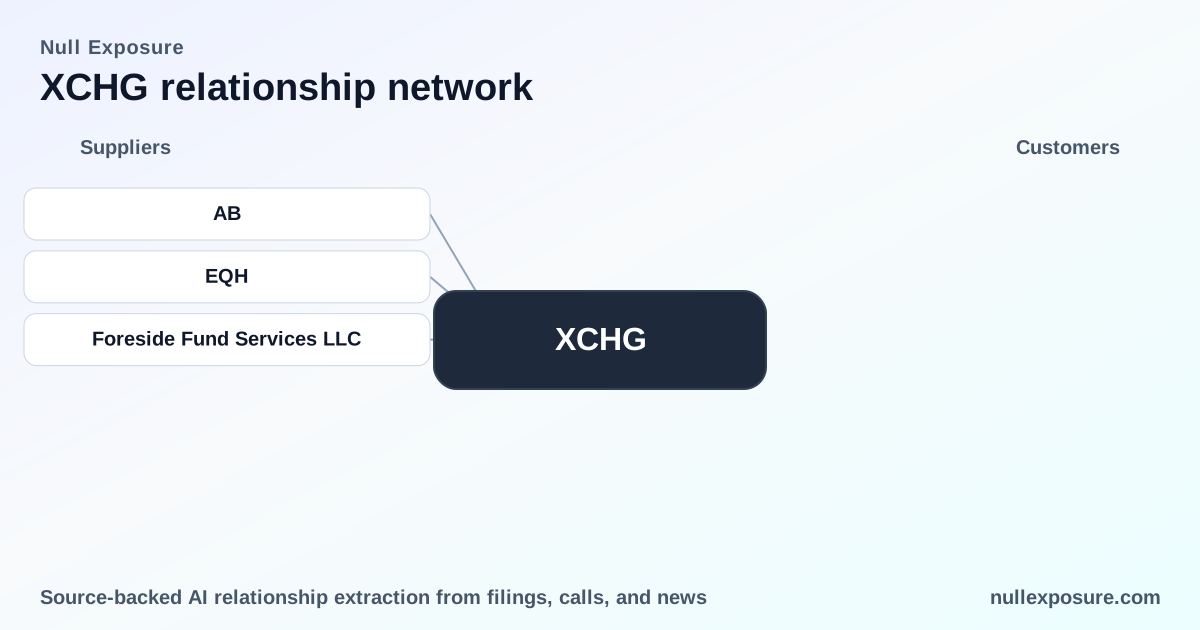
XCHG’s supplier roster in public references is compact and functionally specialized: a global asset manager as advisor, a major insurance/issuer group named as issuer, and a fund distribution specialist. That configuration indicates a lightweight operating footprint that outsources key functions—investment advisory, regulatory issuer duties, and fund distribution—to third parties rather than internalizing them. Outsourcing reduces fixed overhead and accelerates time-to-market, but concentrates execution risk in a handful of relationships.
- Concentration: Three named partners suggest execution is tightly concentrated across advisory, issuance, and distribution roles.
- Contracting posture: The absence of public constraints in the extracted records signals standard vendor arrangements rather than disclosed exclusive long-term mandates.
- Criticality: Each supplier performs a non-redundant, high-criticality function—advisor, issuer, distributor—so operational continuity depends on all three performing to spec.
Detailed relationship roster (plain-English, source-backed)
AllianceBernstein LP — AllianceBernstein is recorded as XCHG’s Primary advisor, indicating responsibility for investment strategy or advisory services; this positions a major asset manager as a central operational partner for XCHG’s product economics and governance. According to the TradingView company page for XCHG (documented March 10, 2026), AllianceBernstein LP is listed as Primary advisor. Source: TradingView listing for AMEX:XCHG (first seen 2026-03-10).
Equitable Holdings, Inc. — Equitable is identified as the Issuer, which places a large insurance and financial-services group in the regulatory and capital-responsibility role for XCHG’s products; this aligns issuance and sponsor obligations with a regulated financial institution. According to the TradingView company page for XCHG (documented March 10, 2026), Equitable Holdings, Inc. is listed as Issuer. Source: TradingView listing for AMEX:XCHG (first seen 2026-03-10).
Foreside Fund Services LLC — Foreside is listed as the Distributor, meaning it handles intermediary and broker-dealer-facing distribution services essential to product placement and retail/institutional sales execution. According to the TradingView company page for XCHG (documented March 10, 2026), Foreside Fund Services LLC is listed as Distributor. Source: TradingView listing for AMEX:XCHG (first seen 2026-03-10).
How the commercial mechanics and risks line up
The partnership map describes a monetization chain typical of white-label or sponsored investment products: advisor sets strategy and generates fee-bearing management; issuer handles legal/regulatory issuance; distributor executes sales and retail/institutional onboarding. For investors, that means:
- Revenue is fee-driven and tied to product sales and assets under management rather than trading profit.
- Counterparty risk is concentrated: a problem at any one of the three partners could interrupt product flows or materially affect revenue.
- Contractual terms matter more than operational scale: exclusivity, termination rights, revenue splits, and service-level commitments determine economic exposure.
No supplier-level contractual constraints are present in the extracted records; this is a company-level signal that public disclosures did not flag restrictive vendor covenants or explicit exclusivity in the sampled source. That absence should be treated as a prompt to request primary contracts or confirm standard service agreements during diligence rather than evidence of guaranteed flexibility.
For a quick look at XCHG’s partner exposures and how they affect revenue sensitivity, explore further at https://nullexposure.com/.
Key investment implications and red flags
- Concentrated partnership model accelerates scaling but increases single-point-of-failure risk. A material operational failure or contract termination with AllianceBernstein, Equitable, or Foreside would interrupt advisory, issuance, or distribution flows respectively.
- Fee-capture is dependent on distribution reach. Foreside’s effectiveness directly impacts AUM growth and recurring revenues; distribution underperformance compresses top-line growth despite intact advisory or issuer relationships.
- Regulatory and reputational linkage to an issuer matters. With Equitable as issuer, regulatory capital and issuer governance are tied to a large financial institution—this reduces early-stage execution risk but ties XCHG to Equitable’s regulatory profile and business cycle.
Practical next steps for investors and operators
Operators should secure redundancy in distribution channels and clarify termination and transition clauses with their advisor and issuer to mitigate single-point-of-failure scenarios. Investors should request copies of the advisory agreement, distribution agreement, and issuer memorandum to quantify fee splits, exclusivity, and change-of-control protections.
- Prioritize review of termination and substitution clauses across all three engagements.
- Validate distribution metrics and historic placement activity from Foreside to model AUM growth scenarios.
- Confirm whether advisory mandates with AllianceBernstein include performance or revenue-sharing provisions that affect margins.
If you want a consolidated view of partner exposures and contract risk for XCHG, start here: https://nullexposure.com/.
Final assessment
XCHG’s partner architecture is lean and functionally complete: one high-quality advisor, one major issuer, and one professional distributor. That alignment supports rapid product rollouts with lower internal cost, but creates concentrated counterparty dependency that directly affects revenue resilience. The public references identify these partners clearly but do not surface supplier-level contractual constraints, which should prompt targeted diligence on commercial terms and contingency planning.
For operational diligence and counterparty exposure analysis tailored to XCHG, visit https://nullexposure.com/ for supplier intelligence and next-step guidance.